Alien spaceship? Scientists detect a mysterious cosmic object unlike anything seen before

Curiously, Punctum can’t be seen in optical or X-ray light. It only reveals itself in millimetre radio wavelengths, a rarity for such a bright and compact source. This makes it invisible to most space observatories, leaving ALMA as the only instrument currently able to detect it.
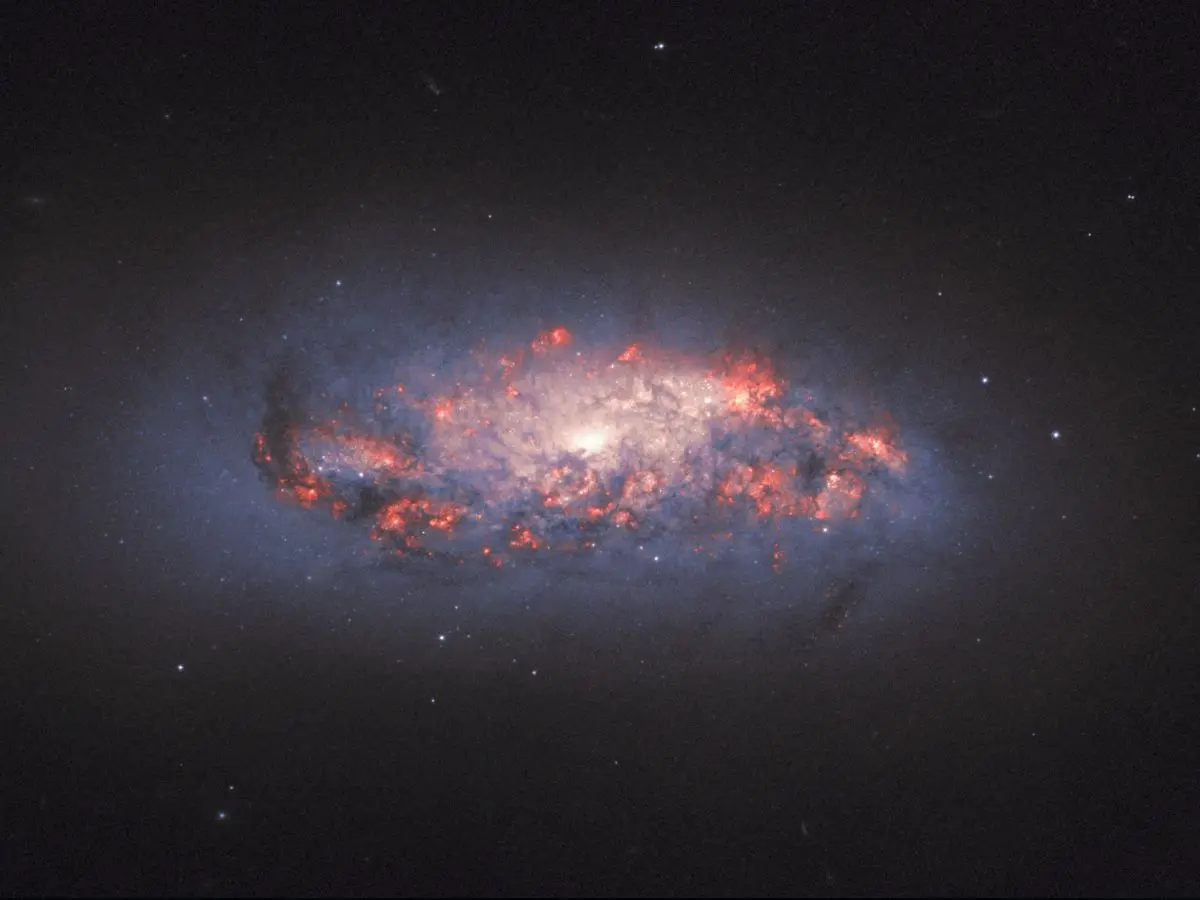
A Strange Signal from a Nearby Galaxy
Astronomers have uncovered a baffling new object in the nearby galaxy NGC 4945, located just 11 million light-years away. The discovery, nicknamed “Punctum” Latin for “point” or “dot” was made using the powerful ALMA telescope in Chile. So far, nothing in the known universe quite matches its profile.
Power Beyond Anything Expected
Outside of supermassive black holes, few cosmic objects are this energetic. Punctum is 10,000–100,000 times more luminous than typical magnetars, around 100 times brighter than microquasars, and vastly outshines almost every known supernova. The Crab Nebula is the only star-related source in our galaxy that can compete.

Invisible to Most Telescopes
Curiously, Punctum can’t be seen in optical or X-ray light. It only reveals itself in millimetre radio wavelengths, a rarity for such a bright and compact source. This makes it invisible to most space observatories, leaving ALMA as the only instrument currently able to detect it.

A Compact, Highly Magnetic Enigma
The light from Punctum is strongly polarised, indicating a highly ordered magnetic field. This points to it being a compact object, possibly a magnetar or something even stranger — but its intensity at these wavelengths is far beyond what such objects normally produce.

Not a Supernova, Not a Pulsar
Supernova remnants like the Crab Nebula are bright in the millimetre range, but they’re vast in size. Punctum is far smaller, ruling out a typical explosion remnant. Pulsars and magnetars, meanwhile, can’t explain its extreme brightness at this wavelength.

Could It Be a New Class of Cosmic Object?
Astronomers admit it may be the first example of an entirely new category of astrophysical object, one that has escaped detection until now because only ALMA has the sensitivity to find it. Alternatively, it could be an extreme version of a known phenomenon, behaving in ways never seen before.

The Hunt for Answers Continues
Future observations from ALMA will target Punctum directly, while the James Webb Space Telescope could check for an infrared counterpart. If found, this may reveal whether its radiation is pure synchrotron or involves dust and other emissions. Until then, Punctum remains one of the most intriguing mysteries in the night sky and possibly, the first of its kind.
)
)
)
)
)