'Graphite Bomb': How US can turn off Venezuela's lights without firing a shot

If war breaks out between the US and Venezuela, the first weapon used might not be a missile that explodes, but one that simply spreads "dust." This weapon is the Graphite Bomb (or "Blackout Bomb").
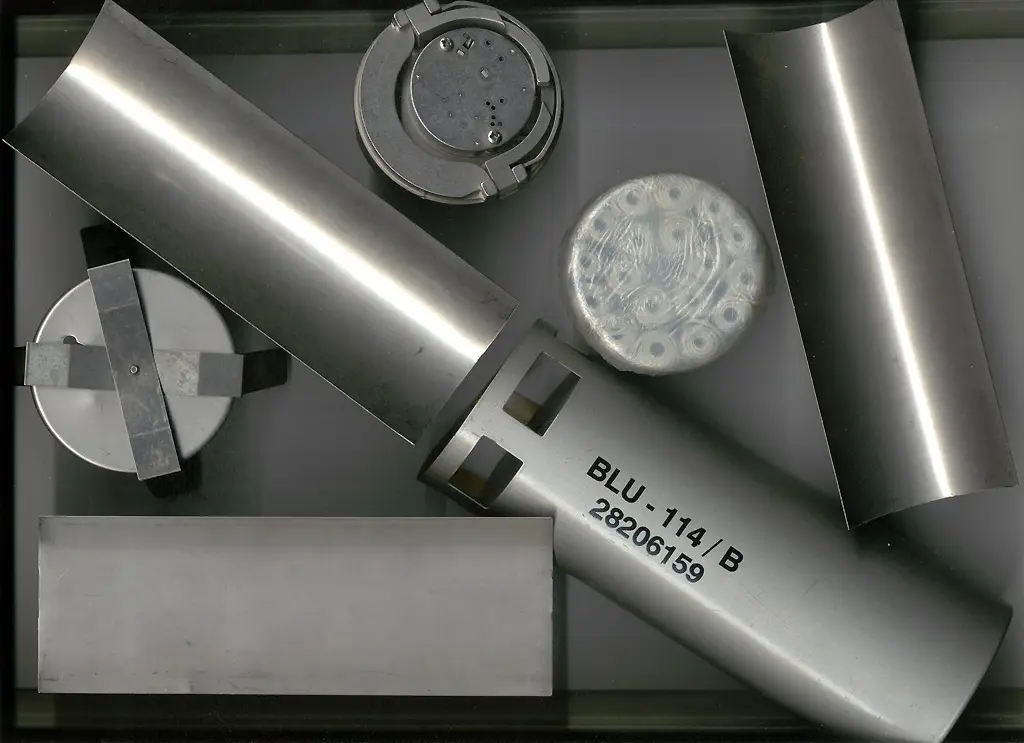
1. The Delivery System: The "Bus" and the "Passengers"
There is often confusion between the terms CBU-94/B and BLU-114/B when discussing blackout bombs. In military terms, the CBU-94/B (Cluster Bomb Unit) acts as the "delivery bus." It is a large, clam-shell dispenser that hangs off a B-2 or F-35 aircraft. It does not cause the blackout itself; its only job is to carry the actual weapons, 202 smaller sub-munitions known as BLU-114/B canisters and release them mid-air over the target area.

2. The Mechanism: Releasing the "Spider Web"
Once ejected from the main CBU dispenser, each individual BLU-114/B canister deploys a small parachute to slow its descent toward electrical substations. At a pre-set altitude, a small charge pops open the canister, rapidly unspooling huge volumes of chemically treated carbon graphite filaments. These filaments are thinner than human hair but are highly conductive, floating down to cover acres of land in a dense, gray, metallic "spider web."

3. The Effect: Violent Electrical Arcing
The weapon exploits the basic physics of high-voltage electricity. As the conductive graphite filaments drift over transformers and power lines, they drape across insulators, connecting different live phases or grounding live wires. This creates immediate, massive short circuits known as "arcing." The resulting electrical flashes violently trip circuit breakers across the grid and can cause oil-filled transformers to overheat and explode, instantly cutting power.

4. The Venezuelan Vulnerability: The Guri Hub
Venezuela's power infrastructure has a unique "Achilles heel": extreme centralization. Nearly 80% of the country's electricity is generated by the massive Guri Dam (Simón Bolívar Hydroelectric Plant). A US strike would not need to hit the dam itself; it would target critical transmission hubs, such as the San Geronimo B substation, which connects Guri to the rest of the country. Disabling just a few key nodes with graphite would cascade into a nationwide blackout.

5. The Strategic Goal: "Blind the Enemy"
The primary military objective of a graphite attack is to degrade Venezuela's air defenses before kinetic strikes begin. Modern Russian-made systems operate by Venezuela, such as the S-300VM radar networks and military command-and-control centers, rely heavily on the national power grid. By cutting the mains power, these systems are forced onto backup diesel generators, which have limited fuel supplies and are prone to failure, significantly lowering the threat to incoming US aircraft.

6. Historical Precedent: Proven in Combat
This is a mature technology with a proven track record in US air campaigns. During the 1991 Gulf War, the US Navy used Tomahawk missiles to dispense graphite over Iraq, disabling nearly 85 per cent of the national power supply within the first 24 hours. In 1999 during Operation Allied Force, US F-117 Nighthawks dropped CBU-94s on Serbia, instantly knocking out 70 per cent of the country's electricity and creating immense psychological pressure on the regime.

7. The "Non-Lethal" Advantage: Reversible Damage
Unlike attacking a power plant with 2,000-pound high-explosive bombs, which destroys infrastructure permanently, the graphite bomb is considered a "soft kill" weapon. The damage is largely reversible. Once hostilities cease, the power grid can be restored by having crews painstakingly wash down the equipment and remove the filaments, allowing the country to recover its utilities without needing years of reconstruction.
)
)
)
)
)