'249 year old doc': AI detector says 1776 declaration is 99.99% AI-written, yet some people believe in its authenticity

These styles tend to use complex structures or formal tone, qualities modern detectors often misinterpret as “AI-like.” The Declaration episode simply made this flaw visible to the wider public.
1. A Reddit Joke That Turned Into a Global Debate
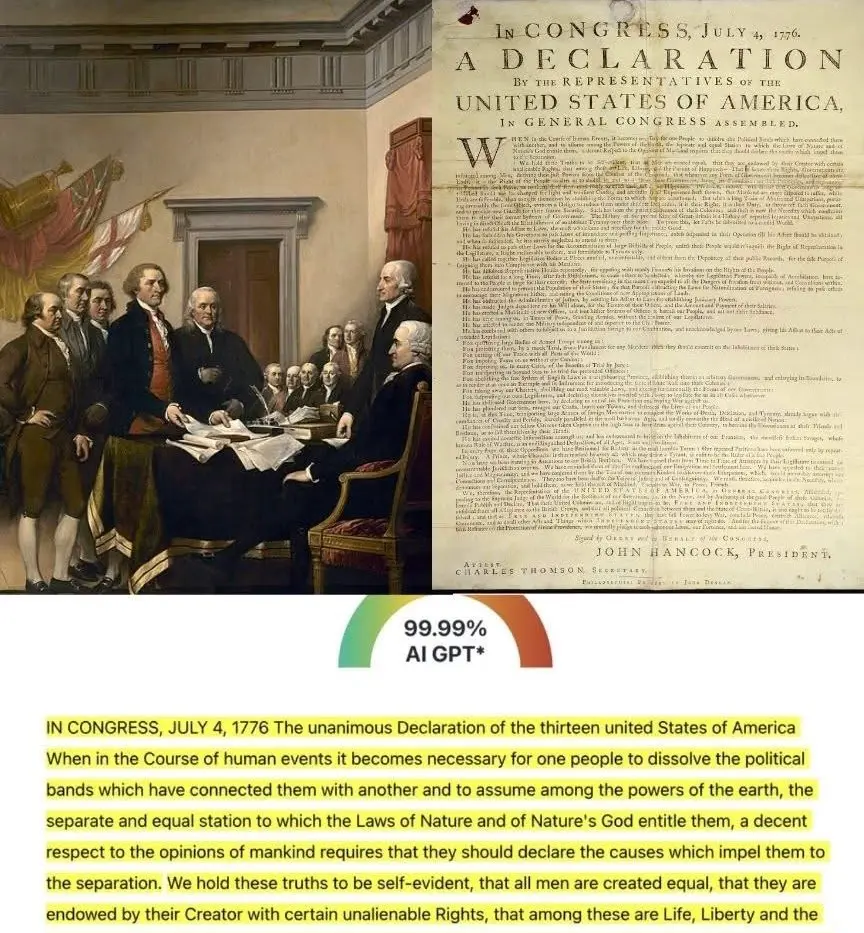
A Reddit user uploaded the original 1776 U.S. Declaration of Independence into an AI-detection tool just for fun and the detector confidently declared the centuries-old document as “99.99 per cent AI-generated.” The text was written long before electricity or computers, making the result absurd. But screenshots spread quickly across social media, sparking a serious discussion about whether AI detectors can actually be trusted. To confirm the experiment, WION team also tried the same method on the Zero-GPT app, and the results were shockingly, nearly same.
2. Why the Detector Got It Wrong: 1700s Writing Looks “Too Perfect”
AI detectors look for patterns like overly structured sentences, uniform vocabulary and predictable phrasing, the same patterns found in 18th-century formal writing. In the 1700s, long, poetic, dramatic lines were standard. To a modern detector trained on 2024 casual English, that style looks suspiciously polished. So instead of recognising historical writing, the tool flagged it as chatbot-generated. The incident highlights that detectors can misjudge anything that deviates from present-day norms.
3. Historic Texts, Poems and Academic Writing Are Most Easily Misclassified
Experts note that older documents, literary essays, research papers, poems and creative writing often trigger false positives in AI detectors. These styles tend to use complex structures or formal tone, qualities modern detectors often misinterpret as “AI-like.” The Declaration episode simply made this flaw visible to the wider public.
4. Schools and Colleges Are Using Tools That Aren’t Fully Reliable
The viral screenshot has ignited debate in the education sector, where AI detectors are already used to judge whether students used ChatGPT. The worrying part is that detectors can incorrectly label genuine student work as fake, exposing them to wrongful accusations. Education experts now warn that such tools should assist teachers, not replace their judgment.
5. Journalists and Writers Face the Same Problem
Newsrooms and media organisations have also begun using AI-detection software to verify authenticity of content. But incidents like this reveal how easily a detector can misclassify original journalism or researched work. A mistake could unfairly damage a writer’s credibility or stall publication, proving that blind dependence on these tools carries real risks.

6. AI Detectors Still Have No Proven Scientific Accuracy
Most AI detection tools are based on probability, not exact science. They look for statistical patterns, not authorship. Even the companies behind these tools openly admit they can generate both false positives and false negatives. The 1776 example proves the technology is still experimental, yet people often treat the output as definitive proof.
7. The Viral Joke Teaches a Serious Lesson: Use Tools, But Don’t Blindly Trust Them
The internet may have laughed at the idea of Thomas Jefferson secretly using ChatGPT in 1776, but the underlying message is clear: AI detectors are helpful indicators, not truth machines. Whether in schools, offices or newsrooms, humans must still apply judgment, context and common sense. Technology can assist, but it cannot replace critical thinking, especially when it confidently mislabels one of history’s most important documents as AI-generated.
)
)
)
)
)