US-Israel-Iran war Highlights: Witkoff and Kushner will go to Islamabad for Iran talks: White House


US-Israel-Iran war LIVE updates Photograph: (AI-generated image)
Tensions continue to flare in the Middle East despite a fragile ceasefire. Will the US and Iran engage in diplomacy? Follow Iran war live updates here.
Tensions between the United States and Iran remain at the centre of the unfolding Middle East crisis, with Donald Trump warning that “the clock is ticking” for Tehran while signalling no urgency to end the war. The US has reinforced its military presence, including the deployment of the USS George H.W. Bush, as part of a broader naval buildup near the Strait of Hormuz.
Washington has also stepped up maritime actions, intercepting vessels linked to Iranian oil shipments and warning it will use force against any attempts to mine the strait. Iran, in response, has effectively restricted passage through Hormuz, a critical global energy route, and begun collecting toll revenues from limited approved shipping. Reports of air defence activity over Tehran have added to uncertainty, though no confirmed strikes were acknowledged. Diplomatic efforts remain stalled, with proposed talks in Islamabad yet to materialise.
Meanwhile, Trump announced that Israel and Lebanon have agreed to extend a fragile ceasefire by three weeks despite ongoing violations, including Israeli strikes and missile fire from Hezbollah. Trump expressed cautious optimism about peace, even as regional tensions continue to simmer.
Follow WION for all the updates, analysis and developments on the US-Israel-Iran war
US special envoy Steve Witkoff and Jared Kushner will head to Islamabad in Pakistan for further talks with Iran, White House Press Secretary Karoline Leavitt told Fox News on Friday.
The two will leave Saturday morning to continue the negotiations, she added.
Israeli Prime Minister Benjamin Netanyahu says a process to achieve a historic peace between Israel and Lebanon is underway, but it is that Hezbollah is trying to sabotage this.
Israel is changing the face of the Middle East, and they’re fully cooperating with the US, said Netanyahu, while praising Donald Trump for “applying very strong pressure on Iran, both economically and militarily."
Iran’s mission to the United Nations has issued a statement denouncing the US’ “illegal seizure” of Iran’s commercial vessel Touska on April 19, as Washington enforced its naval blockade around the Strait of Hormuz.
In a statement posted on X, the mission said the ship was carrying “critical dialysis supplies and medical equipment” and claimed the seizure constituted “a flagrant breach of international law”.
Lebanon’s President Joseph Aoun has stepped up diplomatic efforts in Europe, seeking support to stabilise the country and reinforce a fragile ceasefire.
Aoun held a series of meetings in Cyprus on the sidelines of an informal EU gathering with leaders from the Middle East and North Africa, hosted by the country’s Prime Minister Nikos Christodoulides.
Lawmaker Mohammed Raad, head of Hezbollah's parliamentary bloc, called on Friday for Lebanon to "withdraw" from direct talks with Israel that US President Donald Trump says have a "very good chance" of achieving peace.
The immediate reopening of the Strait of Hormuz without restrictions is "vital" for the world, European Council President Antonio Costa said Friday, after talks with regional leaders including from Lebanon and Syria.
"The Strait of Hormuz must immediately reopen without restrictions and without tolling, in full respect of international law and the principle of freedom of navigation. This is vital for the entire world," Costa told a news conference in Cyprus.
The Israeli military said Hezbollah shot down one of its drones in south Lebanon on Friday, hours after a ceasefire between Israel and the Iran-backed militant group was extended.
"A short while ago, an IDF remotely piloted aircraft was downed in southern Lebanon following the launch of a small surface-to-air missile by the Hezbollah terrorist organisation," the military said in a statement, indicating the incident was under review.
Oil prices slid Friday on hopes of fresh peace talks aimed at ending the Middle East war, with Iran's foreign minister expected later in Islamabad.
After jumping more than two percent, international benchmark Brent North Sea crude showed a loss of 0.5 percent at $104.57 a barrel. The main US contract, West Texas Intermediate, fell 1.1 percent to $94.80.
An Israeli strike killed two people in southern Lebanon on Friday, the Lebanese health ministry reported, hours after a ceasefire between Israel and Hezbollah was extended.
UAE official says rebuilding trust with Iran will take ‘ages and ages.’
Oil prices pushed higher, with Brent at $107 a barrel and West Texas Intermediate at $97, while stocks struggled as investors worried about a lack of progress in ending the West Asia crisis, with Tehran keeping the Strait of Hormuz closed and the US maintaining a blockade of Iranian ports.
International flights from Tehran's Imam Khomeini Airport will resume on Saturday, the ISNA news agency reported, days after Iran reopened its airspace. The first flights to resume will be to Istanbul and Muscat, the announcement said.
The Kuwaiti military said on Friday that two drones coming from the direction of neighbouring Iraq struck border posts on its northern frontier with the country, causing damage but no casualties.
The US military noted that it now has three aircraft carriers -- the USS Abraham Lincoln, USS Gerald R. Ford and USS George H.W. Bush -- in West Asia for the first time since it waged the 2003 Iraq war.
The three battle groups comprise "over 200 aircraft and 15,000 Sailors and Marines", US Central Command said on X.
The residents of Gaza's Deir el-Balah will be conducting a symbolic poll on April 25 for their first local election since 2006. Almost 70,000 eligible voters will cast ballots in 12 polling centres across the city. While many Palestinians view this as a symbolic poll, to signify that Gaza, along with the West Bank, as an inseparable part of the Palestinian political system and Palestinian identity.
China's Foreign Ministry on Friday rejected US President Donald Trump's accusation that the intercepted Iranian ship was a “gift from China”, Reuters reported. Chinese Foreign Ministry spokesperson Guo Jiakun said that it opposes all baseless “accusations and associations”. It further asserted that a "normal trade relationship" between countries should not be subjected to “interference and disruptions”.
Iran's Foreign Minister Abbas Araghchi held a telephonic conversation with Pakistan's Deputy Prime Minister and Minister of Foreign Affairs Ishaq Dar and Field Marshal Asim Munir, commander of the Pakistani army. According to Iran's semi-official news agency Tasnim, the phone call discussed regional developments and a possible peace accord, involving the US-Iran war
European Union's foreign policy chief, Kaja Kallas, warned that exclusion of nuclear experts from negotiations with Tehran could result in an agreement "weaker than the JCPOA". Speaking ahead of an informal EU summit in Cyprus, Kallas cautioned that without technical specialists and a broader focus, the international community would ultimately face a "more dangerous Iran".
Iranian leaders have posted the message on social media that there were no “radicals” and “moderates” in Iran; all of them were unified in a “revolutionary identity”. Almost a similar kind of message was sent out from Iran's Islamic Revolutionary Guard Force. This comes as a response to US President Donald Trump's claim that there was an internal rift within Iran and that Iran is leaderless.
Iran will restart flights between Tehran and Mashhad from Saturday, according to Tasnim News Agency, as part of a phased reopening of its airspace.
The country began restoring aviation operations on April 18 under a four-stage plan, with key airports, including Tehran’s Imam Khomeini International, reopening earlier this week. Mashhad is Iran’s second-largest city and a major religious hub.
South Korea has secured 74.62 million barrels of crude oil for May, covering about 87 per cent of its average monthly imports, as it moves to stabilise supplies amid the Iran conflict.
Officials said the country has also reduced dependence on Middle East oil to 56 per cent from 69 per cent, signalling a shift toward diversified energy sourcing.
The USS George H.W. Bush has arrived in the region, bringing the number of US aircraft carriers in the Middle East to three.
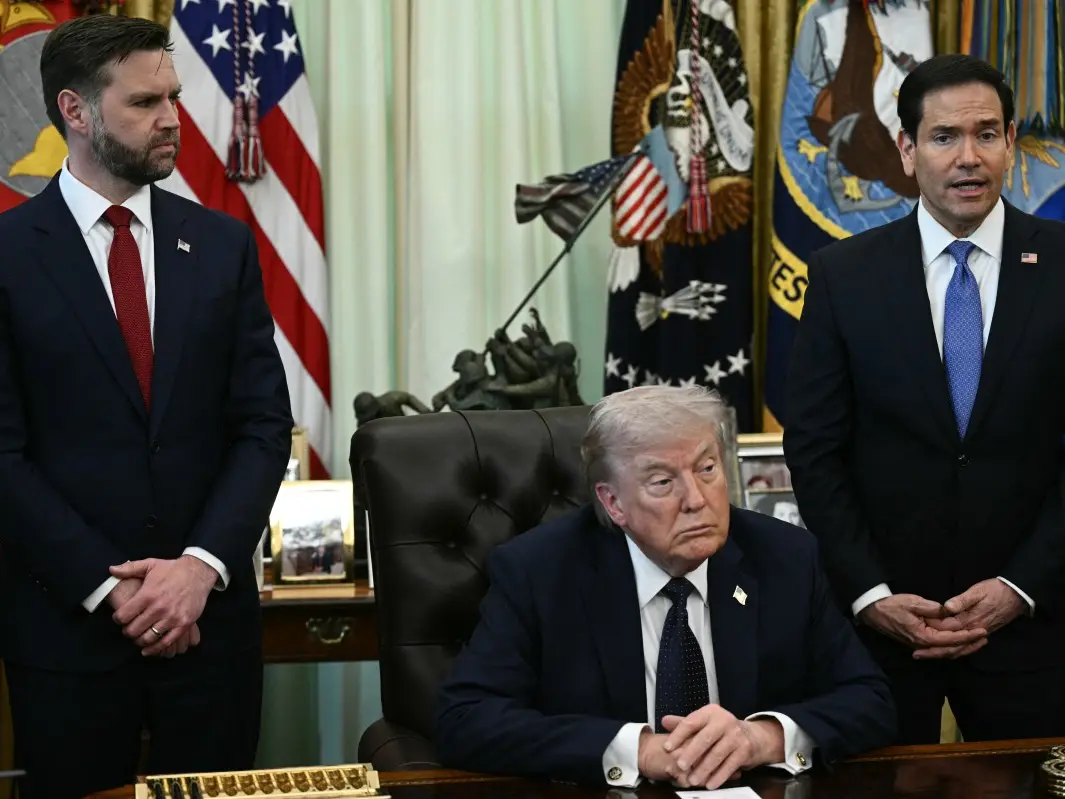
Will the US use nuclear weapons against Iran? That’s the question hanging over the war, and President Donald Trump has now given his clearest answer yet.
What did he say?
&imwidth=800&imheight=600&format=webp&quality=medium)
Trump said the US would act against any attempt to disrupt shipping in the Strait of Hormuz, vowing to destroy vessels laying mines.
Equity markets across Asia traded lower as investors grew cautious over the lack of progress in US-Iran negotiations.
Hong Kong, Shanghai, Seoul and Sydney all declined, reflecting weakening confidence as the conflict drags on.
Key figures at 0230 GMT
West Texas Intermediate: UP 1.1 per cent at $96.92 a barrel
Brent North Sea Crude: UP 1.1 per cent at $106.26 a barrel
Tokyo - Nikkei 225: Up 0.3 per cent at 59,343.40 (break)
Hong Kong - Hang Seng Index: DOWN 0.8 per cent at 25,715.74
Shanghai - Composite: DOWN 0.5 per cent at 4,071.52
Euro/dollar: DOWN at $1.1681 from $1.1684 on Thursday
Pound/dollar: DOWN at $1.3463 from $1.3465
Dollar/yen: UP at 159.79 yen from 159.72 yen
Euro/pound: UP at 86.78 pence from 86.76 pence
New York - Dow Jones: DOWN 0.4 per cent at 49,310.32 (close)
London - FTSE 100: DOWN 0.2 per cent at 10,457.01 (close)
Oil prices continued to climb, with crude gaining by around a fifth over the past week as tensions in the Middle East disrupted supply routes.
The Strait of Hormuz remains closed while the US blockade of Iranian ports continues, raising concerns over global energy flows.
Doubts and questions about Iran’s Supreme Leader Mojtaba Khamenei’s health, have circulated ever since the US and Israel launched strikes on Iran, killing his father and former supreme leader Ali Khamenei. As the US intel continues to find Mojtaba’s whereabouts, a report claims the Iranian leader was “gravely wounded” but is “mentally sharp”. Mojtaba was selected as the country’s new supreme leader on March 8. However, reports suggest that the Islamic Revolutionary Guard Corps has been in control ever since, as his uncertainty looms over his health. Moreover, Mojtaba has not made any public appearances since the war began and only shared written statements through social media or state media.
Iran’s Supreme Leader Mojtaba Khamenei hailed the unity of Iranians that has struck a major blow to the enemy in his latest message on Thursday (Apr 23). He also called for “practical gratitude” to further strengthen national cohesion. This comes after US President Donald Trump claimed that Iran’s leadership was divided from within, saying that there was “infighting” between the “hardliners” and “moderates”. He also said that the US has “total control” over the Strait of Hormuz until Iran makes a deal.
Israel and Lebanon extended a shaky ceasefire by three weeks, President Donald Trump said Thursday, as the United States remained at a standstill in negotiations with Iran to end the Middle East war.
Trump announced the truce extension as he met with ambassadors of the two countries and despite recent Israeli strikes in Lebanon and fresh rocket fire from Iran-backed Hezbollah, which was not part of the talks in Washington.
"I think there's a very good chance of having peace. I think it should be an easy one," Trump told reporters on Thursday. The initial truce had been set to expire on Sunday.
Still, the US president said earlier he was in no rush to end the war with Iran, adding that "the clock is ticking" for the Islamic republic as a third American aircraft carrier arrived in the Middle East.
Iranian media reported blasts over the capital Tehran, a first since the ceasefire in the Middle East war came into effect two weeks ago.
It was not clear what caused the explosions, though an Israeli security source told AFP that their country was not currently striking Iran.
The United States will not exclude Iran from the World Cup tournament it is hosting, Secretary of State Marco Rubio said Thursday, after an official mused about replacing war-battered Iran with Italy, which did not qualify.
"The problem with Iran, it would be not their athletes. It would be some of the other people that we want to bring with them," Rubio told reporters, denying Washington had asked the Iranian team not to come.
US President Donald Trump said Thursday he expected the Israeli and Lebanese leaders to meet with him over the next couple of weeks and voiced hope for a permanent peace deal this year.
"I think there's a very good chance of having peace. I think it should be an easy one," Trump told reporters as he met the Lebanese and Israeli ambassadors to announce an extension of a shaky ceasefire.
US President Donald Trump on Thursday announced that an Israel-Lebanon ceasefire would be extended by three weeks, despite sporadic fighting on the ground.
"The Ceasefire between Israel and Lebanon will be extended by THREE WEEKS," Trump said in a social media posting as he met envoys of Israel and Lebanon.
Hezbollah said on Thursday it fired rockets at northern Israel in response to the country's ceasefire "violations", as Lebanon and Israel's US ambassadors were set to meet in Washington.
"In defence of Lebanon and its people, and in response to the Israeli enemy's violation of the ceasefire and its targeting of the town of Yater in southern Lebanon," Hezbollah "targeted the Shtula settlement with a rocket salvo", the Iran-backed militant group said in a statement.
The Israeli military said "several launches that crossed from Lebanon into Israeli territory were identified" and intercepted.
The USS George H.W. Bush aircraft carrier has arrived in the Middle East, the US military said Thursday, bringing the number of the massive American warships operating in the region to three.
The Bush was sailing "in the Indian Ocean in the US Central Command area of responsibility, April 23," the military command responsible for the Middle East said in a post on X that included an image of the carrier with its deck packed with warplanes.
A second carrier -- the USS Gerald R. Ford -- was operating in the Red Sea on Thursday, while a third -- the USS Abraham Lincoln -- is also in the region, according to social media posts by CENTCOM.
The deployment of the third aircraft carrier to the Middle East comes during a more than two-week ceasefire that paused the devastating US-Israeli air campaign against Iran that was launched in late February.
The Ford sailed to Croatia for repairs several weeks ago after a laundry fire broke out aboard the ship on March 12, but the world's largest aircraft carrier has since returned to operations.
President Donald Trump said Thursday that the United States is under no pressure to end the war with Iran, but "the clock is ticking" for Tehran, as disruption from the conflict batters the world economy.
"I have all the time in the World, but Iran doesn't -- The clock is ticking!" Trump said on social media, adding that Iran's military was destroyed and "their leaders are no longer with us, the Blockade is airtight and strong and, from there, it only gets worse."
An Israeli security source told AFP on Thursday that the country was not carrying out airstrikes in Iran, following reports in Iranian state media of blasts over the capital Tehran.
"Israel is not attacking in Iran," the source said on condition of anonymity.
Earlier on Thursday, Defence Minister Israel Katz said Israel was "prepared to resume the war against Iran", adding that his country was awaiting a green light from the United States to return Iran to "the Stone Age".
US President Donald Trump will meet Israeli and Lebanese envoys when they hold a second round of peace talks Thursday, a US official said.
"The ambassador-level talks between Israel and Lebanon will now take place at the White House," the official said on customary condition of anonymity. "President Trump will greet both representatives upon their arrival."
Tensions between the United States and Iran remain at the centre of the unfolding Middle East crisis, with Donald Trump warning that “the clock is ticking” for Tehran while signalling no urgency to end the war. The US has reinforced its military presence, including the deployment of the USS George H.W. Bush, as part of a broader naval buildup near the Strait of Hormuz.
Washington has also stepped up maritime actions, intercepting vessels linked to Iranian oil shipments and warning it will use force against any attempts to mine the strait. Iran, in response, has effectively restricted passage through Hormuz, a critical global energy route, and begun collecting toll revenues from limited approved shipping. Reports of air defence activity over Tehran have added to uncertainty, though no confirmed strikes were acknowledged. Diplomatic efforts remain stalled, with proposed talks in Islamabad yet to materialise.
Meanwhile, Trump announced that Israel and Lebanon have agreed to extend a fragile ceasefire by three weeks despite ongoing violations, including Israeli strikes and missile fire from Hezbollah. Trump expressed cautious optimism about peace, even as regional tensions continue to simmer.
Follow WION for all the updates, analysis and developments on the US-Israel-Iran war
US special envoy Steve Witkoff and Jared Kushner will head to Islamabad in Pakistan for further talks with Iran, White House Press Secretary Karoline Leavitt told Fox News on Friday.
The two will leave Saturday morning to continue the negotiations, she added.
Israeli Prime Minister Benjamin Netanyahu says a process to achieve a historic peace between Israel and Lebanon is underway, but it is that Hezbollah is trying to sabotage this.
Israel is changing the face of the Middle East, and they’re fully cooperating with the US, said Netanyahu, while praising Donald Trump for “applying very strong pressure on Iran, both economically and militarily."
Iran’s mission to the United Nations has issued a statement denouncing the US’ “illegal seizure” of Iran’s commercial vessel Touska on April 19, as Washington enforced its naval blockade around the Strait of Hormuz.
In a statement posted on X, the mission said the ship was carrying “critical dialysis supplies and medical equipment” and claimed the seizure constituted “a flagrant breach of international law”.
Lebanon’s President Joseph Aoun has stepped up diplomatic efforts in Europe, seeking support to stabilise the country and reinforce a fragile ceasefire.
Aoun held a series of meetings in Cyprus on the sidelines of an informal EU gathering with leaders from the Middle East and North Africa, hosted by the country’s Prime Minister Nikos Christodoulides.
Lawmaker Mohammed Raad, head of Hezbollah's parliamentary bloc, called on Friday for Lebanon to "withdraw" from direct talks with Israel that US President Donald Trump says have a "very good chance" of achieving peace.
The immediate reopening of the Strait of Hormuz without restrictions is "vital" for the world, European Council President Antonio Costa said Friday, after talks with regional leaders including from Lebanon and Syria.
"The Strait of Hormuz must immediately reopen without restrictions and without tolling, in full respect of international law and the principle of freedom of navigation. This is vital for the entire world," Costa told a news conference in Cyprus.
The Israeli military said Hezbollah shot down one of its drones in south Lebanon on Friday, hours after a ceasefire between Israel and the Iran-backed militant group was extended.
"A short while ago, an IDF remotely piloted aircraft was downed in southern Lebanon following the launch of a small surface-to-air missile by the Hezbollah terrorist organisation," the military said in a statement, indicating the incident was under review.
Oil prices slid Friday on hopes of fresh peace talks aimed at ending the Middle East war, with Iran's foreign minister expected later in Islamabad.
After jumping more than two percent, international benchmark Brent North Sea crude showed a loss of 0.5 percent at $104.57 a barrel. The main US contract, West Texas Intermediate, fell 1.1 percent to $94.80.
An Israeli strike killed two people in southern Lebanon on Friday, the Lebanese health ministry reported, hours after a ceasefire between Israel and Hezbollah was extended.
UAE official says rebuilding trust with Iran will take ‘ages and ages.’
Oil prices pushed higher, with Brent at $107 a barrel and West Texas Intermediate at $97, while stocks struggled as investors worried about a lack of progress in ending the West Asia crisis, with Tehran keeping the Strait of Hormuz closed and the US maintaining a blockade of Iranian ports.
International flights from Tehran's Imam Khomeini Airport will resume on Saturday, the ISNA news agency reported, days after Iran reopened its airspace. The first flights to resume will be to Istanbul and Muscat, the announcement said.
The Kuwaiti military said on Friday that two drones coming from the direction of neighbouring Iraq struck border posts on its northern frontier with the country, causing damage but no casualties.
The US military noted that it now has three aircraft carriers -- the USS Abraham Lincoln, USS Gerald R. Ford and USS George H.W. Bush -- in West Asia for the first time since it waged the 2003 Iraq war.
The three battle groups comprise "over 200 aircraft and 15,000 Sailors and Marines", US Central Command said on X.
The residents of Gaza's Deir el-Balah will be conducting a symbolic poll on April 25 for their first local election since 2006. Almost 70,000 eligible voters will cast ballots in 12 polling centres across the city. While many Palestinians view this as a symbolic poll, to signify that Gaza, along with the West Bank, as an inseparable part of the Palestinian political system and Palestinian identity.
China's Foreign Ministry on Friday rejected US President Donald Trump's accusation that the intercepted Iranian ship was a “gift from China”, Reuters reported. Chinese Foreign Ministry spokesperson Guo Jiakun said that it opposes all baseless “accusations and associations”. It further asserted that a "normal trade relationship" between countries should not be subjected to “interference and disruptions”.
Iran's Foreign Minister Abbas Araghchi held a telephonic conversation with Pakistan's Deputy Prime Minister and Minister of Foreign Affairs Ishaq Dar and Field Marshal Asim Munir, commander of the Pakistani army. According to Iran's semi-official news agency Tasnim, the phone call discussed regional developments and a possible peace accord, involving the US-Iran war
European Union's foreign policy chief, Kaja Kallas, warned that exclusion of nuclear experts from negotiations with Tehran could result in an agreement "weaker than the JCPOA". Speaking ahead of an informal EU summit in Cyprus, Kallas cautioned that without technical specialists and a broader focus, the international community would ultimately face a "more dangerous Iran".
Iranian leaders have posted the message on social media that there were no “radicals” and “moderates” in Iran; all of them were unified in a “revolutionary identity”. Almost a similar kind of message was sent out from Iran's Islamic Revolutionary Guard Force. This comes as a response to US President Donald Trump's claim that there was an internal rift within Iran and that Iran is leaderless.
Iran will restart flights between Tehran and Mashhad from Saturday, according to Tasnim News Agency, as part of a phased reopening of its airspace.
The country began restoring aviation operations on April 18 under a four-stage plan, with key airports, including Tehran’s Imam Khomeini International, reopening earlier this week. Mashhad is Iran’s second-largest city and a major religious hub.
South Korea has secured 74.62 million barrels of crude oil for May, covering about 87 per cent of its average monthly imports, as it moves to stabilise supplies amid the Iran conflict.
Officials said the country has also reduced dependence on Middle East oil to 56 per cent from 69 per cent, signalling a shift toward diversified energy sourcing.
The USS George H.W. Bush has arrived in the region, bringing the number of US aircraft carriers in the Middle East to three.
Will the US use nuclear weapons against Iran? That’s the question hanging over the war, and President Donald Trump has now given his clearest answer yet.
What did he say?
Trump said the US would act against any attempt to disrupt shipping in the Strait of Hormuz, vowing to destroy vessels laying mines.
Equity markets across Asia traded lower as investors grew cautious over the lack of progress in US-Iran negotiations.
Hong Kong, Shanghai, Seoul and Sydney all declined, reflecting weakening confidence as the conflict drags on.
Key figures at 0230 GMT
West Texas Intermediate: UP 1.1 per cent at $96.92 a barrel
Brent North Sea Crude: UP 1.1 per cent at $106.26 a barrel
Tokyo - Nikkei 225: Up 0.3 per cent at 59,343.40 (break)
Hong Kong - Hang Seng Index: DOWN 0.8 per cent at 25,715.74
Shanghai - Composite: DOWN 0.5 per cent at 4,071.52
Euro/dollar: DOWN at $1.1681 from $1.1684 on Thursday
Pound/dollar: DOWN at $1.3463 from $1.3465
Dollar/yen: UP at 159.79 yen from 159.72 yen
Euro/pound: UP at 86.78 pence from 86.76 pence
New York - Dow Jones: DOWN 0.4 per cent at 49,310.32 (close)
London - FTSE 100: DOWN 0.2 per cent at 10,457.01 (close)
Oil prices continued to climb, with crude gaining by around a fifth over the past week as tensions in the Middle East disrupted supply routes.
The Strait of Hormuz remains closed while the US blockade of Iranian ports continues, raising concerns over global energy flows.
Doubts and questions about Iran’s Supreme Leader Mojtaba Khamenei’s health, have circulated ever since the US and Israel launched strikes on Iran, killing his father and former supreme leader Ali Khamenei. As the US intel continues to find Mojtaba’s whereabouts, a report claims the Iranian leader was “gravely wounded” but is “mentally sharp”. Mojtaba was selected as the country’s new supreme leader on March 8. However, reports suggest that the Islamic Revolutionary Guard Corps has been in control ever since, as his uncertainty looms over his health. Moreover, Mojtaba has not made any public appearances since the war began and only shared written statements through social media or state media.
Iran’s Supreme Leader Mojtaba Khamenei hailed the unity of Iranians that has struck a major blow to the enemy in his latest message on Thursday (Apr 23). He also called for “practical gratitude” to further strengthen national cohesion. This comes after US President Donald Trump claimed that Iran’s leadership was divided from within, saying that there was “infighting” between the “hardliners” and “moderates”. He also said that the US has “total control” over the Strait of Hormuz until Iran makes a deal.
Israel and Lebanon extended a shaky ceasefire by three weeks, President Donald Trump said Thursday, as the United States remained at a standstill in negotiations with Iran to end the Middle East war.
Trump announced the truce extension as he met with ambassadors of the two countries and despite recent Israeli strikes in Lebanon and fresh rocket fire from Iran-backed Hezbollah, which was not part of the talks in Washington.
"I think there's a very good chance of having peace. I think it should be an easy one," Trump told reporters on Thursday. The initial truce had been set to expire on Sunday.
Still, the US president said earlier he was in no rush to end the war with Iran, adding that "the clock is ticking" for the Islamic republic as a third American aircraft carrier arrived in the Middle East.
Iranian media reported blasts over the capital Tehran, a first since the ceasefire in the Middle East war came into effect two weeks ago.
It was not clear what caused the explosions, though an Israeli security source told AFP that their country was not currently striking Iran.
The United States will not exclude Iran from the World Cup tournament it is hosting, Secretary of State Marco Rubio said Thursday, after an official mused about replacing war-battered Iran with Italy, which did not qualify.
"The problem with Iran, it would be not their athletes. It would be some of the other people that we want to bring with them," Rubio told reporters, denying Washington had asked the Iranian team not to come.
US President Donald Trump said Thursday he expected the Israeli and Lebanese leaders to meet with him over the next couple of weeks and voiced hope for a permanent peace deal this year.
"I think there's a very good chance of having peace. I think it should be an easy one," Trump told reporters as he met the Lebanese and Israeli ambassadors to announce an extension of a shaky ceasefire.
US President Donald Trump on Thursday announced that an Israel-Lebanon ceasefire would be extended by three weeks, despite sporadic fighting on the ground.
"The Ceasefire between Israel and Lebanon will be extended by THREE WEEKS," Trump said in a social media posting as he met envoys of Israel and Lebanon.
Hezbollah said on Thursday it fired rockets at northern Israel in response to the country's ceasefire "violations", as Lebanon and Israel's US ambassadors were set to meet in Washington.
"In defence of Lebanon and its people, and in response to the Israeli enemy's violation of the ceasefire and its targeting of the town of Yater in southern Lebanon," Hezbollah "targeted the Shtula settlement with a rocket salvo", the Iran-backed militant group said in a statement.
The Israeli military said "several launches that crossed from Lebanon into Israeli territory were identified" and intercepted.
The USS George H.W. Bush aircraft carrier has arrived in the Middle East, the US military said Thursday, bringing the number of the massive American warships operating in the region to three.
The Bush was sailing "in the Indian Ocean in the US Central Command area of responsibility, April 23," the military command responsible for the Middle East said in a post on X that included an image of the carrier with its deck packed with warplanes.
A second carrier -- the USS Gerald R. Ford -- was operating in the Red Sea on Thursday, while a third -- the USS Abraham Lincoln -- is also in the region, according to social media posts by CENTCOM.
The deployment of the third aircraft carrier to the Middle East comes during a more than two-week ceasefire that paused the devastating US-Israeli air campaign against Iran that was launched in late February.
The Ford sailed to Croatia for repairs several weeks ago after a laundry fire broke out aboard the ship on March 12, but the world's largest aircraft carrier has since returned to operations.
President Donald Trump said Thursday that the United States is under no pressure to end the war with Iran, but "the clock is ticking" for Tehran, as disruption from the conflict batters the world economy.
"I have all the time in the World, but Iran doesn't -- The clock is ticking!" Trump said on social media, adding that Iran's military was destroyed and "their leaders are no longer with us, the Blockade is airtight and strong and, from there, it only gets worse."
An Israeli security source told AFP on Thursday that the country was not carrying out airstrikes in Iran, following reports in Iranian state media of blasts over the capital Tehran.
"Israel is not attacking in Iran," the source said on condition of anonymity.
Earlier on Thursday, Defence Minister Israel Katz said Israel was "prepared to resume the war against Iran", adding that his country was awaiting a green light from the United States to return Iran to "the Stone Age".
US President Donald Trump will meet Israeli and Lebanese envoys when they hold a second round of peace talks Thursday, a US official said.
"The ambassador-level talks between Israel and Lebanon will now take place at the White House," the official said on customary condition of anonymity. "President Trump will greet both representatives upon their arrival."
Tensions between the United States and Iran remain at the centre of the unfolding Middle East crisis, with Donald Trump warning that “the clock is ticking” for Tehran while signalling no urgency to end the war. The US has reinforced its military presence, including the deployment of the USS George H.W. Bush, as part of a broader naval buildup near the Strait of Hormuz.
Washington has also stepped up maritime actions, intercepting vessels linked to Iranian oil shipments and warning it will use force against any attempts to mine the strait. Iran, in response, has effectively restricted passage through Hormuz, a critical global energy route, and begun collecting toll revenues from limited approved shipping. Reports of air defence activity over Tehran have added to uncertainty, though no confirmed strikes were acknowledged. Diplomatic efforts remain stalled, with proposed talks in Islamabad yet to materialise.
Meanwhile, Trump announced that Israel and Lebanon have agreed to extend a fragile ceasefire by three weeks despite ongoing violations, including Israeli strikes and missile fire from Hezbollah. Trump expressed cautious optimism about peace, even as regional tensions continue to simmer.
Follow WION for all the updates, analysis and developments on the US-Israel-Iran war
US special envoy Steve Witkoff and Jared Kushner will head to Islamabad in Pakistan for further talks with Iran, White House Press Secretary Karoline Leavitt told Fox News on Friday.
The two will leave Saturday morning to continue the negotiations, she added.
Israeli Prime Minister Benjamin Netanyahu says a process to achieve a historic peace between Israel and Lebanon is underway, but it is that Hezbollah is trying to sabotage this.
Israel is changing the face of the Middle East, and they’re fully cooperating with the US, said Netanyahu, while praising Donald Trump for “applying very strong pressure on Iran, both economically and militarily."
Iran’s mission to the United Nations has issued a statement denouncing the US’ “illegal seizure” of Iran’s commercial vessel Touska on April 19, as Washington enforced its naval blockade around the Strait of Hormuz.
In a statement posted on X, the mission said the ship was carrying “critical dialysis supplies and medical equipment” and claimed the seizure constituted “a flagrant breach of international law”.
Lebanon’s President Joseph Aoun has stepped up diplomatic efforts in Europe, seeking support to stabilise the country and reinforce a fragile ceasefire.
Aoun held a series of meetings in Cyprus on the sidelines of an informal EU gathering with leaders from the Middle East and North Africa, hosted by the country’s Prime Minister Nikos Christodoulides.
Lawmaker Mohammed Raad, head of Hezbollah's parliamentary bloc, called on Friday for Lebanon to "withdraw" from direct talks with Israel that US President Donald Trump says have a "very good chance" of achieving peace.
The immediate reopening of the Strait of Hormuz without restrictions is "vital" for the world, European Council President Antonio Costa said Friday, after talks with regional leaders including from Lebanon and Syria.
"The Strait of Hormuz must immediately reopen without restrictions and without tolling, in full respect of international law and the principle of freedom of navigation. This is vital for the entire world," Costa told a news conference in Cyprus.
The Israeli military said Hezbollah shot down one of its drones in south Lebanon on Friday, hours after a ceasefire between Israel and the Iran-backed militant group was extended.
"A short while ago, an IDF remotely piloted aircraft was downed in southern Lebanon following the launch of a small surface-to-air missile by the Hezbollah terrorist organisation," the military said in a statement, indicating the incident was under review.
Oil prices slid Friday on hopes of fresh peace talks aimed at ending the Middle East war, with Iran's foreign minister expected later in Islamabad.
After jumping more than two percent, international benchmark Brent North Sea crude showed a loss of 0.5 percent at $104.57 a barrel. The main US contract, West Texas Intermediate, fell 1.1 percent to $94.80.
An Israeli strike killed two people in southern Lebanon on Friday, the Lebanese health ministry reported, hours after a ceasefire between Israel and Hezbollah was extended.
UAE official says rebuilding trust with Iran will take ‘ages and ages.’
Oil prices pushed higher, with Brent at $107 a barrel and West Texas Intermediate at $97, while stocks struggled as investors worried about a lack of progress in ending the West Asia crisis, with Tehran keeping the Strait of Hormuz closed and the US maintaining a blockade of Iranian ports.
International flights from Tehran's Imam Khomeini Airport will resume on Saturday, the ISNA news agency reported, days after Iran reopened its airspace. The first flights to resume will be to Istanbul and Muscat, the announcement said.
The Kuwaiti military said on Friday that two drones coming from the direction of neighbouring Iraq struck border posts on its northern frontier with the country, causing damage but no casualties.
The US military noted that it now has three aircraft carriers -- the USS Abraham Lincoln, USS Gerald R. Ford and USS George H.W. Bush -- in West Asia for the first time since it waged the 2003 Iraq war.
The three battle groups comprise "over 200 aircraft and 15,000 Sailors and Marines", US Central Command said on X.
The residents of Gaza's Deir el-Balah will be conducting a symbolic poll on April 25 for their first local election since 2006. Almost 70,000 eligible voters will cast ballots in 12 polling centres across the city. While many Palestinians view this as a symbolic poll, to signify that Gaza, along with the West Bank, as an inseparable part of the Palestinian political system and Palestinian identity.
China's Foreign Ministry on Friday rejected US President Donald Trump's accusation that the intercepted Iranian ship was a “gift from China”, Reuters reported. Chinese Foreign Ministry spokesperson Guo Jiakun said that it opposes all baseless “accusations and associations”. It further asserted that a "normal trade relationship" between countries should not be subjected to “interference and disruptions”.
Iran's Foreign Minister Abbas Araghchi held a telephonic conversation with Pakistan's Deputy Prime Minister and Minister of Foreign Affairs Ishaq Dar and Field Marshal Asim Munir, commander of the Pakistani army. According to Iran's semi-official news agency Tasnim, the phone call discussed regional developments and a possible peace accord, involving the US-Iran war
European Union's foreign policy chief, Kaja Kallas, warned that exclusion of nuclear experts from negotiations with Tehran could result in an agreement "weaker than the JCPOA". Speaking ahead of an informal EU summit in Cyprus, Kallas cautioned that without technical specialists and a broader focus, the international community would ultimately face a "more dangerous Iran".
Iranian leaders have posted the message on social media that there were no “radicals” and “moderates” in Iran; all of them were unified in a “revolutionary identity”. Almost a similar kind of message was sent out from Iran's Islamic Revolutionary Guard Force. This comes as a response to US President Donald Trump's claim that there was an internal rift within Iran and that Iran is leaderless.
Iran will restart flights between Tehran and Mashhad from Saturday, according to Tasnim News Agency, as part of a phased reopening of its airspace.
The country began restoring aviation operations on April 18 under a four-stage plan, with key airports, including Tehran’s Imam Khomeini International, reopening earlier this week. Mashhad is Iran’s second-largest city and a major religious hub.
South Korea has secured 74.62 million barrels of crude oil for May, covering about 87 per cent of its average monthly imports, as it moves to stabilise supplies amid the Iran conflict.
Officials said the country has also reduced dependence on Middle East oil to 56 per cent from 69 per cent, signalling a shift toward diversified energy sourcing.
The USS George H.W. Bush has arrived in the region, bringing the number of US aircraft carriers in the Middle East to three.
Will the US use nuclear weapons against Iran? That’s the question hanging over the war, and President Donald Trump has now given his clearest answer yet.
What did he say?
Trump said the US would act against any attempt to disrupt shipping in the Strait of Hormuz, vowing to destroy vessels laying mines.
Equity markets across Asia traded lower as investors grew cautious over the lack of progress in US-Iran negotiations.
Hong Kong, Shanghai, Seoul and Sydney all declined, reflecting weakening confidence as the conflict drags on.
Key figures at 0230 GMT
West Texas Intermediate: UP 1.1 per cent at $96.92 a barrel
Brent North Sea Crude: UP 1.1 per cent at $106.26 a barrel
Tokyo - Nikkei 225: Up 0.3 per cent at 59,343.40 (break)
Hong Kong - Hang Seng Index: DOWN 0.8 per cent at 25,715.74
Shanghai - Composite: DOWN 0.5 per cent at 4,071.52
Euro/dollar: DOWN at $1.1681 from $1.1684 on Thursday
Pound/dollar: DOWN at $1.3463 from $1.3465
Dollar/yen: UP at 159.79 yen from 159.72 yen
Euro/pound: UP at 86.78 pence from 86.76 pence
New York - Dow Jones: DOWN 0.4 per cent at 49,310.32 (close)
London - FTSE 100: DOWN 0.2 per cent at 10,457.01 (close)
Oil prices continued to climb, with crude gaining by around a fifth over the past week as tensions in the Middle East disrupted supply routes.
The Strait of Hormuz remains closed while the US blockade of Iranian ports continues, raising concerns over global energy flows.
Doubts and questions about Iran’s Supreme Leader Mojtaba Khamenei’s health, have circulated ever since the US and Israel launched strikes on Iran, killing his father and former supreme leader Ali Khamenei. As the US intel continues to find Mojtaba’s whereabouts, a report claims the Iranian leader was “gravely wounded” but is “mentally sharp”. Mojtaba was selected as the country’s new supreme leader on March 8. However, reports suggest that the Islamic Revolutionary Guard Corps has been in control ever since, as his uncertainty looms over his health. Moreover, Mojtaba has not made any public appearances since the war began and only shared written statements through social media or state media.
Iran’s Supreme Leader Mojtaba Khamenei hailed the unity of Iranians that has struck a major blow to the enemy in his latest message on Thursday (Apr 23). He also called for “practical gratitude” to further strengthen national cohesion. This comes after US President Donald Trump claimed that Iran’s leadership was divided from within, saying that there was “infighting” between the “hardliners” and “moderates”. He also said that the US has “total control” over the Strait of Hormuz until Iran makes a deal.
Israel and Lebanon extended a shaky ceasefire by three weeks, President Donald Trump said Thursday, as the United States remained at a standstill in negotiations with Iran to end the Middle East war.
Trump announced the truce extension as he met with ambassadors of the two countries and despite recent Israeli strikes in Lebanon and fresh rocket fire from Iran-backed Hezbollah, which was not part of the talks in Washington.
"I think there's a very good chance of having peace. I think it should be an easy one," Trump told reporters on Thursday. The initial truce had been set to expire on Sunday.
Still, the US president said earlier he was in no rush to end the war with Iran, adding that "the clock is ticking" for the Islamic republic as a third American aircraft carrier arrived in the Middle East.
Iranian media reported blasts over the capital Tehran, a first since the ceasefire in the Middle East war came into effect two weeks ago.
It was not clear what caused the explosions, though an Israeli security source told AFP that their country was not currently striking Iran.
The United States will not exclude Iran from the World Cup tournament it is hosting, Secretary of State Marco Rubio said Thursday, after an official mused about replacing war-battered Iran with Italy, which did not qualify.
"The problem with Iran, it would be not their athletes. It would be some of the other people that we want to bring with them," Rubio told reporters, denying Washington had asked the Iranian team not to come.
US President Donald Trump said Thursday he expected the Israeli and Lebanese leaders to meet with him over the next couple of weeks and voiced hope for a permanent peace deal this year.
"I think there's a very good chance of having peace. I think it should be an easy one," Trump told reporters as he met the Lebanese and Israeli ambassadors to announce an extension of a shaky ceasefire.
US President Donald Trump on Thursday announced that an Israel-Lebanon ceasefire would be extended by three weeks, despite sporadic fighting on the ground.
"The Ceasefire between Israel and Lebanon will be extended by THREE WEEKS," Trump said in a social media posting as he met envoys of Israel and Lebanon.
Hezbollah said on Thursday it fired rockets at northern Israel in response to the country's ceasefire "violations", as Lebanon and Israel's US ambassadors were set to meet in Washington.
"In defence of Lebanon and its people, and in response to the Israeli enemy's violation of the ceasefire and its targeting of the town of Yater in southern Lebanon," Hezbollah "targeted the Shtula settlement with a rocket salvo", the Iran-backed militant group said in a statement.
The Israeli military said "several launches that crossed from Lebanon into Israeli territory were identified" and intercepted.
The USS George H.W. Bush aircraft carrier has arrived in the Middle East, the US military said Thursday, bringing the number of the massive American warships operating in the region to three.
The Bush was sailing "in the Indian Ocean in the US Central Command area of responsibility, April 23," the military command responsible for the Middle East said in a post on X that included an image of the carrier with its deck packed with warplanes.
A second carrier -- the USS Gerald R. Ford -- was operating in the Red Sea on Thursday, while a third -- the USS Abraham Lincoln -- is also in the region, according to social media posts by CENTCOM.
The deployment of the third aircraft carrier to the Middle East comes during a more than two-week ceasefire that paused the devastating US-Israeli air campaign against Iran that was launched in late February.
The Ford sailed to Croatia for repairs several weeks ago after a laundry fire broke out aboard the ship on March 12, but the world's largest aircraft carrier has since returned to operations.
President Donald Trump said Thursday that the United States is under no pressure to end the war with Iran, but "the clock is ticking" for Tehran, as disruption from the conflict batters the world economy.
"I have all the time in the World, but Iran doesn't -- The clock is ticking!" Trump said on social media, adding that Iran's military was destroyed and "their leaders are no longer with us, the Blockade is airtight and strong and, from there, it only gets worse."
An Israeli security source told AFP on Thursday that the country was not carrying out airstrikes in Iran, following reports in Iranian state media of blasts over the capital Tehran.
"Israel is not attacking in Iran," the source said on condition of anonymity.
Earlier on Thursday, Defence Minister Israel Katz said Israel was "prepared to resume the war against Iran", adding that his country was awaiting a green light from the United States to return Iran to "the Stone Age".
US President Donald Trump will meet Israeli and Lebanese envoys when they hold a second round of peace talks Thursday, a US official said.
"The ambassador-level talks between Israel and Lebanon will now take place at the White House," the official said on customary condition of anonymity. "President Trump will greet both representatives upon their arrival."
Tensions between the United States and Iran remain at the centre of the unfolding Middle East crisis, with Donald Trump warning that “the clock is ticking” for Tehran while signalling no urgency to end the war. The US has reinforced its military presence, including the deployment of the USS George H.W. Bush, as part of a broader naval buildup near the Strait of Hormuz.
Washington has also stepped up maritime actions, intercepting vessels linked to Iranian oil shipments and warning it will use force against any attempts to mine the strait. Iran, in response, has effectively restricted passage through Hormuz, a critical global energy route, and begun collecting toll revenues from limited approved shipping. Reports of air defence activity over Tehran have added to uncertainty, though no confirmed strikes were acknowledged. Diplomatic efforts remain stalled, with proposed talks in Islamabad yet to materialise.
Meanwhile, Trump announced that Israel and Lebanon have agreed to extend a fragile ceasefire by three weeks despite ongoing violations, including Israeli strikes and missile fire from Hezbollah. Trump expressed cautious optimism about peace, even as regional tensions continue to simmer.
Follow WION for all the updates, analysis and developments on the US-Israel-Iran war
US special envoy Steve Witkoff and Jared Kushner will head to Islamabad in Pakistan for further talks with Iran, White House Press Secretary Karoline Leavitt told Fox News on Friday.
The two will leave Saturday morning to continue the negotiations, she added.
Israeli Prime Minister Benjamin Netanyahu says a process to achieve a historic peace between Israel and Lebanon is underway, but it is that Hezbollah is trying to sabotage this.
Israel is changing the face of the Middle East, and they’re fully cooperating with the US, said Netanyahu, while praising Donald Trump for “applying very strong pressure on Iran, both economically and militarily."
Iran’s mission to the United Nations has issued a statement denouncing the US’ “illegal seizure” of Iran’s commercial vessel Touska on April 19, as Washington enforced its naval blockade around the Strait of Hormuz.
In a statement posted on X, the mission said the ship was carrying “critical dialysis supplies and medical equipment” and claimed the seizure constituted “a flagrant breach of international law”.
Lebanon’s President Joseph Aoun has stepped up diplomatic efforts in Europe, seeking support to stabilise the country and reinforce a fragile ceasefire.
Aoun held a series of meetings in Cyprus on the sidelines of an informal EU gathering with leaders from the Middle East and North Africa, hosted by the country’s Prime Minister Nikos Christodoulides.
Lawmaker Mohammed Raad, head of Hezbollah's parliamentary bloc, called on Friday for Lebanon to "withdraw" from direct talks with Israel that US President Donald Trump says have a "very good chance" of achieving peace.
The immediate reopening of the Strait of Hormuz without restrictions is "vital" for the world, European Council President Antonio Costa said Friday, after talks with regional leaders including from Lebanon and Syria.
"The Strait of Hormuz must immediately reopen without restrictions and without tolling, in full respect of international law and the principle of freedom of navigation. This is vital for the entire world," Costa told a news conference in Cyprus.
The Israeli military said Hezbollah shot down one of its drones in south Lebanon on Friday, hours after a ceasefire between Israel and the Iran-backed militant group was extended.
"A short while ago, an IDF remotely piloted aircraft was downed in southern Lebanon following the launch of a small surface-to-air missile by the Hezbollah terrorist organisation," the military said in a statement, indicating the incident was under review.
Oil prices slid Friday on hopes of fresh peace talks aimed at ending the Middle East war, with Iran's foreign minister expected later in Islamabad.
After jumping more than two percent, international benchmark Brent North Sea crude showed a loss of 0.5 percent at $104.57 a barrel. The main US contract, West Texas Intermediate, fell 1.1 percent to $94.80.
An Israeli strike killed two people in southern Lebanon on Friday, the Lebanese health ministry reported, hours after a ceasefire between Israel and Hezbollah was extended.
UAE official says rebuilding trust with Iran will take ‘ages and ages.’
Oil prices pushed higher, with Brent at $107 a barrel and West Texas Intermediate at $97, while stocks struggled as investors worried about a lack of progress in ending the West Asia crisis, with Tehran keeping the Strait of Hormuz closed and the US maintaining a blockade of Iranian ports.
International flights from Tehran's Imam Khomeini Airport will resume on Saturday, the ISNA news agency reported, days after Iran reopened its airspace. The first flights to resume will be to Istanbul and Muscat, the announcement said.
The Kuwaiti military said on Friday that two drones coming from the direction of neighbouring Iraq struck border posts on its northern frontier with the country, causing damage but no casualties.
The US military noted that it now has three aircraft carriers -- the USS Abraham Lincoln, USS Gerald R. Ford and USS George H.W. Bush -- in West Asia for the first time since it waged the 2003 Iraq war.
The three battle groups comprise "over 200 aircraft and 15,000 Sailors and Marines", US Central Command said on X.
The residents of Gaza's Deir el-Balah will be conducting a symbolic poll on April 25 for their first local election since 2006. Almost 70,000 eligible voters will cast ballots in 12 polling centres across the city. While many Palestinians view this as a symbolic poll, to signify that Gaza, along with the West Bank, as an inseparable part of the Palestinian political system and Palestinian identity.
China's Foreign Ministry on Friday rejected US President Donald Trump's accusation that the intercepted Iranian ship was a “gift from China”, Reuters reported. Chinese Foreign Ministry spokesperson Guo Jiakun said that it opposes all baseless “accusations and associations”. It further asserted that a "normal trade relationship" between countries should not be subjected to “interference and disruptions”.
Iran's Foreign Minister Abbas Araghchi held a telephonic conversation with Pakistan's Deputy Prime Minister and Minister of Foreign Affairs Ishaq Dar and Field Marshal Asim Munir, commander of the Pakistani army. According to Iran's semi-official news agency Tasnim, the phone call discussed regional developments and a possible peace accord, involving the US-Iran war
European Union's foreign policy chief, Kaja Kallas, warned that exclusion of nuclear experts from negotiations with Tehran could result in an agreement "weaker than the JCPOA". Speaking ahead of an informal EU summit in Cyprus, Kallas cautioned that without technical specialists and a broader focus, the international community would ultimately face a "more dangerous Iran".
Iranian leaders have posted the message on social media that there were no “radicals” and “moderates” in Iran; all of them were unified in a “revolutionary identity”. Almost a similar kind of message was sent out from Iran's Islamic Revolutionary Guard Force. This comes as a response to US President Donald Trump's claim that there was an internal rift within Iran and that Iran is leaderless.
Iran will restart flights between Tehran and Mashhad from Saturday, according to Tasnim News Agency, as part of a phased reopening of its airspace.
The country began restoring aviation operations on April 18 under a four-stage plan, with key airports, including Tehran’s Imam Khomeini International, reopening earlier this week. Mashhad is Iran’s second-largest city and a major religious hub.
South Korea has secured 74.62 million barrels of crude oil for May, covering about 87 per cent of its average monthly imports, as it moves to stabilise supplies amid the Iran conflict.
Officials said the country has also reduced dependence on Middle East oil to 56 per cent from 69 per cent, signalling a shift toward diversified energy sourcing.
The USS George H.W. Bush has arrived in the region, bringing the number of US aircraft carriers in the Middle East to three.
Will the US use nuclear weapons against Iran? That’s the question hanging over the war, and President Donald Trump has now given his clearest answer yet.
What did he say?
Trump said the US would act against any attempt to disrupt shipping in the Strait of Hormuz, vowing to destroy vessels laying mines.
Equity markets across Asia traded lower as investors grew cautious over the lack of progress in US-Iran negotiations.
Hong Kong, Shanghai, Seoul and Sydney all declined, reflecting weakening confidence as the conflict drags on.
Key figures at 0230 GMT
West Texas Intermediate: UP 1.1 per cent at $96.92 a barrel
Brent North Sea Crude: UP 1.1 per cent at $106.26 a barrel
Tokyo - Nikkei 225: Up 0.3 per cent at 59,343.40 (break)
Hong Kong - Hang Seng Index: DOWN 0.8 per cent at 25,715.74
Shanghai - Composite: DOWN 0.5 per cent at 4,071.52
Euro/dollar: DOWN at $1.1681 from $1.1684 on Thursday
Pound/dollar: DOWN at $1.3463 from $1.3465
Dollar/yen: UP at 159.79 yen from 159.72 yen
Euro/pound: UP at 86.78 pence from 86.76 pence
New York - Dow Jones: DOWN 0.4 per cent at 49,310.32 (close)
London - FTSE 100: DOWN 0.2 per cent at 10,457.01 (close)
Oil prices continued to climb, with crude gaining by around a fifth over the past week as tensions in the Middle East disrupted supply routes.
The Strait of Hormuz remains closed while the US blockade of Iranian ports continues, raising concerns over global energy flows.
Doubts and questions about Iran’s Supreme Leader Mojtaba Khamenei’s health, have circulated ever since the US and Israel launched strikes on Iran, killing his father and former supreme leader Ali Khamenei. As the US intel continues to find Mojtaba’s whereabouts, a report claims the Iranian leader was “gravely wounded” but is “mentally sharp”. Mojtaba was selected as the country’s new supreme leader on March 8. However, reports suggest that the Islamic Revolutionary Guard Corps has been in control ever since, as his uncertainty looms over his health. Moreover, Mojtaba has not made any public appearances since the war began and only shared written statements through social media or state media.
Iran’s Supreme Leader Mojtaba Khamenei hailed the unity of Iranians that has struck a major blow to the enemy in his latest message on Thursday (Apr 23). He also called for “practical gratitude” to further strengthen national cohesion. This comes after US President Donald Trump claimed that Iran’s leadership was divided from within, saying that there was “infighting” between the “hardliners” and “moderates”. He also said that the US has “total control” over the Strait of Hormuz until Iran makes a deal.
Israel and Lebanon extended a shaky ceasefire by three weeks, President Donald Trump said Thursday, as the United States remained at a standstill in negotiations with Iran to end the Middle East war.
Trump announced the truce extension as he met with ambassadors of the two countries and despite recent Israeli strikes in Lebanon and fresh rocket fire from Iran-backed Hezbollah, which was not part of the talks in Washington.
"I think there's a very good chance of having peace. I think it should be an easy one," Trump told reporters on Thursday. The initial truce had been set to expire on Sunday.
Still, the US president said earlier he was in no rush to end the war with Iran, adding that "the clock is ticking" for the Islamic republic as a third American aircraft carrier arrived in the Middle East.
Iranian media reported blasts over the capital Tehran, a first since the ceasefire in the Middle East war came into effect two weeks ago.
It was not clear what caused the explosions, though an Israeli security source told AFP that their country was not currently striking Iran.
The United States will not exclude Iran from the World Cup tournament it is hosting, Secretary of State Marco Rubio said Thursday, after an official mused about replacing war-battered Iran with Italy, which did not qualify.
"The problem with Iran, it would be not their athletes. It would be some of the other people that we want to bring with them," Rubio told reporters, denying Washington had asked the Iranian team not to come.
US President Donald Trump said Thursday he expected the Israeli and Lebanese leaders to meet with him over the next couple of weeks and voiced hope for a permanent peace deal this year.
"I think there's a very good chance of having peace. I think it should be an easy one," Trump told reporters as he met the Lebanese and Israeli ambassadors to announce an extension of a shaky ceasefire.
US President Donald Trump on Thursday announced that an Israel-Lebanon ceasefire would be extended by three weeks, despite sporadic fighting on the ground.
"The Ceasefire between Israel and Lebanon will be extended by THREE WEEKS," Trump said in a social media posting as he met envoys of Israel and Lebanon.
Hezbollah said on Thursday it fired rockets at northern Israel in response to the country's ceasefire "violations", as Lebanon and Israel's US ambassadors were set to meet in Washington.
"In defence of Lebanon and its people, and in response to the Israeli enemy's violation of the ceasefire and its targeting of the town of Yater in southern Lebanon," Hezbollah "targeted the Shtula settlement with a rocket salvo", the Iran-backed militant group said in a statement.
The Israeli military said "several launches that crossed from Lebanon into Israeli territory were identified" and intercepted.
The USS George H.W. Bush aircraft carrier has arrived in the Middle East, the US military said Thursday, bringing the number of the massive American warships operating in the region to three.
The Bush was sailing "in the Indian Ocean in the US Central Command area of responsibility, April 23," the military command responsible for the Middle East said in a post on X that included an image of the carrier with its deck packed with warplanes.
A second carrier -- the USS Gerald R. Ford -- was operating in the Red Sea on Thursday, while a third -- the USS Abraham Lincoln -- is also in the region, according to social media posts by CENTCOM.
The deployment of the third aircraft carrier to the Middle East comes during a more than two-week ceasefire that paused the devastating US-Israeli air campaign against Iran that was launched in late February.
The Ford sailed to Croatia for repairs several weeks ago after a laundry fire broke out aboard the ship on March 12, but the world's largest aircraft carrier has since returned to operations.
President Donald Trump said Thursday that the United States is under no pressure to end the war with Iran, but "the clock is ticking" for Tehran, as disruption from the conflict batters the world economy.
"I have all the time in the World, but Iran doesn't -- The clock is ticking!" Trump said on social media, adding that Iran's military was destroyed and "their leaders are no longer with us, the Blockade is airtight and strong and, from there, it only gets worse."
An Israeli security source told AFP on Thursday that the country was not carrying out airstrikes in Iran, following reports in Iranian state media of blasts over the capital Tehran.
"Israel is not attacking in Iran," the source said on condition of anonymity.
Earlier on Thursday, Defence Minister Israel Katz said Israel was "prepared to resume the war against Iran", adding that his country was awaiting a green light from the United States to return Iran to "the Stone Age".
US President Donald Trump will meet Israeli and Lebanese envoys when they hold a second round of peace talks Thursday, a US official said.
"The ambassador-level talks between Israel and Lebanon will now take place at the White House," the official said on customary condition of anonymity. "President Trump will greet both representatives upon their arrival."