
&imwidth=800&imheight=600&format=webp&quality=medium "Origin of 3I/ATLAS: Scientists claim the interstellar visitor is travelling from THIS point in space")
A team of astronomers from China have figured out the origin point of interstellar object 3I/Atlas. Earlier observations had shown that this mysterious object is travelling from the thick disk of the Milky Way. However, Yiyang Guo and his team from the Shanghai Jiao Tong University have deduced that it might have actually come from the thin disk of our galaxy. The thin disk is a region full of new stars and dust that sits inside a puffy region that is known as the thick disk. The latter has residents that are quite old and also has a different composition than the thin disk. Around 10 per cent of the galaxy’s stars can be found in the thick disk. Guo analysed the current orbit of 3I/ATLAS and the orbits of nearby stars to learn where this interstellar object could have come from. Their research changes the earlier view that it originated from among the ancient stars in the Milky Way.
Guo and his team posted their findings to the preprint server arXiv. They suspected that any of the stars could have flung 3I/Atlast into interstellar space. They looked at the past orbits of the object and of 30 million stars to confirm if this was a possibility, since this is a common way interstellar objects are formed. It is like a slingshot, where if an asteroid or comet comes near a planet, the gravitational force throws it out of the star system. The researchers were looking for one such star that came close to 3I/Atlas, and likely shoved it out into interstellar space. Simulations revealed that 25 stars passed within 1 parsec (3.26 light-years) of 3I/ATLAS. But the problem was that even though these stars were close enough to slingshot it, the relative speeds were too high, and so none of them could be called a culprit.

3I/Atlas and the several anomalies
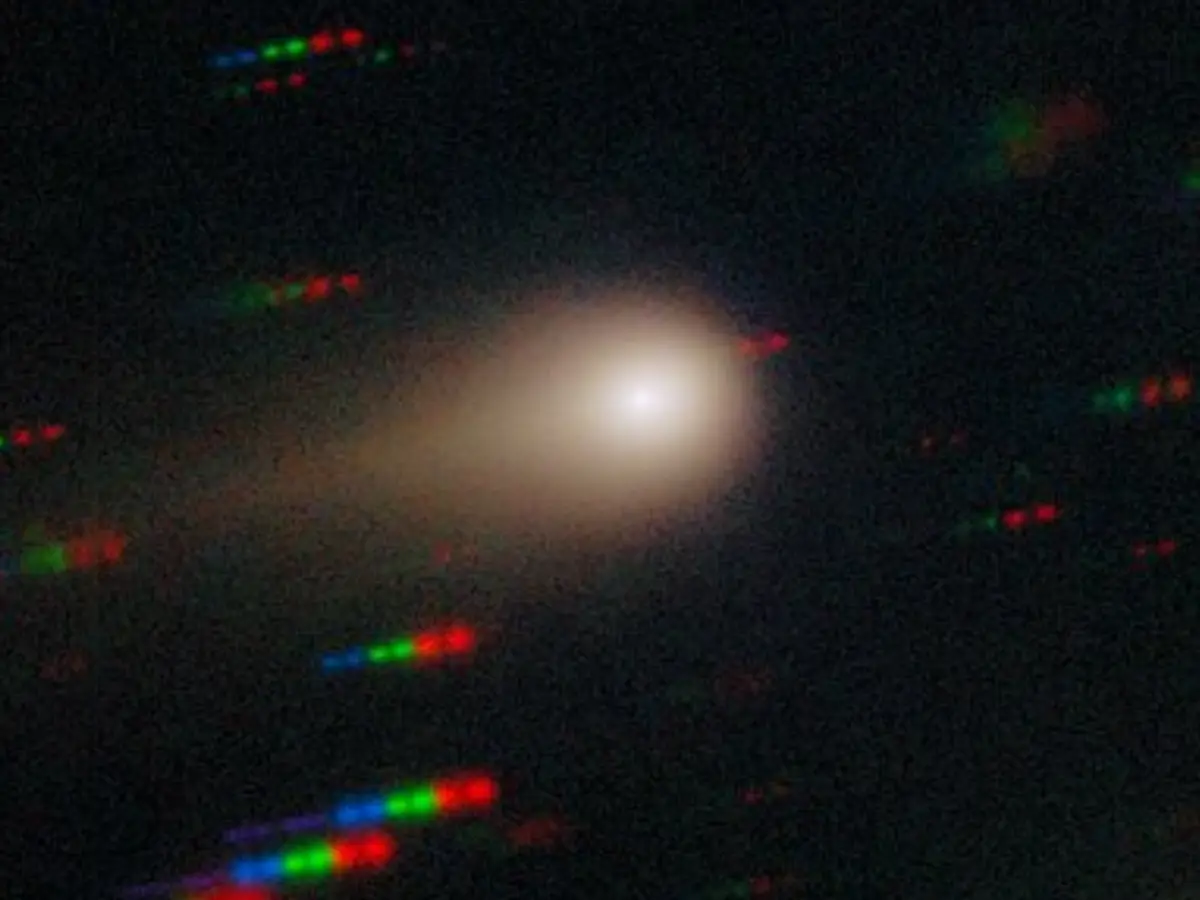
So the researchers shifted their focus to the stars in the thin disk, matching its current motion to the velocity distribution of stars in the thin disk. Since most of the stars reside in the thin disk, the researchers zeroed in on the possibility that 3I/Atlas likely originated in this region of the Milky Way. This is one aspect of the interstellar visitor among a myriad of things that have baffled scientists. For one, its trajectory aligns perfectly with the planets in the solar system, leading some scientists, like Avi Loeb, to claim that it has been deliberately sent by an alien civilisation to seed probes. The coma of 3I/Atlas is exhibiting strange occurrences, as it contains one of the highest ratios of carbon dioxide to water ever observed in any comet. The object has been deduced to be a comet, although no tail was visible for a very long time. But, in late August, the Gemini telescope in Chile saw that it was becoming more active as it hurtles towards the inner solar system, and has developed a tail.

