

&imwidth=800&imheight=600&format=webp&quality=medium "3I/ATLAS Live Tracker and Latest Updates: What will happen after comet exits Sun's glare?")
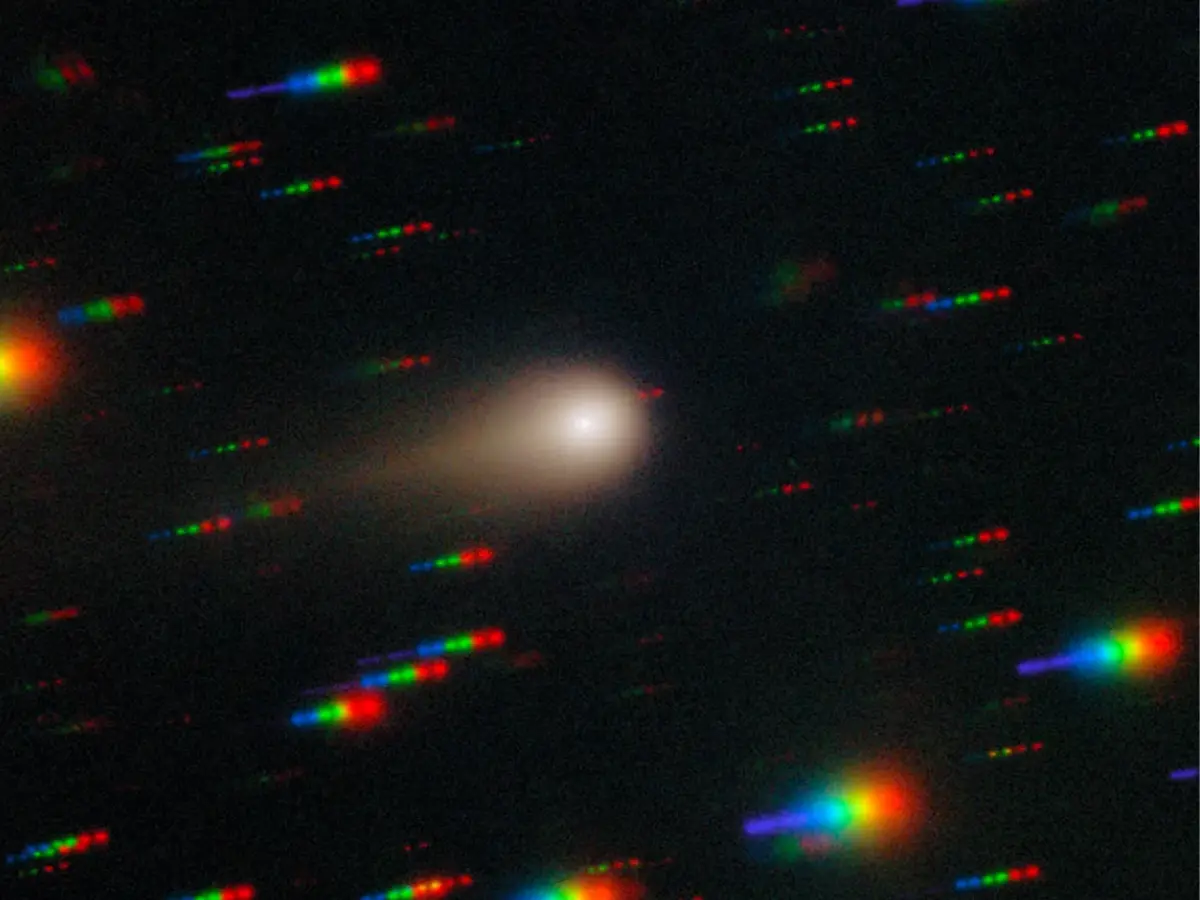
Interstellar comet 3I/ATLAS has been the star of the astronomical world for months now. It was discovered on July 1 by the ATLAS observatory in Chile. Since then, scientists worldwide have been observing it to learn more about the alien visitor. One scientist even thinks that it could be an alien spaceship, citing several anomalies. However, NASA, ESA and others agree that it is a comet paying us a visit from the outer world and will soon leave the solar system. The comet did not have a tail for the longest time, and this was one of the reasons why Avi Loeb, a Harvard professor, believed it was not a comet. He put the chances of it being a natural space rock at 30-40%. The size, speed, and the light it was generating, all of them were pointed out as reasons why something was not right with it. Now the comet is at solar conjunction and reached perihelion on October 29. It is not visible because of the glare of the Sun, but it will emerge soon again, presenting an invaluable opportunity to learn more about the alien comet, 3I/ATLAS.
After a few days, 3I/ATLAS will travel away from the Sun and become visible once again from Earth. It will continue to move forward and will then come near Earth in December. In November, two spacecraft, Hera and Europa, will travel through its tail. The JUICE probe by the ESA will also observe and gather data about it in November. Then, on March 16, 2026, the JUNO probe will watch 3I/ATLAS and hopefully reveal more about the comet that will soon leave our solar system.
Harvard scientist Avi Loeb earlier claimed that the direction from which the famous Wow! Signal came in 1977, and was almost the same as the place 3I/ATLAS is coming from. He listed a series of calculations to deduce the position of 3I/Atlas in 1977, right about the time the Wow! Signal reached Earth originating in a far-off location. The Wow! Signal was detected by SETI (Search for Extraterrestrial Intelligence) astronomer Jerry R. Ehman while using the Ohio State University’s Big Ear radio telescope. He was stumped by a sudden signal and simply wrote “WOW” on a piece of paper.
Two spacecraft en route to their destinations are expected to cut through the ion tail of 3I/ATLAS. NASA’s Europa Clipper, which is going to the eponymous Jovian moon, and the European Space Agency’s Hera spacecraft, which is travelling to the binary asteroid Didymos and Dimorphos, were both expected to travel through the tail of the alien comet. The authors stated that their paths are aligned in a manner that might take them through the interstellar comet's tail. This was stated in a paper that has been accepted for publication in Research Notes of the AAS.
Scientists are still not sure about the origin of the interstellar comet. Early observations showed that this mysterious object was travelling from the thick disk of the Milky Way. But astronomers from China figured out that it originated in the thin disk. Yiyang Guo and his team from the Shanghai Jiao Tong University deduced the alien comet's origin point. The thin disk is a region full of new stars and dust that sits inside a puffy region known as the thick disk. The latter has residents that are quite old and also has a different composition than the thin disk.
Some scientists, like Avi Loeb, have raised the possibility that the interstellar comet could use the Sun's gravity to fling itself towards Earth. When 3I/ATLAS goes around the Sun, researchers will be watching for something called the Oberth effect, which means that "if you were to whip around the sun, you would pick up extra energy in the process."
On October 21, the interstellar comet reached solar conjunction, meaning it went on the opposite side of the Sun. Its brightness is hiding the comet, making it impossible to see it. On October 29, 3I/ATLAS reached perihelion, that is, its closest point to the Sun. It is still hiding in this place and won't be visible again for a few more days.
The interstellar comet's trajectory was flagged as an anomaly by Harvard scientist Avi Loeb. It is moving in a hyperbolic path. Loeb said that its path brings it close to Mars and Jupiter. 3I/ATLAS passed within 29 million kilometres from Mars on October 3, and will encounter Jupiter on March 16, 2026, when it will be 54 million kilometres from the gas giant. Loeb says that this shows a "near alignment by 4.89 degrees of the retrograde orbital plane of 3I/ATLAS with the ecliptic plane of the Earth around the Sun," and the chances of this happening are only 0.002.
The interstellar comet is moving at a staggering speed of 221,000 km/hr, or 60 km/s. This was one of the clues about the alien comet's origin. This is extremely fast for a regular comet found in our solar system.
Scientists found precovery images of 3I/ATLAS while scanning through NASA's Transiting Exoplanet Survey Satellite (TESS). To their surprise, they saw that it had captured it way back in May-June. The data was analysed to look for an extended coma that would be a clear indication of cometary activity. However, they did not find a clear indicator.
Scientists aren't fully sure about the size of the interstellar comet. The Hubble Space Telescope observations suggest that the diameter of 3I/ATLAS's nucleus is between 0.32 and 5.6 km. Most experts say its diameter is only about a kilometre wide. However, Avi Loeb, a Harvard scientist, cites the brightness of 3I/ATLAS at a wavelength of 1 micrometre to claim that it has a nucleus that measures 46 kilometres in diameter. His claims have been disputed by others.
The interstellar comet is believed to be 7 to 14 billion years old, making it the oldest comet ever spotted by humans. A July 2025 study led by Matthew Hopkins stated that 3I/ATLAS could be anywhere between 7.6 and 14 billion years old. This means the comet is even older than the solar system, which was born 4.6 billion years ago.
Click on the link below to see all the images of the interstellar comet 3I/ATLAS captured so far.
The interstellar comet is not going to get too close to Earth. The closest it will come is 268 million kilometres on December 19. It poses no threat to our planet. In fact, to even view it, you'll need an advanced telescope.
After 3I/Atlas was spotted in July earlier this year, scientists didn't immediately know that it was an interstellar comet. When they started looking at its trajectory, something seemed off. It was not normal for asteroids and comets that reside in our solar system. After several observations and calculations, they concluded that it was coming from interstellar space.
The interstellar comet reached its closest point to the Sun on October 29. This was pointed out as a crucial moment in its journey, since this encounter is expected to change it dramatically. The ice will dissipate, and the comet's appearance will change. The reappearance is expected to happen in early November. We'll have to wait and watch how 3I/ATLAS might have changed.

