Ukraine war: Russia's Orlan-10 Krasnopol laser-guided drones


Russian Orlan-10 drones
As Ukraine's forces continue to resist Russia over three weeks into the war, the Russian ministry of defence had released a video which reportedly showed Orlan-10 UAV Krasnopol laser-guided artillery strikes in Kyiv Oblast.
Reports also claimed Russia may be using "suicide drones" or "loitering munition" in the Ukraine war.
The Zala KYB UAV "loitering munition" is designed to take out remote ground targets with ease and can hit targets with high precision.

Orlan-10 UAV
The Orlan-10 UAV is a medium-range, multi-purpose unmanned aerial vehicle which conducts aerial reconnaissance and electronic warfare. It is usually used in groups by the Russian army as it strikes enemy targets.
The Orlan-10 has multiple cameras including thermal imaging camera and radio transmitter and can offer real-time intelligence on the ground with 3D maps. The production of Orlan-10 had started in 2010
The Russian forces had conducted drills of the Orlan-10 in the Kemerovo region in southwestern Siberia last year.
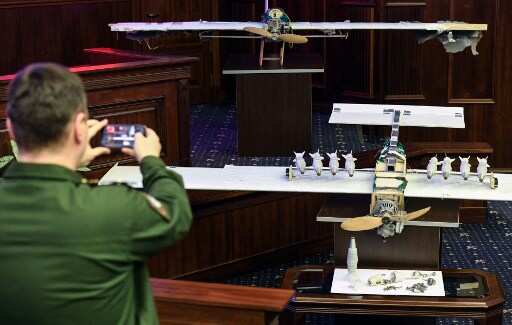
Russia's Krasnopol weapons
Krasnopol weapons are Soviet-era laser-guided, artillery weapon system. It locks into a target automatically by a laser designator through a drone or ground-based artillery.
The former Soviet army used the Krasnopol weapon system on howitzers against tanks and other targets. The 155mm KM-1 Krasnopol artillery guided weapon system can take out bridges and other targets within a range of 3 to 20 km.
Reports claim India had purchased Krasnopol laser-guided shells from Russia between 1999 to 2002 meant to be fired from 155mm Bofors guns.

Ukraine's Punisher drone
As the war with Russia continues to drag on, Ukraine has deployed the lethal Punisher drones which has carried out several successful missions.
It can reportedly fly upto 30 miles inside enemy territory and has been used to disrupt Russia's supply lines blasting the long convoys and targeting the ammunition dumps.
The drones fly almost undetected with a wingspan of 7.5 feet and can fly at a height of 1,300 feet. The flight path of the "Punisher" is automatic and it feeds off its companion drone called the "Spectre" which helps in reconnaissance and identifying targets.
The drone is reportedly designed by a company called UA Dynamics comprising of veterans who fought in the Crimea conflict against Russia in 2014.

Drones target Russian columns
The Ukrainian ambassador in Ankara has regularly tweeted images of explosions attributed to the drones, targeting Russian columns and artillery, with accompanying phrases like: "#c -- "Mashallah (God be praised)" and strings of joyous emojis.
"These TB2 strikes are, in comparison to ground combat, relatively small in number, but important for Ukrainian morale precisely because it shows Russia does not control the skies," said Aaron Stein, of the Foreign Policy Research Institute.

Orion combat drone
As tensions mounted along the border in Ukraine last year, Russia launched the Orion combat drone. The attack drone fired an air-to-air munition at an unmanned vehicle during testing.
According to the Russian defence ministry the drone also fired at ground targets during the exercise at the Crimean training ground.
Reports said Russia has also reportedly developed a new aircraft-launched laser-guided missile. The Orion drone can take on other drones during combat.

Drone with air-to-surface missiles
The drone is equipped with electro-optical and infrared cameras and is controlled by a "pilot" on the ground. The drone can also carry out reconnaissance while patrolling a specific area.
The drone also has KAB-20 and KAB-50 aerial bombs including UPAB-50 guided gliding aerial bombs
The Orion drone is a medium-altitude, long-duration, unmanned aerial system engineered by Russia's Kronshtadt company.
The drone is capable of carrying four air-to-surface missiles, accelerating to 200 km per hour climbing to 7.5 km can operate for as long as 24 hours.
The drone can carry a combat payload of 250 kg.

Ukraine claims it is 'defending its territory'
Ukrainian President Volodymyr Zelensky had brushed aside Western criticism of Kyiv using a Turkish-made drone in its conflict with pro-Moscow rebels, saying his country was "defending its territory."
The introduction of the drone is being seen as a potential gamechanger in the Russian-Ukraine struggle.
International monitors in eastern Ukraine, who use unmanned aircraft to report ceasefire violations, have recently said their drones were being jammed.
President Vladimir Putin had earlier told his defence chiefs to work on further developing Russia's arsenal of drones, especially through artificial intelligence.

Artificial intelligence in Orion
Putin said the military already had more than 2,000 drones at its disposal. The Russian President said drones had proven their effectiveness in recent conflicts and that Russia had developed defences against their use, including against "terrorist drone attacks" in Syria.
In fact, Kronshtadt Company had said unmanned aerial vehicles like the Orion are becoming more autonomous with the introduction of artificial intelligence.
Drone development is part of a major push for weapons development under Putin, who has made increased Russian military might a cornerstone of his two-decade rule.
A new generation of the Sukhoi stealth fighter jet -- dubbed "The Checkmate" -- was unveiled last year with the ability to carry and launch drones in flight.
)
)

)
)