‘Guns will not go away’: Why India’s K9, M777 and ATAGS still matter in the drone age

&imwidth=600&imheight=450&format=webp&quality=medium "‘Guns will not go away’: Why India’s K9, M777 and ATAGS still matter in the drone age")
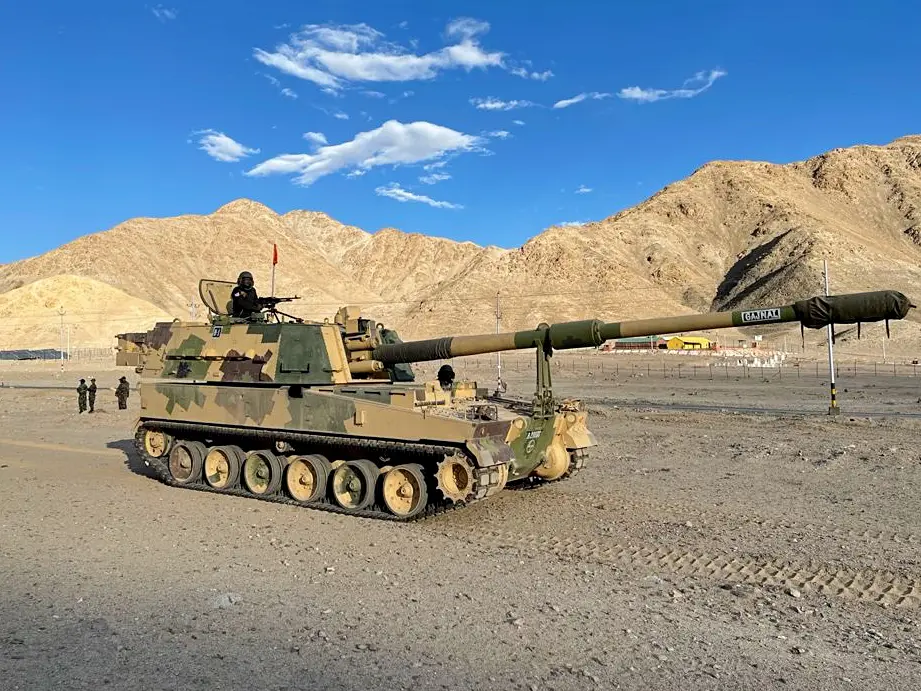
Indian Army K9 Vajra self-propelled howitzer deployed along the Line of Actual Control with China on October 2, 2021. Photograph: (ANI)
India’s K9 Vajra T, M777 and ATAGS underline why artillery remains central to battlefield firepower even as drones and loitering munitions transform modern warfare.
Drones and loitering munitions are transforming the battlefield, but India is simultaneously investing heavily in a weapon that has dominated land warfare for generations: the 155mm artillery gun. At the centre of this modernisation are three very different systems: the K9 Vajra-T, M777 Ultra-Light Howitzer and indigenous Advanced Towed Artillery Gun System (ATAGS).
The K9 Vajra-T is a 155mm/52-calibre tracked self-propelled howitzer designed to combine heavy firepower with battlefield mobility. India inducted an initial 100 guns and contracted another 100 in December 2024 for more than ₹7,600 crore. Originally associated primarily with plains and desert operations, the K9 was subsequently adapted for deployment in extreme high-altitude conditions.
The M777, meanwhile, addresses a different challenge. Weighing roughly 4.2 tonnes, the 155mm/39-calibre ultra-light howitzer can be transported by heavy-lift helicopters, giving artillery commanders considerably greater flexibility in mountainous terrain.
ATAGS represents India's indigenous 155mm/52-calibre path. The government contracted 307 guns for 15 artillery regiments in 2025, alongside 327 high-mobility gun-towing vehicles.
But the rise of drones is changing how all these guns operate. Speaking on WION's Defence Pulse, former Director General of Artillery Lt Gen Tarun Kumar Chawla (R), who has nearly four decades of experience as a gunner, said artillery and unmanned systems should increasingly be viewed as complementary capabilities. “There is space for all these to coexist today,” Chawla explained that drones can penetrate deeper and provide artillery with information that traditional ground observation posts may struggle to obtain.
“Drones can play a bigger role as the eyes for the artillery, as the observation platform for the artillery.” That could allow artillery units to locate hostile batteries, logistics facilities and other targets beyond direct observation. But Chawla strongly rejected the proposition that drones could make heavy guns irrelevant. “Guns will not go away.” His reasoning comes down to the ability of artillery formations to generate concentrated and sustained firepower. “Mass effects can only be created by guns.”
He also highlighted another vulnerability of unmanned systems: their susceptibility to electronic warfare, including jamming and spoofing. The emerging battlefield therefore may not be artillery versus drones. Instead, drones can find targets while artillery delivers sustained firepower.
India's K9, M777 and ATAGS represent three different ways of delivering that firepower across deserts, mountains and conventional battlefields.