Majority of 'healthy' recovered coronavirus patients show heart damage months later

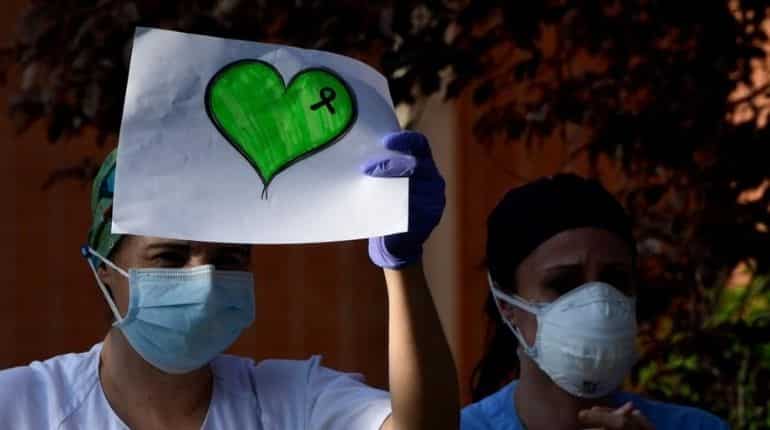
A healthcare worker holds a drawing of a green heart with a black ribbon during a protest calling for a reinforced healthcare system outside the Severo Ochoa hospital in Leganes outside Madrid on May 25, 2020 as the country loosens a national lockdown tha
Coronavirus pandemic has wreaked havoc all over the world, infiltrating and decapitating every territory that falls in its way. Scientifically, the most annoying facet of the virus has been its unpredictability.
In the beginning, scientists weren’t sure what to make of it, and what its most definitive group of symptoms are. Over the course of 2020, the information has been modified many times. Very recently, a group of scientists posited that the virus may indeed be airborne, which shocked the scientific community worldwide.
As the death toll and the number of infections continue to induct record numbers everyday, a group of scientists have found that COVID-19 may be the underlying cause for more than lung-related ailments in the long term.
Heart damage
The new twin researches from Germany claim that the virus can trigger long-lasting heart damage. This is not limited to patients with co-morbidities; even healthy people can develop long-lasting damage after recovering from the virus.
Out of the two studies, one focused simply on the effects on the heart, while the other limited itself to its effects in the elderly.
The former was published in JAMA Cardiology on Monday and found that three-quarters of recovered patients experienced structural changes in their hearts, even two months after recovering from the virus.
The scientists took into account MRIs of over 100 patients who had now recovered, all aged between 45-53. They then juxtaposed the structural definitions of the heart with those who had never contracted the virus. Out of the 100, 78 showed changes in the basic structure of their hearts.
"Biomarker"
Out of these, 76 had a “biomarker”, which usually appears in people who experienced a heart attack. 60 also showed heart inflammation, which is called myocarditis. The most important facet of this study is perhaps that the majority of these people were “healthy” before contracting the virus. A false belief has long been held by people that only people with co-morbidities and the elderly develop the serious symptoms of virus. This has been dispelled multiple times over the course of the pandemic, as new information starts flowing in.
Even weeks after recovering, the effects on the heart remained pronounced, opening doors of potential long-term effects that we may still not be aware of.
The second study focused on39 subjects aged between 78-89 who died in the earlier stages of the pandemic. The researchers analysed their autopsy reports and found that heart issues were noticed in more than 41 per cent of elderly patients.