Davos push: Maharashtra bets on small nuclear reactors to power future growth

&imwidth=600&imheight=450&format=webp&quality=medium "Davos push: Maharashtra bets on small nuclear reactors to power future growth")
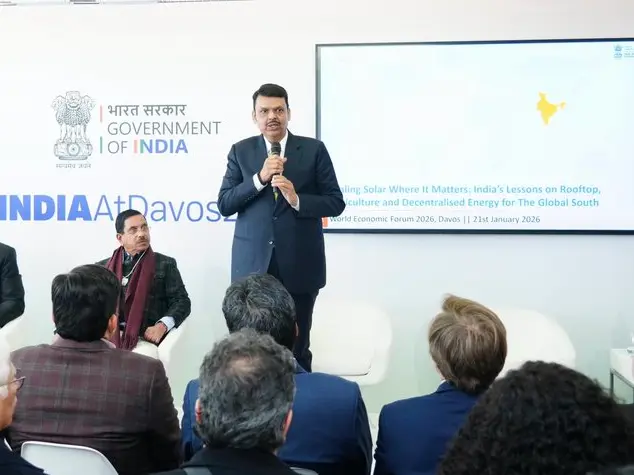
Davos push: Maharashtra bets on small nuclear reactors to power future growth Photograph: (Credit: X/@CMOMaharashtra)
Maharashtra CM linked the SMR push directly to state's rising electricity demand. With data centres, circular economy projects, expanding municipal corporations and large private investments on the horizon, the need for reliable, round-the-clock power is expected to grow sharply.
Maharashtra is laying the groundwork for a major shift in its energy strategy, with Chief Minister Devendra Fadnavis announcing at the ongoing World Economic Forum in Davos that the state has signed Memorandums of Understanding to explore Small Modular Reactors (SMRs) as a future power source. Speaking on the sidelines of the global summit, Fadnavis said Maharashtra has entered into partnerships with an Indian government company and Russian company. He indicated that the first SMR project in the country could potentially come up in Maharashtra, given the early momentum and discussions already underway.
For years, nuclear power in India has largely meant large, centralised plants that take a long time to build and require vast land parcels. SMRs, however, offer a different model. These reactors are smaller, modular and faster to deploy, allowing power generation to be closer to consumption centres. This makes them particularly relevant for industrial clusters and urban regions. The Chief Minister linked the SMR push directly to Maharashtra's rising electricity demand. With data centres, circular economy projects, expanding municipal corporations and large private investments on the horizon, the need for reliable, round-the-clock power is expected to grow sharply. While renewable energy will remain a key pillar, officials acknowledge that solar and wind alone cannot meet continuous base-load requirements. SMRs provide stable electricity with minimal carbon emissions, positioning them as a cleaner alternative to coal-based power.
Also read: 'So many friends, few enemies': Trump’s defiant return to Davos charms CEOs but warns rivals
The state sees them as a way to balance economic growth with environmental commitments, especially as industries increasingly look for sustainable energy options. Another significant aspect of the proposal is the funding approach. Instead of relying solely on government resources, Maharashtra is exploring a collaborative model where municipal bodies, private companies, financial institutions and large power consumers could jointly fund future SMR projects. Officials clarified that the MoUs signed at Davos are focused on feasibility studies, technology cooperation and long-term planning. Any move towards actual construction would require approvals from the central government and nuclear regulators. The announcement at Davos signals Maharashtra's intent to position itself as a leader in advanced and clean energy solutions.