
&imwidth=800&imheight=600&format=webp&quality=medium "Myth or real? Archimedes DEATH RAY burned ships 1,000 feet away. A teenager recreated it")
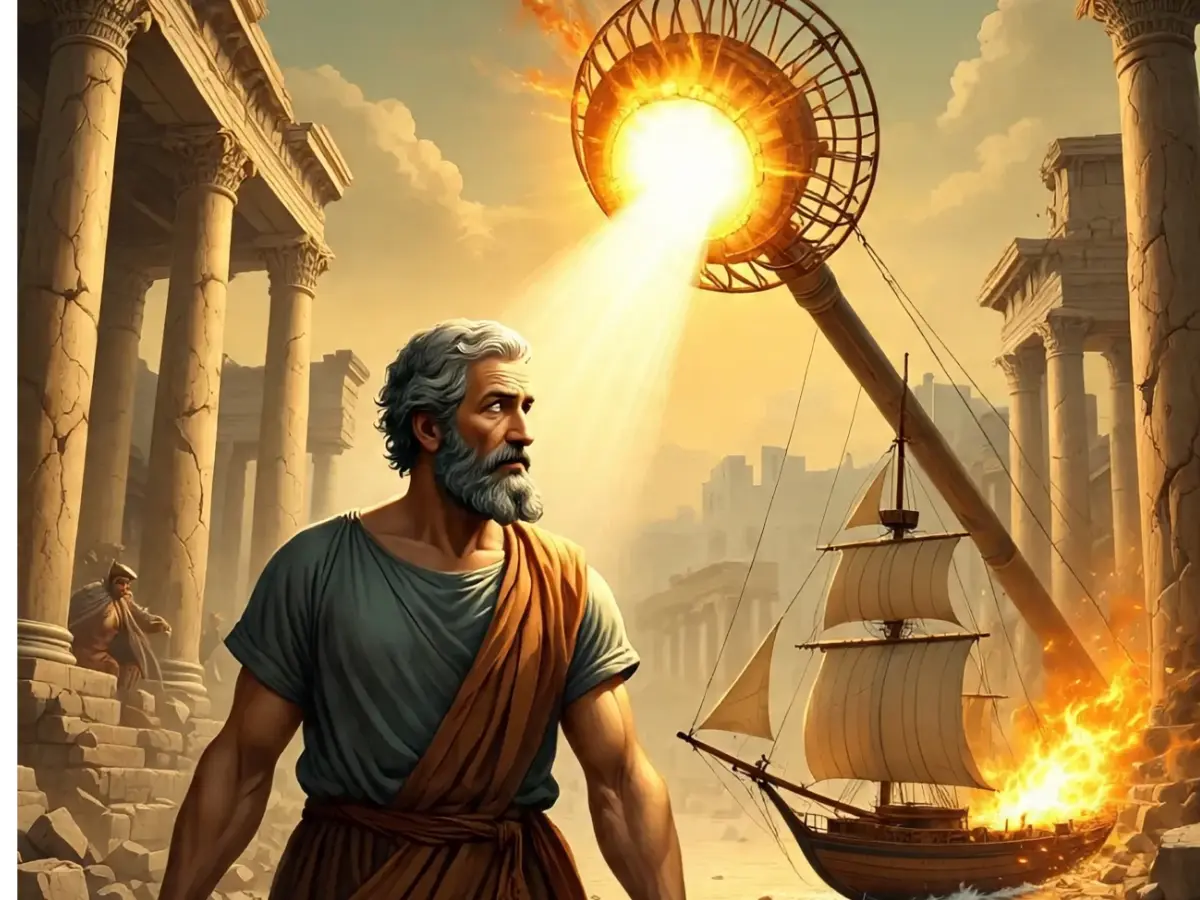
Ancient Greek mathematician Archimedes believed that the Sun's energy could be harnessed to build a death ray. He is thought to have built one as well. But experts think it was only a mythical object. A teenager intrigued by his idea actually managed to create one. Brenden Sener of London, Ontario, studied Archimedes' principles and has attempted to bring the ancient device to life several times. He has also won awards for his attempt to build the death ray. Sener said in his 2024 paper published in the Canadian Science Fair Journal that he has shown that “the principle behind the Archimedes Death Ray is certainly possible." The death ray remains a mythical object, and no evidence has ever been found that it was real. However, Sener believes the death ray existed in ancient times. He has even won several awards for building one.
“The historical descriptions of the use of the death ray in ancient Syracuse are plausible,” even though "no archaeological evidence of the Archimedes death ray has been found besides what is recorded in the books of ancient philosophers," Sener said. The death ray finds mention in an account of the battle of Syracuse that ran from 214 to 212 BC. Historical texts suggest that the device was used to set approaching Roman ships on fire from 1,000 feet away. The teenager says that the ancient death ray was made up of large concave mirrors, which were placed in such a way that they could focus the Sun’s rays onto a single focal point. This is how a deadly ray was released, destroying objects at a distance. Sener took inspiration from the texts and used a heat lamp and four concave mirrors to build his own death ray that hit a point on a piece of cardboard. He says the ancient device likely used mirrors or highly polished shields, Popular Mechanics reported. Also Read: Secret of the mysterious structures near Norway has finally been revealed
Others who tried building the Archimedes death ray

Sener isn't the first person to explore the concept behind Archimedes' death ray. Sener wrote in his paper that the MythBusters series from the Discovery Channel also tested different ways a death ray could have worked. They built a device and tried to attack an object in three different scenarios. CNN reported that in 2005, a group of students from the Massachusetts Institute of Technology (MIT) created a death ray which burned a boat on the first attempt. However, their second attempt to hit the boat failed. Sener's other attempt to recreate Archimedes' concepts included a screw that helped move water. He told CNN, "Archimedes was so ahead of his time with his inventions."

