&imwidth=800&imheight=600&format=webp&quality=medium "NASA Parker probe captures solar winds flowing through Sun's corona in eerie video. Watch")
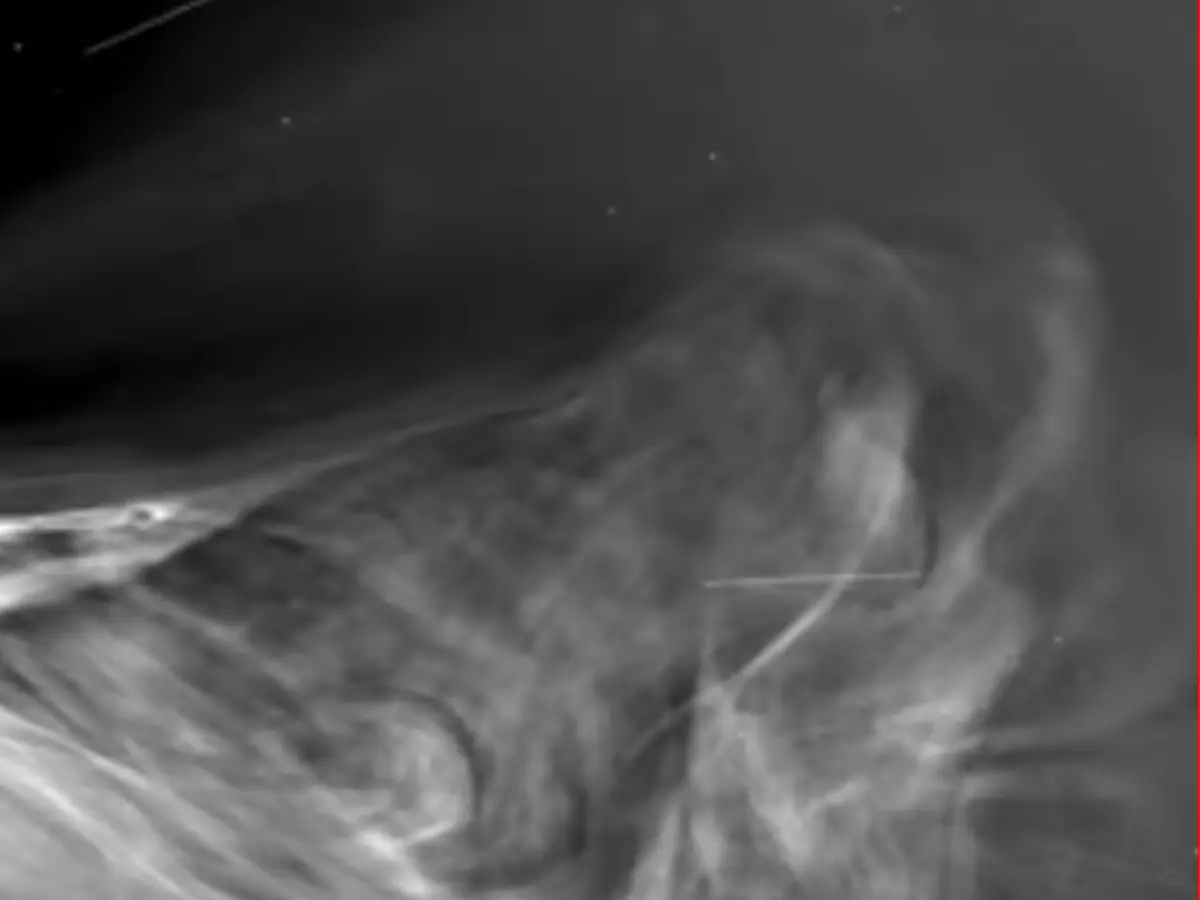
NASA’s Parker Solar Probe has taken the closest images ever from the Sun, capturing eerie waves just 3.8 million miles from the solar surface. These photos show the Sun in a new light and can help scientists better understand the Sun’s influence across the solar system. The new images will also offer insights into events that affect Earth. The shots show solar wind flowing through our star's atmosphere. “Parker Solar Probe has once again transported us into the dynamic atmosphere of our closest star,” Nicky Fox, associate administrator, Science Mission Directorate at NASA Headquarters in Washington, said. “We are witnessing where space weather threats to Earth begin, with our eyes, not just with models." He added that the latest data can help "improve our space weather predictions to ensure the safety of our astronauts and the protection of our technology here on Earth and throughout the solar system." Also Read: Earth is unknowingly sending signals into space revealing our location to aliens
Watch the Parker Solar Probe video here
These photos were taken late last year when the Parker probe made its closest approach to the Sun on December 24, 2024. The probe brushed past the Sun’s outer atmosphere, called the corona. In doing so, it collected data with an array of scientific instruments, including the Wide-Field Imager for Solar Probe, or WISPR. Solar winds can be clearly seen in the photos, which are nothing but a constant stream of electrically charged particles released by the Sun that whip the entire solar system. The material and magnetic currents ejected by the Sun hit Earth and other planets. Here, they not only produce beautiful auroras, but a strong wave can affect power grids and disrupt communications. Scientists have been working to learn more about the solar winds, and looking directly at the point where the solar wind originates can offer a peek into how this happens in the Sun. Also Read: Is a rogue exoplanet roaming in the solar system? The answer cannot be revealed before 2076

“In these images, we’re seeing the Coronal Mass Ejections (CMEs) basically piling up on top of one another,” said Angelos Vourlidas, the WISPR instrument scientist at the Johns Hopkins Applied Physics Laboratory. Vourlidas and his team are behind the design, construction and operation of the spacecraft. “We’re using this to figure out how the CMEs merge together, which can be important for space weather.” Coronal Mass Ejections can prove dangerous to several systems on Earth. Not only this, but they can also impact the astronauts in space. As NASA prepares to send humans to the Moon and beyond, it is important to know the hazards of CMEs and how to safeguard the astronauts. They can also speed up charged particles and mix magnetic fields, which can prove dangerous to astronauts and satellites. The telescopes in orbit and on Earth can also be impacted.