Hubble's latest spectacle! Captivating images of Jupiter's storms revealed...

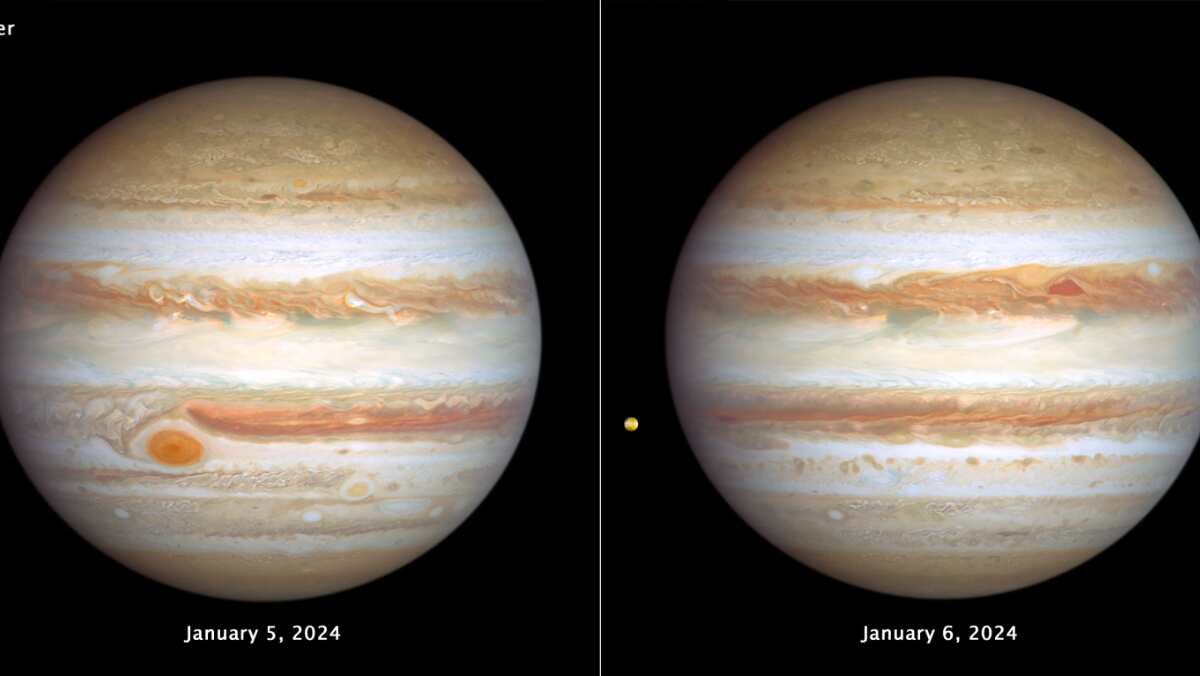
Images of Jupiter's stormy weather as posted by NASA
NASA's Hubble Space Telescope has once again turned its gaze towards Jupiter. This time the telescope,in a captivating display of celestial choreography has captured the breathtaking images of the gas giant's tumultuous storms.
These latest snapshots, taken on January 5-6, 2024, show Jupiter in its full splendor, offering a rare glimpse into the intricate dance of storms and atmospheric dynamics that define this enigmatic world.
Notably, under the Outer Planet Atmospheres Legacy program (OPAL), Hubble diligently monitors Jupiter and other solar system planets. These massive celestial bodies have ever-shifting weather patterns.
In one striking image from the telescope, the iconic Great Red Spot commands attention. Adjacent to it lies the enigmatic "Red Spot Jr," a smaller yet equally intriguing anticyclone whose reddish hue hints at a complex interplay of chemical compounds swirling within Jupiter's atmosphere.
Further north, another crimson vortex adds to the spectacle and offers clues about the planet's atmosphere.
"The many large storms and small white clouds are a hallmark of a lot of activity going on in Jupiter's atmosphere right now," said Amy Simon, OPAL project lead at NASA's Goddard Space Flight Centre in Greenbelt, Maryland.
Meanwhile, in the opposite hemisphere, a pair of stormsand their rotations create a mesmerising interplay of high and low pressure systems.
This celestial ballet, along with swirling cyclones and anticyclones showthe nature of Jupiter's violent winds which coverthe landscape on a grand scale.
Watch |Chile Wildfire: Fire ravages hillside in Chile's Valparaiso
The innermost Galilean moon, Io, was also seen in the picture as a volcanic hotspot, its surface bearing witness to the relentless forces at play within the Jovian system. Hubble's keen eye captured the moon's volcanic activity in detail.
"Hubble resolves volcanic outflow deposits on the surface. Hubble's sensitivity to blue and violet wavelengths clearly reveals interesting surface features. In 1979 NASA's Voyager 1 spacecraft discovered Io's pizza-like appearance and volcanism, to the surprise of planetary scientists because it is such a small moon. Hubble picked up where Voyager left off by keeping an eye on restless Io year by year," NASA said in a statement.
Through international collaboration between NASA and ESA, Hubble remains at the forefront of scientific discovery, inspiring awe and wonder with each new revelation.
(With inputs from agencies)