

&imwidth=800&imheight=600&format=webp&quality=medium "Ancient mountain range ran through India and Antarctica 150 million years ago")
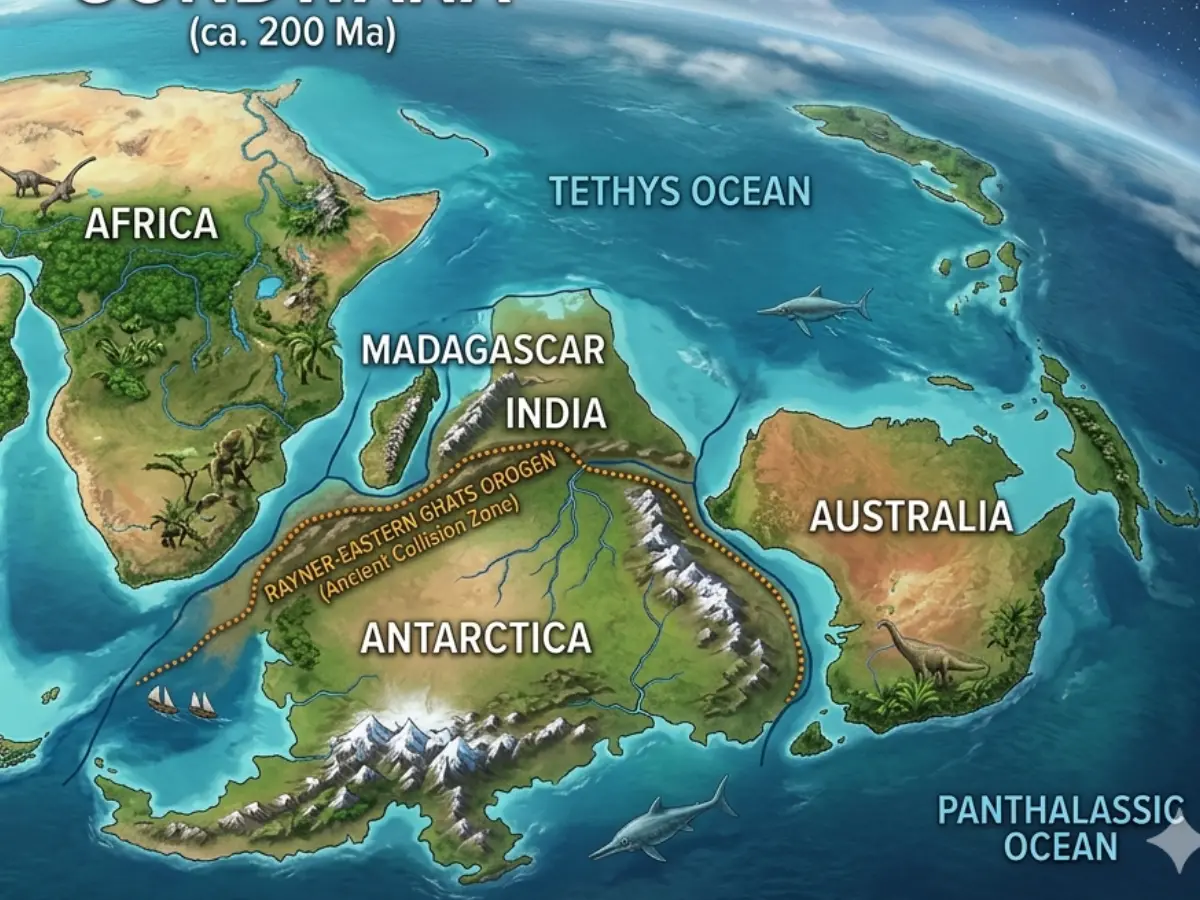
A team of international researchers have found proof that India and Antarctica were once joined together. Scientists from Presidency University (Kolkata, India), the Queensland University of Technology (Australia), the National Centre for Earth Science Studies (Thiruvananthapuram, India), and the Korea Polar Research Institute (Republic of Korea) carried out a geological study of ancient metamorphic rocks in Andhra Pradesh. They found that the rocks in the state share the exact same age, chemical signatures, mineral composition, and three-stage geological history as those found in East Antarctica. Eastern India and Antarctica were once fused together and formed a single, massive ancient mountain belt known as the Rayner-Eastern Ghats orogen. Millions of years later, the supercontinent Gondwana split, separating them.
Similar rocks found in India and Antarctica
The study involved the analysis of granulite rocks, which carry highly durable minerals like zircon, garnet, and monazite. The scientists measured the radioactive decay of uranium and lead within the zircon crystals and were able to map out a precise timeline dating back hundreds of millions to a billion years. This is because these rocks act as "time capsules" or "geological clocks" as they are formed under intense heat and pressure. Prof Sankar Bose, the lead researcher, said, "Zircon is renowned for its durability under extreme heat and pressure, which can obliterate other minerals. Due to this robust nature, zircon acts as a tiny time capsule within these rocks."
Also Read: Pieces of lost continent found under Antarctica and India point to one thing
Also Read: Antarctic cosmic dust proves Earth has been traversing through supernova debris for 80,000 years
Professor Bose said that the three major stages of geological history that have already been identified in East Antarctica were also found in these granulites in Andhra Pradesh. The first stage was recorded around 1,000 to 990 million years ago. At this time, a major continental collision led to the formation of a mountain range, subjecting the rocks to a whopping heat of 1,000 degrees Celsius. The second stage occurred between 950 and 890 million years ago and was marked by more heat and pressure. The third stage, between 570 and 540 million years ago, was what actually sealed the deal. During this time. mineral-rich fluids flowed through these rocks and left a distinct signature in the cracks, which is present in rocks in India and Antarctica.
This mammoth mountain range between India and Antarctica existed until supercontinent Gondwana started splitting apart roughly 130 to 150 million years ago. Asia moved north, while Antarctica drifted southwards, becoming the cold and harsh continent it is known as today.
Continental plates found under Antarctica
This is not the first study to link India and Antarctica. A study published in Scientific Reports in March last year stated that ancient continental plates lie beneath Antarctica, Australia and India, proving that East Antarctica was once joined to the two countries. “In East Antarctica, we see an exciting mosaic of geological features that reveal fundamental similarities and differences between the crust beneath Antarctica and other continents it was joined to until 160 million years ago,” co-author Fausto Ferraccioli said.

