Trapped in the observable universe: Is the cosmos truly without end?

Cosmic inflation, the rapid burst of expansion in the earliest fraction of a second after the Big Bang, provides a clue to what may exist beyond our horizon.

The Limits of What We Can See
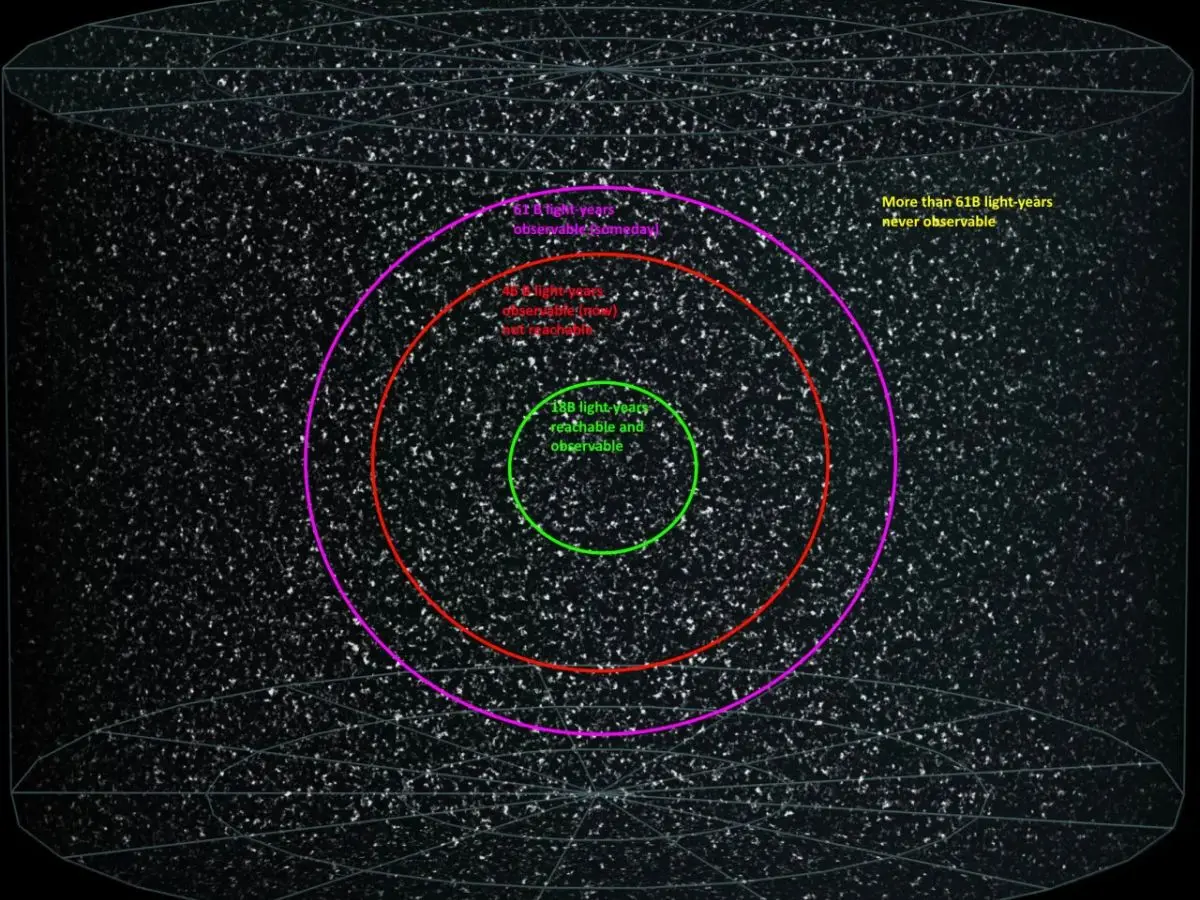
The observable universe is not the whole universe, it is simply the portion accessible to us. Defined by the distance light has travelled since the Big Bang 13.8 billion years ago, it stretches to a radius of about 46 billion light-years, giving a diameter of roughly 93 billion light-years. Beyond this boundary, called the particle horizon, light has not had time to reach us. No telescope or future technology can ever extend our view beyond this physical limit. What lies outside remains hidden by the structure of spacetime itself.

Inflation and a Vast Hidden Cosmos
Cosmic inflation, the rapid burst of expansion in the earliest fraction of a second after the Big Bang, provides a clue to what may exist beyond our horizon. Inflation smoothed the universe, explaining why our visible patch appears uniform. But it also implies that the cosmos extends far further than we can see, perhaps millions, or even infinitely, times larger. What we call the observable universe may be no more than a tiny bubble in an oceanic expanse that will always remain beyond us.

Infinite or Finite—but Unbounded
If the universe is infinite, then every possible configuration of matter is realised somewhere. That would mean, far beyond our reach, there could be countless versions of ourselves and our world, repeated endlessly across space. Alternatively, the universe could be finite but curved in higher dimensions, like the surface of a sphere. In such a model, space loops back on itself, so travelling in one direction long enough could, in principle, bring you back to where you began. In that case, the idea of an “outside” becomes meaningless.

The Prospect of a Multiverse
Some models of inflation suggest it may not end everywhere at once. Instead, inflation continues eternally in parts of space, generating a patchwork of 'bubble universes'. Each bubble could have its own laws of physics, constants, and even dimensions. Theoretical physicist Max Tegmark has categorised such ideas into levels of multiverse, ranging from regions just beyond our horizon to wholly separate realms where the fabric of reality itself is different. Whether these exist is unconfirmed, but the mathematics of inflation keeps the possibility alive.
A Shrinking Horizon in the Future
Even within our observable bubble, visibility is temporary. The universe’s expansion is accelerating, driven by dark energy, which makes up about 68 per cent of the cosmic energy budget. Over time, more galaxies will slip beyond reach, their light stretched away forever. Far in the future, only the Milky Way and its neighbours may remain visible. Future observers could find themselves in apparent isolation, unaware of the wider cosmos that once filled the sky.
The Existential Consequences
These realities highlight unsettling limits. Physics itself imposes barriers to knowledge, not just technology. We may never know the full extent or shape of the universe, nor confirm whether others exist beyond it. The possibility of infinite repetition, the shrinking horizon caused by dark energy, and the chance of multiple disconnected realities all point to a cosmos more mysterious and disorienting than we can easily comprehend.
)
)
)
)
)