With all eyes on Vikram-1, Singapore's wealth fund and investment body fuels India's private space era

&imwidth=600&imheight=450&format=webp&quality=medium "With all eyes on Vikram-1, Singapore's wealth fund and investment body fuels India's private space era")
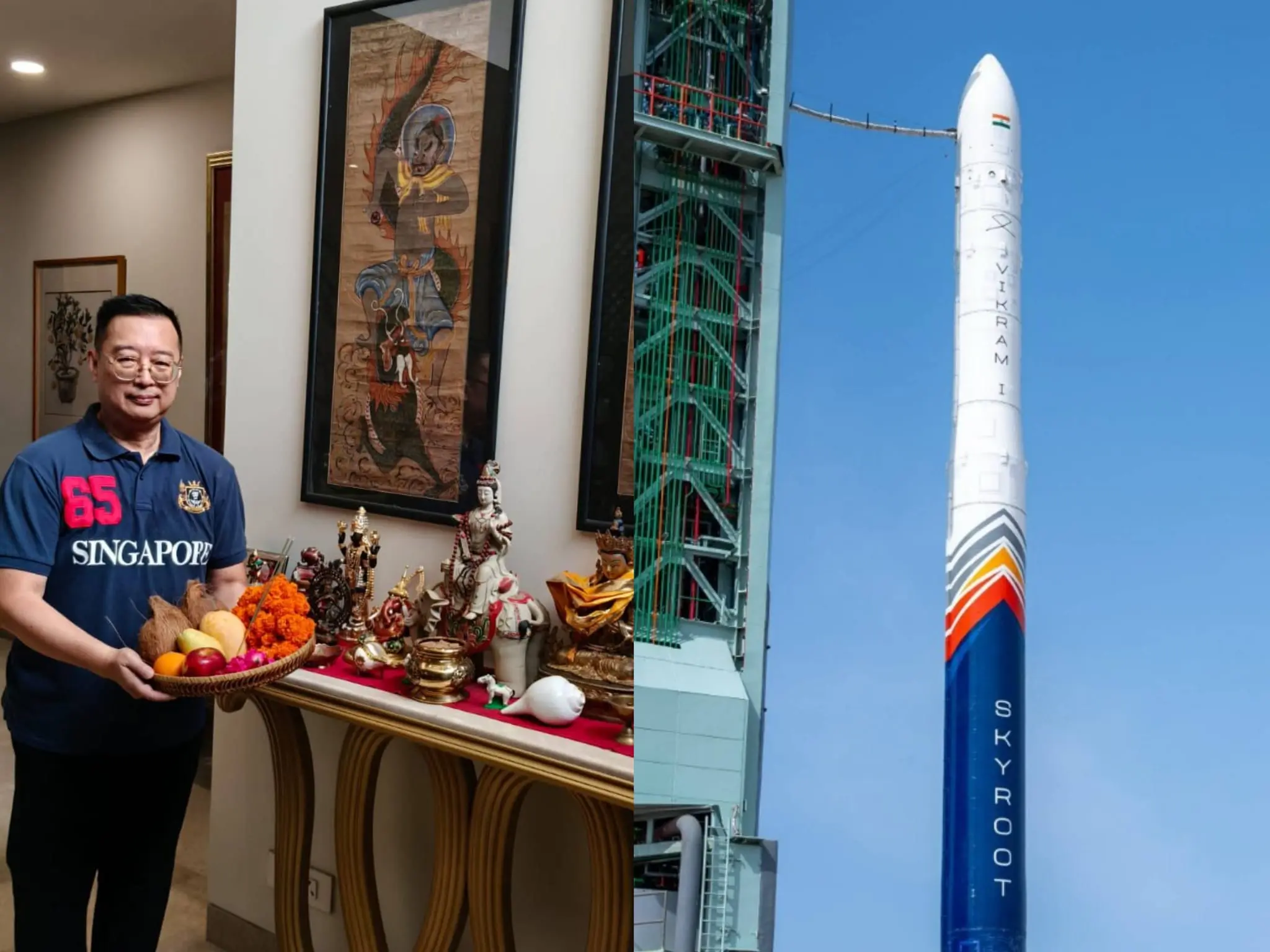
Singapore High Commissioner Simon Wong prayers ahead of the launch of Skyroot Aerospace's Vikram-1. Photograph: (X@SGinIndia)
Singapore's sovereign wealth funds have emerged as key backers of Skyroot Aerospace, providing crucial funding as India's first privately developed orbital rocket, Vikram-1, prepares for its maiden launch.
As India's first privately developed orbital rocket, Skyroot Aerospace's Vikram-1, stands ready on the launch pad at Sriharikota, the milestone carries more than just Indian ingenuity. It shows a deepening partnership with Singapore, whose sovereign wealth funds have provided critical financial muscle to propel the Hyderabad-based startup into the global small-satellite launch market.
Scheduled to launch soon for its maiden test flight, Mission Aagaman ("Arrival"), the Vikram-1 aims to place payloads of up to 350 kg into a 450 km low Earth orbit at 60 degrees inclination. The four-stage, carbon-composite rocket, named after India's space pioneer Dr Vikram Sarabhai, features indigenously developed 3D-printed engines and solid-fuel boosters. Success would mark the first time a privately built Indian vehicle has reached orbit, opening doors for cost-effective, dedicated launches.
Singapore's role is pivotal. Government of Singapore Investment Corporation (GIC), Singapore's sovereign wealth fund managing national reserves, co-led a funding round that elevated Skyroot's valuation. Earlier backing from Temasek, a Singaporean state-owned multinational investment firm, further bolstered the company. These investments reflect Singapore's calculated push into high-growth frontier technologies, positioning the city-state as among the key financiers in India's burgeoning private space sector.
Singapore High Commissioner Simon Wong captured the sentiment ahead of the launch, offering a special prayer and declaring, "Singapore-India ties are reaching for the stars!". Space has long been a cornerstone of India-Singapore science and technology cooperation. ISRO launched more than 20 Singaporean satellites, making Singapore one of ISRO's top foreign customers.
In September 2025, during Singapore Prime Minister Lawrence Wong's visit to Delhi, the two nations signed a significant Memorandum of Understanding on space collaboration. Witnessed by PMs Modi and Wong, the agreement between India's IN-SPACe and Singapore's Office for Space Technology & Industry (OSTIn) promotes joint work in policy, industry development, research, Earth observation, and satellite communications.
"We will expand cooperation in frontier areas like space," PM Wong declared. "Through the MOU... we will broaden this partnership and push the boundaries of what we can achieve together." For Skyroot, founded in 2018 by former ISRO scientists Pawan Kumar Chandana and Naga Bharath Daka, the launch represents validation after suborbital successes. The company eyes frequent, affordable missions to serve global demand for small-satellite rideshares.
Singapore's involvement, from funding to future potential satellite launches, highlights pragmatic synergy: India's launch expertise and talent pool paired with Singapore's capital, and innovation ecosystem. As the countdown proceeds at Sriharikota, Vikram-1 embodies more than a technical feat - it is the arrival of private enterprise in India's space story, with Singapore firmly along.