India Independence: These gems of Indian higher education are envy of the world

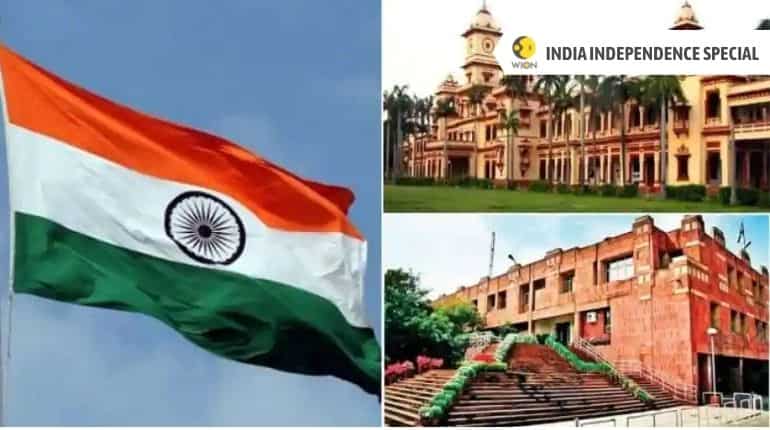
Indian higher institutes
India has one of the largest and most diverse higher education sectors, especially the technical and engineering schools. As the nation celebrates its Independence Day, here is a look at how Indian higher education institutions grew from their humble beginnings to some of the most recognised places of learning that churned out global leaders.
The Indian Parliament in 1961 had declared technical institutes as "institutes of national importance", which helped the universities grow leaps and bounds and maintain international importance.
Now, it is not just the India-born students who aim to study in the well-established institutes of India.
The demand for Indian higher education institutes grew massively among the international students too, mainly because the majority of the courses are taught in English.
Add to that the beautiful and green campus settings, diverse cultural learning, and exciting events and festivals, and that provides an all-round experience for students, from home and abroad.
Here are some of the best institutes of India:
Indian Institutes of Technology
Governed by the Institutes of Technology Act, 1961, the Indian Institutes of Technology (IITs) are a group of autonomous public technical universities spread across the country. As of now, IITs are located in nearly 23 cities of India. While all branches of IITs are connected through a common council (IIT Council) that is responsible for handling the administration side, every IIT runs as an autonomous institute.
Out of all the IITs, Madras and Ropar usually have been fighting for the first spot in the country. IIT Ropar was established in 2008 and is located in Rupnagar in the state of Punjab. Covered over nearly 203 hectares of campus, the institute provides several courses in the STEM field such as chemical engineering, mathematics, physics, electrical engineering and many more.
IIT Madras is one of the oldest IITs in the country. Established in 1959 in Chennai as the third IIT of India, IIT Madras has maintained its position in the top 10 institutes of India for more than 10 years. With access to Guindy National park and a campus area of nearly 2.5 square kilometres, the institute has managed to protect a large number of wild animals such as chital, black buck, and many more.
In addition to this, IIT Bombay, Kharagpur, Delhi, Kanpur, Roorkee, Indore, Guwahati, and many more havea remarkable presence in technical training in the world.
Indian Institutes of Science
Established in 1909 in the state of Karnataka, IISc is one of the top 3 institutes of India. Even though the institute offers only one major undergraduate course (BA in Science), getting admission tothis university usually proves to be highly difficult for students. IIS mainly focuses on research and nearly 70 per cent of students opt for MA research and PhD.
Banaras Hindu University
Formerly known as Central Hindu College, BHU was established in 1916 in Varanasi, in the state of Uttar Pradesh. BHU is one of the largest residential universities in Asia and is located on a 1,300 acres land near the banks of the holy river, Ganga. BHU prides itself on having alumni and faculty members such as Harivansh Rai Bachchan, Narla Tata Rao, Robert M. Pirsig and many more.
University of Delhi
Considered to be one of the biggest higher education institutes of India now, the University of Delhi opened with just 750 students and only two schools — arts and sciences. The Vice President of India serves as the Chancellor of the university and the Chief Justice of India retains the position of pro-chancellor.
Over time, the university has expanded its roots with the north and south campus that houses colleges from the two directions, and all other colleges fall under an informal label known as 'off campus'.
Jamia Milia Islamia
A public university in Delhi, Jamia Milia Islamia was established by Muslim leaders in 1920 such as Maulana Mehmud Hasan. The institute’s faculty was largely made up of scholars who quit Aligarh Muslim University due to its alleged pro-British rule inclinations. While it was established in 1920, it was officially deemed as a university in 1962 and now has nearly nine faculties.
The university, once described as ‘one of the most progressive educational institutions of India’ by Rabindranath Tagore, has also earned laurels for hosting Ranji Trophy cricket matches, Women's Cricket Test matches, Women World Cup and more.
Jawaharlal Nehru University
Established in 1969, JNU was named in honour of India’s first prime minister. The university is one of the smallest universities of India that holds the status of ‘national importance’. JNU has nearly 10,000 students and almost all the enrolled students are already graduates. The university fiercely screens its candidates, with the process usually consisting a written exam followed by an interview round. It usually attracts three times the number of applications for limited available seats in every course.
For the past few years, the institute has been in the headlines for its vibrant and active student-political culture and related controversies.
Indian Institutes of Management
IIM(s) are one of the most reputed chain of universities for management education and research. With a presence in over 20 cities of India, these IIMs fall under the jurisdiction of the Ministry of Education of the Government of India. The first IIM was established by India's first Prime Minister, Jawaharlal Nehru, in 1961.Later, the institutes were given more freedom for their daily tasks after the passage of Indian Institutes of Management Act 2017. Present in Ahemedabad, Bangalore, Rohtak, Ranchi, Lucknow, Indore, Calcutta and many other places, IIMs draw crowds from India as well as abroad for its wide-ranging management-related courses.