How China is fighting 'novel' war on coronavirus through Twitter

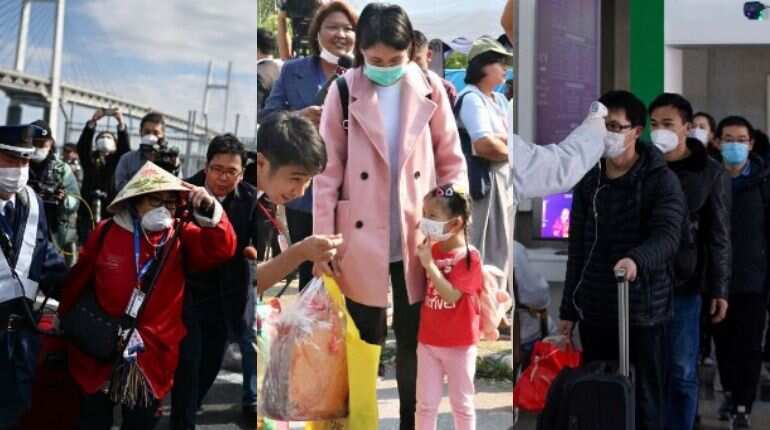
Coronavirus outbreak
China said it would welcome assistance from the United States to fight thecoronavirus outbreakafter it accused Washington of "scaremongering"even as the death toll in China rose to 492on Wednesday.
The deadly virus has now gone beyond China with a man dieing in Hong Kong on Tuesday, earlier the Philippines was the first country to report death caused due to coronavirus outside China.
China had accused the US of scaremongering as the United States set its advisory level at 4, which is the highest safety risk. The US State Department in its latest travel advisory had told its citizens not to travel to China because of the threat to life posed by the virus.
Travel and trade restrictions introduced to control the spread of the coronavirus from China are now expected to deliver a short, sharp blow to both Chinese and global economic activity for the first quarter of this year.
While it remains unclear how far the virus will spread and when it will peak, economists have been trying to estimate the impact on the GDP of the world's second-largest economy.
With worrying signs in Chinese and Asian markets, China's central bank injected 1.2 trillion-yuan ($174 billion) worth of liquidity into money marketsafter promising to help companies struggling due to the virus.
SARS outbreak in 2002 and 2003 had resulted in a global economic loss of $40 billion, according to a study by the National Center for Biotechnology Information and authored by Jong-Wha Lee and Warwick J. McKibbin. If experts are to be believed the coronavirus may dwarf SARS $40 billion global economic blow.
China does realise things are not easier this time around. It is nowdifferent because of the dissemination of information in the digital era has led countries and companies to act faster in an authoritarian state like China.
One of the biggest reasons why the coronavirus is a big test for Chinese President Xi Jinping is because of the digital transformation that has changed lives in China and around the world. Realising that the war is not just on the ground but on digital platforms too, China has unleased its diplomatic circuit from around the world to say that “situation is under control in China”.
The systematic approach of popular Twitter handles of Chinese diplomats fighting the "online war of perception"for China reflects how the Chinese regime has been working hard to minimise the impact of nCoV outbreak on its economy.
Twitter handles of Chinese diplomats - Lijian Zhao (deputy director-general, information department, ministry of foreign affairs, China), Sun Weidong (Chinese ambassador to India), Liu Xiaoming (Chinese ambassador to the UK), Chinese ambassador to South Africa (@AmbLINSongtian), or Yao Jing, Chinese embassy in Pakistan @CathayPak, each one of them have been tweeting on China "successfully" handling the situation.
Yao Jing, in the Chinese embassy to Pakistan on Tuesday tweeted, “CPEC will not be affected by #Coronavirus. It is long-term cooperation between the two countries. The Chinese Government and people is firmly committed to the BRI and CPEC cooperation with Pakistan.”
He also tweeted a link to an article published in "People’s Daily"titled, “agood neighbour is ablessing". Pakistan is one of the few countries that has stood with its “all-weather ally” China and not evacuated its citizens amid the virus outbreak.
As many as twenty-seven thousand Pakistani nationals are in China among them 1,500 are in Hubei and 559 in Wuhan, which are the epicenters of the coronavirus outbreak. The ambassdor also tweeted a video titled "Pak Chin Dosti Zindabad!"in which students from the University of Sargodha expressed their support to China on the coronavirus in the Chinese language.
Lin Songtian, Chinese ambassador to South Africa, is another diplomat who has been fighting the “digital war” and has been allaying Africa’s coronavirus fears.
The ambassador to South Africa said that there is no need for Africans to panic over the virus.
China is South Africa’s largest trading partner and more than 3,000 South African nationals reside in China.
The ambassador advised the South African nationals in China to remain in place. The Chinese ambassodor took to Twitter and retweeted a "China Daily"tweet saying, "This is the way we will win the global battles, now not only in China, but in the world."
In a tweetlater,he again emphasised on China’s capability to fight the outbreak saying, “This is the ways we are fighting against the epidemic,” while he retweeted a video of "China Daily" depicting renovation of the city's sports stadium and two convention centers into three mobile cabin hospitals to treat the virus-hit patients.
As the other Chinese diplomats were on a defensive mode displaying and talking about the Chinese government's efforts on effectively handling the situation, Lijian Zhao, deputy director-general, information department, ministry of foreign affairs, went one step further and attacked the US for “scaremongering” over the virus.
Lijan in a series of tweets on Tuesday accused US politicians of using the virus to attack China. He asserted that “such an act is disgraceful by any social moral standards.”
“Nobody should underestimate China's ability to fight a public health crisis. As we can take measures that many countries cannot take, we can quickly recover after the crisis. Some countries should not hurt Chinese people's feelings when China is in temporary difficulties,” Lijan added.
Lijan compared the 2019-nCoV situation to that of H1N1 flu virus with the US as one of the original sites of the outbreak.
“It killed 284,000 people worldwide& WHO declared the flu a PBEIC. However, the US failed to adopt effective control measures, causing a worldwide spread of H1N1. 2019-20 flu season is "on track for one of the worst flu seasons in decades,” he added.
Once a country which would shy away from US-based social media platforms, to now aggressively using the platform to fight the “battle of perception”, China has come a long way.
The country's diplomatic brigade has clearly taken up up the job on social media platforms while the Chinese government continues to take measures to contain the nCoV.
It also reflects China’s damage control through social media platforms to reduce panic among citizens around the world regarding China, as a continued ban on travel to China from different countries hurts Chinese economic interests. If China wants to win this "war", actions will have to be more on the ground than on Twitter.