Bilawal Bhutto and S Jaishankar: Why no handshakes at SCO foreign ministers' meet?

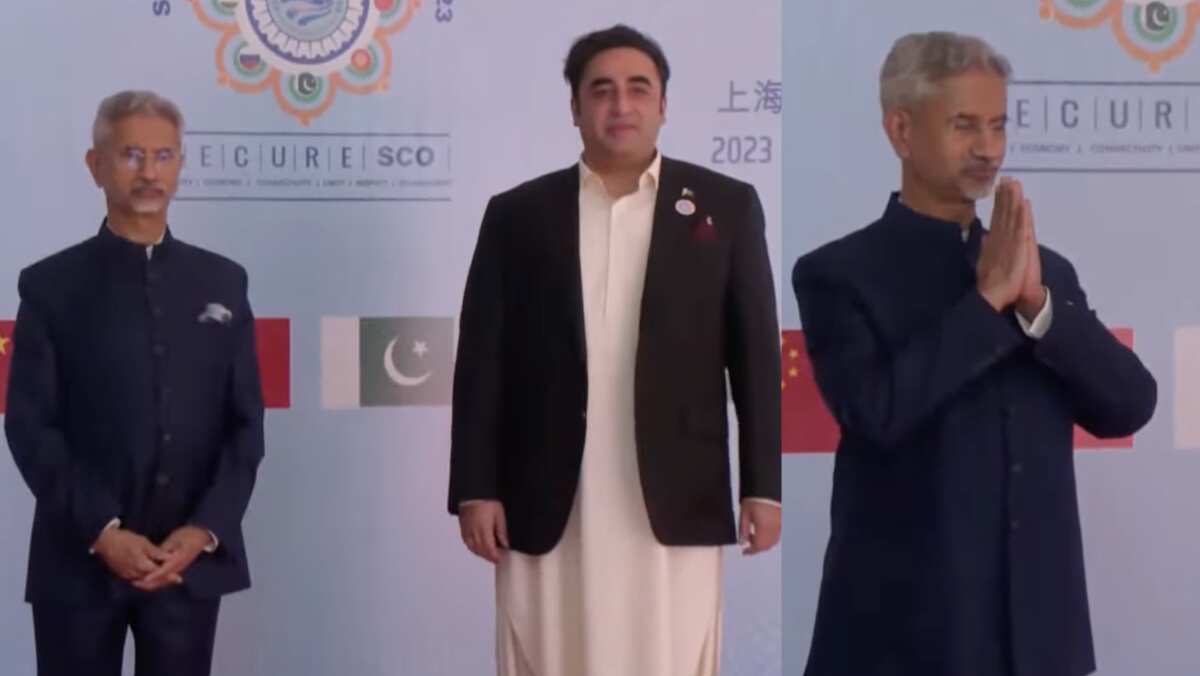
Jaishankar with Pak FM
They say optics matter and international relations are not untouched by it either. All eyes are on the ongoing Shanghai Cooperation Organisation meeting in the Indian state of Goa, where foreign ministers of the member states have marked their presence under New Delhi's chairmanship.
The greetings upon the arrival of ministers ahead of any crucial summit like the SCO foreign ministers' meet are usually carried out with a firm handshake and photo op.
However, it was not business as usual on Friday when Pakistani Foreign Minister Bilawal Bhutto Zardari met Indian External Affairs Minister S Jaishankar.
Upon receiving Zardari, who arrived from Pakistan yesterday to attend SCO summit, Jaishankar chose to greet the Pakistani foreign minister with a 'Namaste' rather than a handshake.
On the arrival podium ahead of the commencement of the SCO meeting, there were no handshakes between the two ministers, at least not publicly.
Jaishankar did Namaste to the Pakistani foreign minister just like he did with other foreign ministers, including the China's Qin Gang.
So, why did Jaishankar choose not to shake hands?
Every gesture matters in international affairs. Remember Biden's fist bump with the Saudi crown prince and the striking photograph which was much discussed in the world arena?
Even when Rajnath Singh met his Chinese counterpart Li Shangfu at the SCO defence ministers' meet, the Indian defence minister skipped a handshake.
He, just like Jaishankar, chose to welcome his Chinese counterpart with a Namaste.
Leaving alone only the Chinese counterpart, Singh shook hands with Tajik, Iranian and Kazakh counterparts. The video footage gained much traction on social media and was shared widely.
India's ties with Pakistan are strained even further after the Pulawama terror attack and the revocation of Article 370 on the status of Jammu and Kashmir. Jaishankar, on many international forums, has brought the attention of the world towards the state-sponsored cross-border terrorism by Pakistan.
Watch | China issues report on US CIA's cyberattacks on other countries
India's retaliation to the Pulwama attack with Balakot strikes in 2019 was New Delhi's befitting reply to Islamabad.
The most recent incident which left five soldiers dead and many others injured in Jammu and Kashmir's Poonch district was Pakistan’s act of “desperation” after the 2019 Balakot air strikes, as per Lt. Gen. (Retd) Kanwal Jeet Singh Dhillon, media reports said.
“After Pulwama, the Indian government’s resolve and their will to strike at will was showcased when we carried out the air strikes in Balakot. As per technical terminology, when the Air Force fully armed crosses the international boundary it’s actually a declaration of war,” said Dhillon.
He added, “(The) Indian Air Force crossed the Line of Control, overflew Pakistan-occupied Kashmir, suppressed the Pakistani air defence, defeated the Pakistani Air Force and crossed the international boundary.”
Dhillon cautioned Pakistan that India will hit back if Pulwama is repeated.
“Balakot is not in PoK, Balakot is in proper Pakistan. So IAF struck in proper Pakistan, destroyed the camp and came back safely without even being noticed or touched by the Pakistani air defence. So that was the lesson told to Pakistan that we will hit back if you try out anything like this (Pulwama),” he added.
Apart from that, India-China relations have also suffered several blows in recent years. Chinese Foreign Minister Qin Gang in his meeting with Jaishankar said, “Both sides should continue to implement the important consensus reached by the leaders of the two countries, consolidate the existing achievements, strictly abide by relevant agreements, take joint action to further ease and cool down the border situation and maintain sustainable peace and tranquillity in the border areas."
But the tensions cut deeper than the diplomatic words. Starting from Galwan clashes to China's renaming of about 11 places in Arunachal Pradesh, the relationship is marred by varied incidents. India has already rejected China's renaming of places in Arunachal Pradesh, and the instances like Namaste for a handshake are not a surprise and are often resorted to conveying a strong warning or a message.
WATCH WION LIVE HERE
You can now write for wionews.com and be a part of the community. Share your stories and opinions with us here.