Turkish inflation hits new record high after currency crisis

Turkish inflation hits new record high after currency crisis
Turkey's annualinflationrate surged to itshighestlevelsince2002in December, official data showed Monday, after a currency crisis sparked by President Recep Tayyip Erdogan's unconventional economic policies.
Consumer prices jumped to 36.1 percent last month from the same period in 2020, up from 21.3 percent in November, according to theTurkishstatistics office.
The figure is thehighestsinceOctober2002wheninflationreached 33.45 percent, before the party of Erdogan came to power.
It is also more than seven times the official government target.
Erdogan's enduring success has often been attributed to the development and prosperity his government enabled after a financial crisis in 2001.
His Islamic-rooted party rose to power the following year, and he has dominatedTurkishpolitics for the past two decades as both prime minister and president.
But he faces an increasingly difficult path to re-election in polls due to be held by mid-2023.
Opinion polls show him losing in a second-round runoff against most major rivals, and his ruling alliance ceding control of parliament to an increasingly popular group of opposition parties.
But Erdogan has stuck fast to his policies, opposing interest rate hikes -- which he calls "the mother and father of all evil" -- to combatinflation.
High interest rates are a drag on activity and slow down economic growth.
But central banks raise their policy rates out of necessity wheninflationgets out of hand.
Erdogan on Monday accused "the elites" of profiting from "unearned interest income", sticking by his pledge not to raise borrowing costs.
Lira collapse
TheTurkishlira lost 44 percent of its value against the dollar in 2021, with the losses accelerating at the end of last year, when Erdogan orchestrated a series of sharp interest rate reductions.
The dollar soared to a historic high of nearly 18.4 liras by the time Erdogan announced new currency support measures last month that were backed by reportedly heavy indirect interest rate interventions.
The exchange rate hassinceslipped back down to around 13 liras to the dollar, although theTurkishcurrency lost a further two percent after the latestinflationreading was announced.
A dollar was worth 7.4 liras at the start of 2021.
The monthlyinflationreading has turned into an politically-sensitive issue in Turkey, with opposition leaders claiming that the government is putting pressure on the statistics agency to underreport price jumps.
They point to separate readings prepared to independent economic institutes such as theInflationResearch Group (ENAG), which calculated last month's annualinflationrate at 82.8 percent.
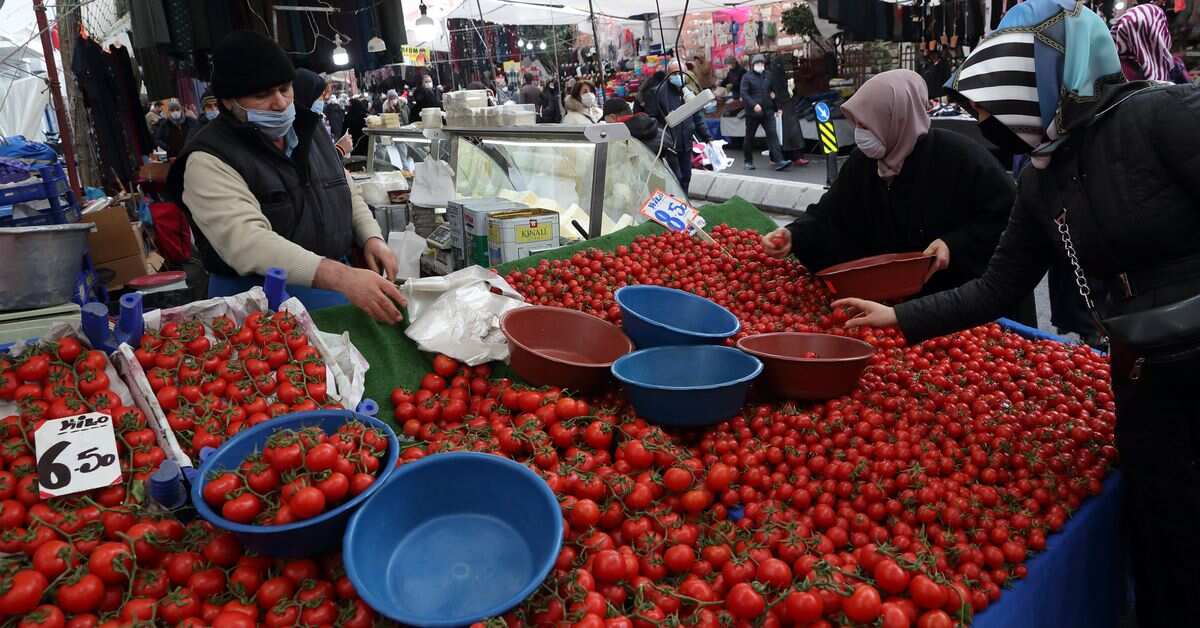
The official readings show prices for most food staples raising substantially above the annualinflationrate.
The price of milk, yogurt and sunflower oil all jumped by roughly 75 percent on the year, while that of chicken rose by 86 percent.
Erdogan has raised the take-home monthly minimum rage by 50 percent, raising it to 4,250 liras (about $310, 275 liras), which economists worry will further feedinflation.
His government has also raised sharply raised utility costs, including those of heat, gas and electricity.