

&imwidth=800&imheight=600&format=webp&quality=medium "Is smart money leaving AI? South Korea's market swings hint capital rotation")
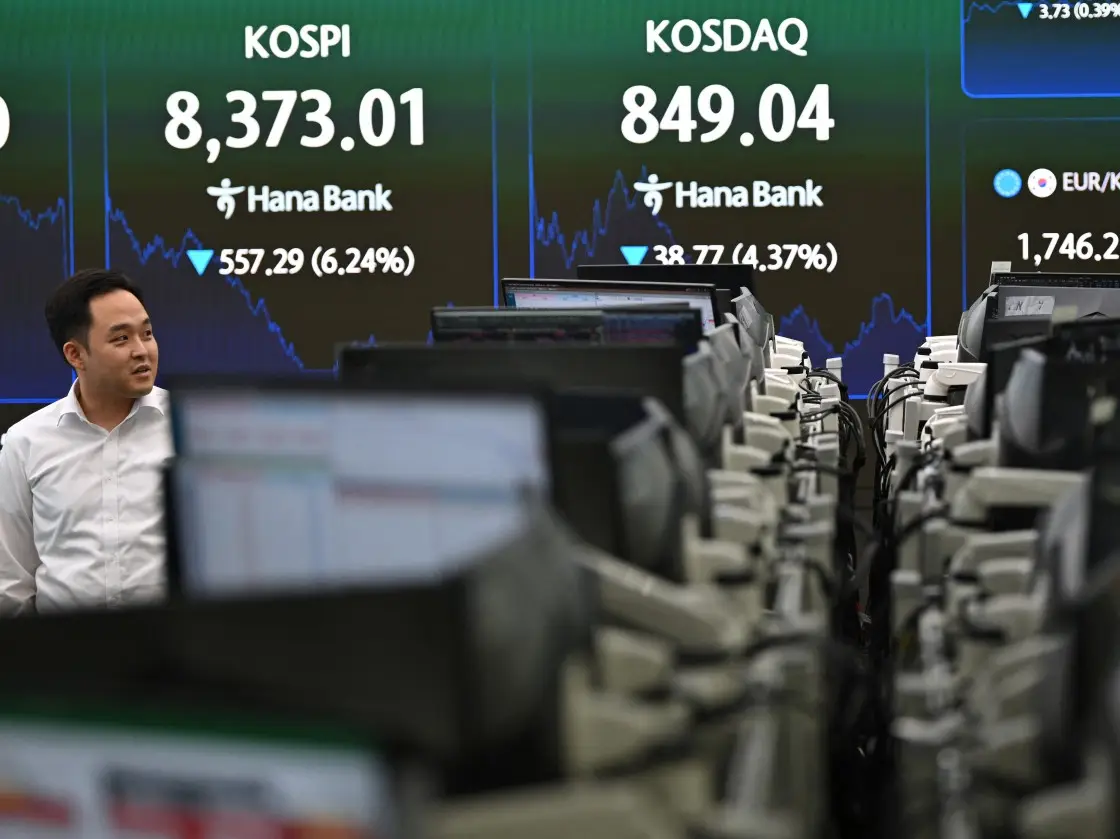
The South Korean market just hit its worst week in decades, with circuit breakers twice and sidecar three times. Volatility is at a level not seen since the financial crisis in 2008. The Kospi closed down just 0.2 per cent, recovering from a 3.4 per cent drop, while the Kosdaq gauge jumped more than 8 per cent. A similar trend was seen in Japan's Nikkei, which dropped 2.25 per cent at first, then recovered to close at 0.15 per cent up. It might seem positive, but the inside numbers are flashing warning signs.
Smart money leaving AI in South Korea?
On June 29, the Kospi closed at 8,394.65, down 16.56 points. Domestic retail and institutional investors absorbed the massive foreign exit on the main board. Foreigners hedged their downside via the futures market. Institutions and individual investors recorded net purchases of 2.9325 trillion won and 4.5971 trillion won, respectively. Samsung Electronics and SK hynix fell by 4.86 per cent and 1.68 per cent, respectively. The aggressive tech exit of foreign investors was accompanied by foreigners hedging their downside via the futures market. Institutions and individuals recorded net sales of 883.2 billion won and 6.2 billion won, respectively, while foreign net purchases were recorded at 917.5 billion won.
Massive asset reallocation
The massive South Korean market divergence is primarily driven by a global shift in foreign capital away from hardware-heavy AI infrastructure, while domestic retail and institutional investors are aggressively rotating their money into other sectors like clean energy, biopharma, and construction.
Most large-cap Kosdaq saw positive numbers. Domestic retail and institutional investors poured money directly into Kosdaq’s heavyweights. It closed at 920.57, up 69.2 points. Institutions and foreign investors recorded net purchases of 504.1 billion won and 38.1 billion won, respectively. While individual investors recorded net sales of 526.9 billion won. The safe haven shifted to the biotech and EV battery sector. Among EVs, Ecopro rose by 23.69 per cent, and Ecopro BM rose by 15.56 per cent. In biotech, Legochem Bio rose by 14.0 per cent, ABL Bio 20.18 per cent, and Samchundang Pharm 13.3 per cent.
Similarly, in Japan, the specific stocks moving the market show exactly where the capital leaving AI went. SoftBank Group, a premier global investor in OpenAI and AI tech, has borne the brunt of the valuation de-risking, sinking by 5.3 per cent. Nintendo and the Sony group jumped because lower projected memory chip costs ease the margin pressure on its hardware production.
Analysts are divided on the massive capital reshuffle. One group is saying the asset reallocation is a crack in the AI narrative. They argue that smart money is reducing exposure to crowded AI stocks. Another segment is suggesting that the AI memory trade isn't broken; they point to the domestic and retail investors buying the AI hardware sector as evidence. They claim it just got over-levered in one country, and the margin calls came.

