&imwidth=800&imheight=600&format=webp&quality=medium "JD Vance 'snubbed' at US-Iran peace talks? Qatar PM shares photo with JD Vance after viral video")
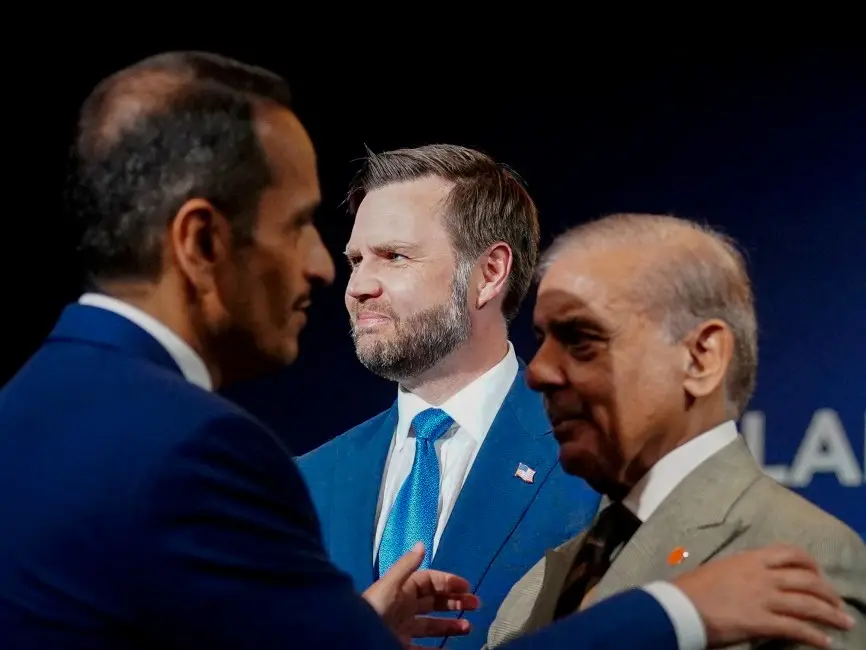
A video from US-Iran peace talks in Switzerland circulating on social media has drawn attention from internet sleuths. The footage appears to show Qatar's Prime Minister Sheikh Mohammed bin Abdulrahman Al Thani greeting Pakistan's Prime Minister Shehbaz Sharif while not engaging with US Vice President JD Vance standing next to him. Many netizens interpreted this as a snub of Vance as Al Thani chose to walk past him while he watched him awkwardly.
However, as the discussion commenced, Al Thani shared a picture on Social media with JD Vance working on his laptop, himself sitting next and making suggestions. Trump's son-in-law, Jared Kushner, was also in the frame, observing and listening attentively. The post had the caption “Live from Lucerne, work continues.” All these exchanges were unfolding at the Burgenstock resort, in Switzerland, on Sunday, June 21, as the US, Iran, Qatar and Pakistan gathered for the quadrilateral talk to discuss the technicalities of the newly discussed Memorandum of Understanding.
Also Read: 'Not a single FIR': Arvind Kejriwal questions lack of action in Ram temple donation 'theft' case

Qatar's role in the mediation
“It’s important to note that Qatar only became a mediator after Pakistan succeeded in reaching a certain level of stabilisation — the ceasefire, the initial Islamabad talks, regardless of their outcome,” said Rashid Al-Mohanadi, vice president at the Centre for International Policy Research. Pakistanis engaged when the region was reaching a boiling point, when Qataris and Omanis could not have done anything. Pakistan could communicate with Iran due to their shared diplomatic concerns about Israeli aggression in the region.
Analysts suggest that, compared to the JCPOA brokered by Obama in 2015, this deal seems more promising due to the presence of wider regional stakes. It gives everyone an agency for grievance, either about Iran's interference in the region or about Israel's unilateral aggression, which was absent earlier. The European leadership involved in the JCPOA rarely bothered about non-Western actors. “Now there is a chance for this region to take some agency and develop a new security architecture that everybody can either subscribe to now, or that gains enough critical mass for other actors to join later,” said Al-Mohanadi.