
&imwidth=800&imheight=600&format=webp&quality=medium "Pakistan's space launch faces questions over ‘historic’ image")
Pakistan's space agency SUPARCO in late April launched of its EO-3 Earth observation satellite, the final addition to the PRSC-EO (Pakistan Remote Sensing Satellite Electro-Optical) constellation. The spacecraft, carried aloft by a Chinese Long March 6 rocket from the Taiyuan Satellite Launch Centre on 25 April, is equipped with onboard AI processing and a Multi-Geometry Imaging Module. Pakistan has claimed that the system will support agriculture monitoring, disaster management, urban planning and national security.
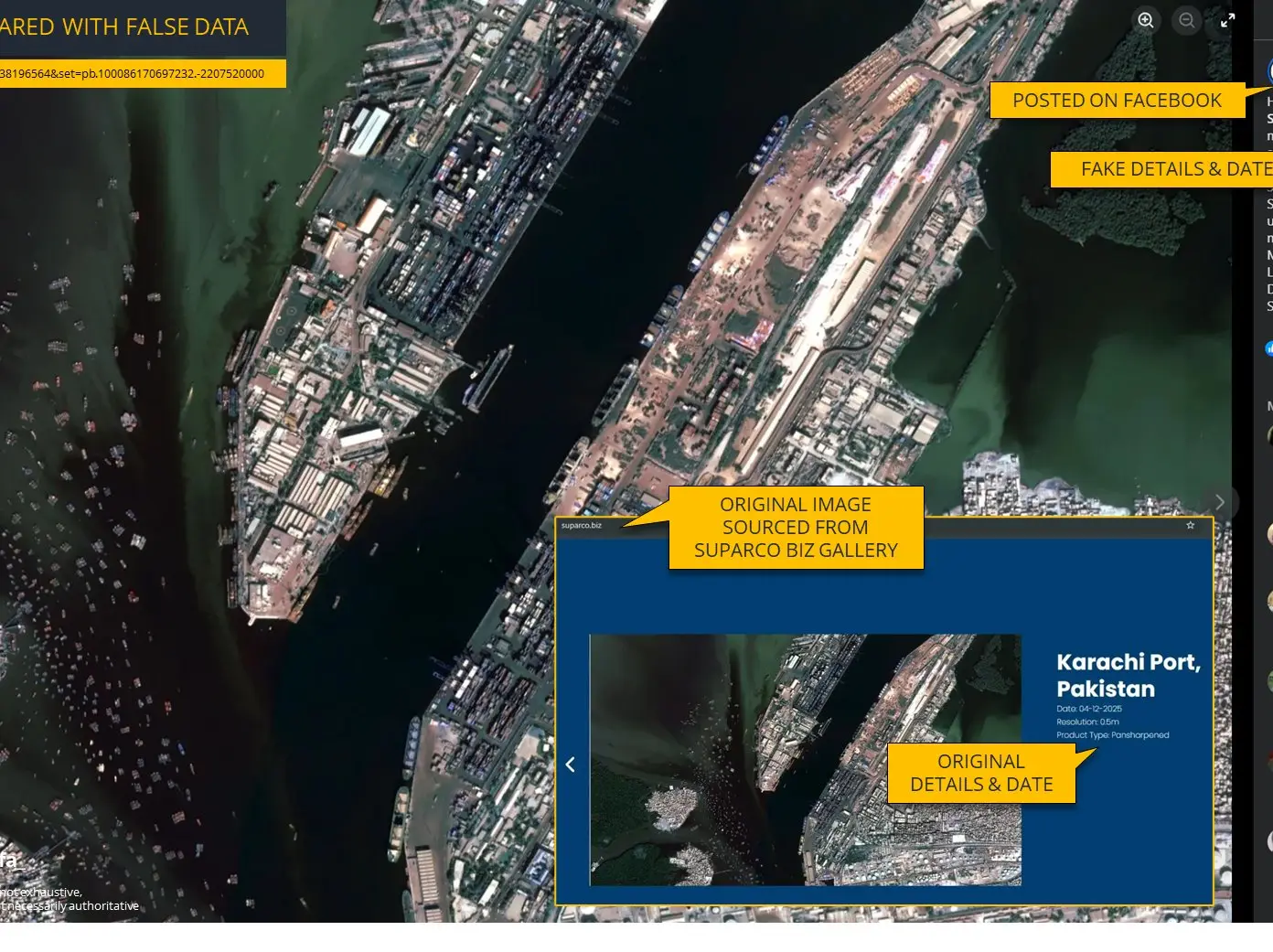
The launch was presented as a capstone for Pakistan's Earth observation capabilities, with two earlier satellites already in operation. Yet within days, the achievement was complicated by the rapid spread of an image claimed to be EO-3's first photograph of Karachi Port. Shared widely on social media and amplified by accounts close to official circles, the picture generated patriotic excitement as proof that the new satellite was already delivering data.
Independent analysts quickly identified the image on SUPARCO's own public website, where it had been uploaded months earlier in 2025, well before the launch. The photograph could not have come from EO-3. SUPARCO has not issued a public correction.

Such episodes form part of a recurring pattern in Pakistan's information management around its space programme. During India's Operation Sindoor in May 2025, Pakistani media and officials circulated images and videos purporting to show destroyed Indian airbases, missile sites and air defence systems. India's Press Information Bureau and Western open-source analysts later traced much of the material to unrelated conflicts or even a military simulation video game.
The tendency to embellish has historical roots. In the early 2000s, then President Pervez Musharraf claimed Pakistan's space programme had surpassed India's, citing Paksat-1. The satellite was in fact a second- or third-hand spacecraft originally built by Hughes for Indonesia, later acquired by Pakistan to secure its remaining orbital slot.
Pakistan received five geostationary slots from the International Telecommunication Union in 1984 but lost four after repeatedly failing to meet launch deadlines. Its early promise, SUPARCO was founded in 1961, predating ISRO, has been hampered by funding shortages, institutional delays and political priorities. The 2001 Badr-B Earth observation satellite, for instance, spent years in storage before launch and ultimately underperformed relative to initial expectations.
