

&imwidth=800&imheight=600&format=webp&quality=medium "Nepal-Tibet floods Highlights: Death toll rises to 750; MEA shares update on Indian nationals rescued in Nepal")
Nepal Tibet LIVE updates: Nepal’s death toll from this week’s devastating floods has risen to 734, the country’s disaster authority said Sunday, as rescue teams continue searching for thousands of people missing after a massive surge of water, ice and debris tore through Himalayan communities. China earlier reported 16 deaths, bringing the total death toll in the disaster to 750. Across Nepal and Tibet, more than 3,000 people remain unaccounted for.
The disaster struck Wednesday along the China-Nepal border after a glacial collapse sent a powerful torrent through valleys, sweeping away settlements, bridges and roads. The US Geological Survey has attributed the flooding to a glacial collapse which sent a wall of water and debris downstream.
Rescue teams race to trapped workers
In Nepal, rescuers are focusing on hydropower project tunnels where more than 100 workers may still be alive and trapped. At the Trishuli 3A site, the Nepali Army successfully inserted a pipe into a tunnel and began sending air through the narrow opening, Home Minister Sudan Gurung said. Heavy rain and rising river levels, however, have complicated the operation.
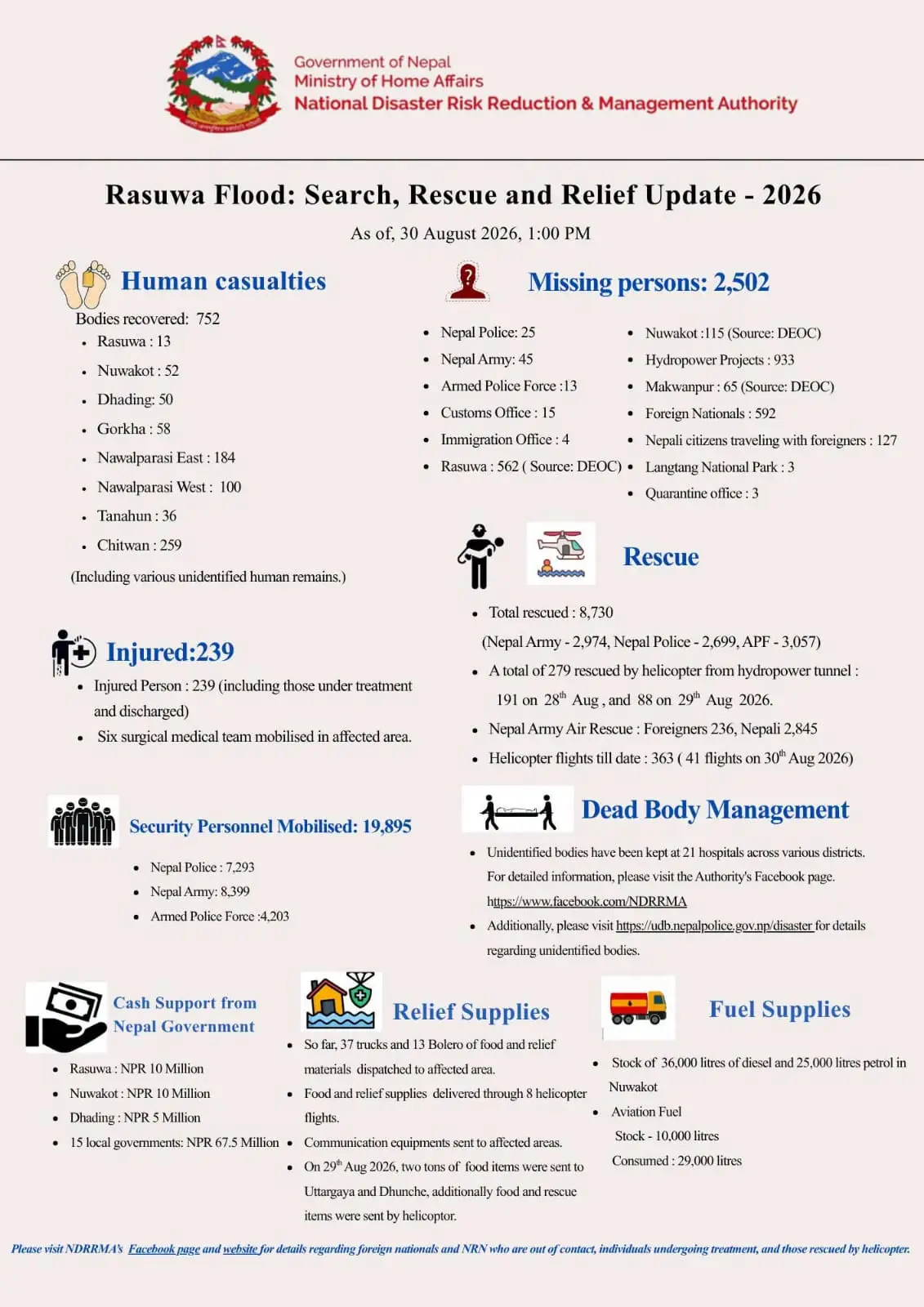
Nepal’s disaster authority lists 933 hydropower workers among the missing, along with 517 foreigners, including trekkers and pilgrims travelling towards Mount Kailash.
The Isha Foundation said 80 members were on a pilgrimage in the region. It said there were no encouraging indications of survivors at the immigration office area.
International aid pours in
The scale of the destruction has triggered a major international relief effort. The United States and Canada have each pledged $3.6 million, while Britain has offered $6.8 million. The UN has released $2.5 million in emergency funding.
Nepal’s Foreign Minister Shisir Khanal warned that rebuilding could cost “billions of dollars” and called for specialised equipment, including heavy-lift drones and technology to locate people trapped underground.
Fresh flood threat
The disaster has also raised fears of further flooding from lakes formed by the deluge.
In Tibet, rescue operations were temporarily halted around Gyirong over concerns that a newly formed lake could overflow. Chinese state broadcaster CCTV later said the lake was “discharging naturally” and had been “essentially drained”.
Meanwhile, Indian officials said seven bodies believed to be flood victims had been recovered from rivers flowing from Nepal.
Figures released by Nepalese officials and Chinese authorities overseeing Tibet put the total number of missing people at 3,048, with 768 confirmed deaths. Nepal reported that 2,502 people, including 592 foreign nationals, remain out of contact in the country. The death toll there rose to 752 as of Sunday.
Tibet, an autonomous region of China, remained largely inaccessible to foreign journalists, making it difficult to independently assess the full scale of the disaster. China’s state broadcaster CCTV reported on Sunday that 546 people were missing and 16 had died. Of those reported missing in Tibet, 261 were foreign nationals, according to CCTV.
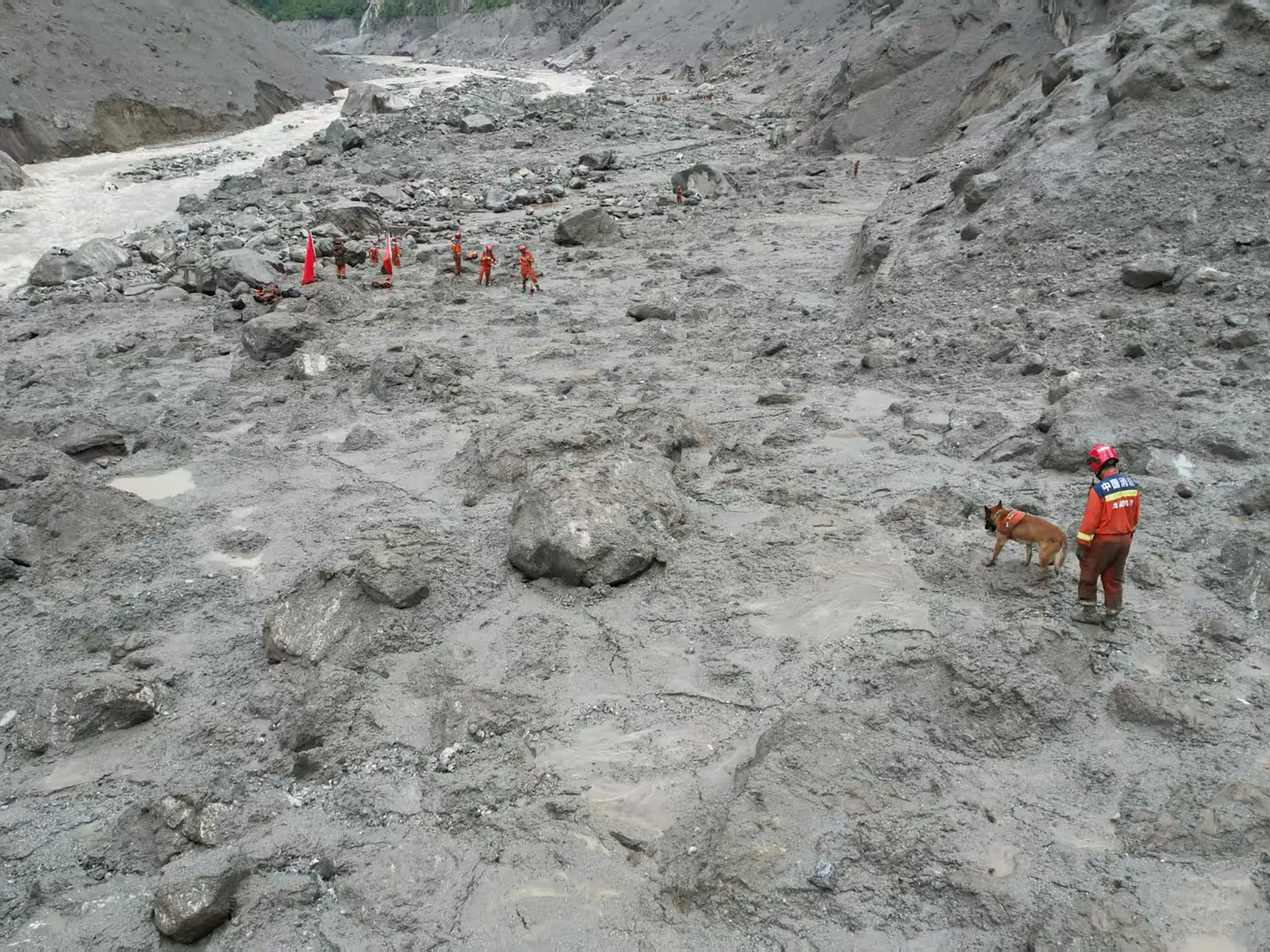
Nepali rescuers resumed a desperate search on Sunday for hydropower workers believed to be trapped inside tunnels buried under flood debris, as difficult weather and swollen rivers continued to hamper operations. The disaster’s death toll has climbed to 750, while more than 3,000 people remain missing in Nepal and Tibet.
India's Ministry of External Affairs spokesperson Randhir Jaiswal said in a statement that the Indian forensic team has been deployed to Nepal to help their counterparts in identifying flash flood victims. “Ambassador Naveen Srivastava met members of the Indian Forensic Team deployed to Nepal. The team will work alongside their Nepali counterparts in analysing DNA samples to assist in identifying the mortal remains of the victims of the recent flash floods,” he said.
A brief 20-minute halt at a Buddhist temple ended up saving their lives—a realisation that left a 31-member group of Keralites in tears and disbelief as they returned safely to the state on Sunday, having been stuck in Nepal amid the devastating flash floods. "Around 20-25 minutes we spent at a Buddha temple at the request of the women in our group helped save us from the tragedy," one of the men told news agency PTI. "But for the delay, we would have been crossing the bridge and road when they were completely washed away," he said, recalling the narrow escape.
The water levels in the Bhotekoshi River has rose again on Sunday, days after a devastating flash flood hit Nepal killing nearly 600 people. Authorities urged residents and rescue personnel in flood-hit districts to remain alert. In a statement, the National Disaster Risk Reduction and Management Authority (NDRRMA) warned that water levels in the river had risen again.
The burial pits are being dug to a depth of 1.5 metres to ensure the bodies can be easily exhumed later. A 40-centimetre gap has been maintained between them to ensure that only the specific body identified via DNA matching can be retrieved.
At an army base in the Nepali town of Bidur, a key rescue hub, relatives crowded around lists of rescued people pasted on a wall.
"I have come here looking for my son," said Kalka Sharda, scanning the list in desperation. "He was a labourer at the hydropower plant, but I can't find his name, and the authorities are not saying anything."
Devastating floods near the border with China killed at least 734 people in Nepal and 2,498 remain missing, its disaster authority said Sunday, as rescue efforts entered a fifth day.
Chinese state media had earlier confirmed 16 dead in Tibet and 546 people missing following Wednesday's disaster.
That takes the overall toll to 750 dead and 3,044 missing.
Nepali rescuers seeking to reach hydropower workers believed trapped in tunnels swamped by flood debris were hampered Sunday by heavy overnight rain and rising river waters.
Nepal's government says more than 100 workers may still be alive and trapped inside multiple tunnels at hydropower projects, with key rescue efforts focused on the Trishuli 3A and 3B sites.
Nepal warned Sunday of rising flood waters and urged rescue teams to exercise caution, as efforts to retrieve victims from areas devastated by a deadly torrent of icy debris and water entered a fifth day.
"We have received information that the flood flow in the Bhotekoshi River in Rasuwa has increased further," the National Disaster Risk Reduction and Management Authority (NDRRMA)said in a warning issued at 7:20 am (0135 GMT).
"Therefore, all personnel engaged in search, rescue, and relief operations, those in riverside areas, and everyone else in affected areas including Rasuwa, Nuwakot, Dhading, and Chitwan are requested to exercise caution."
China said the death toll from a mudslide that struck Tibet rose to 16 and 546 people were still missing, state media reported Sunday, citing local officials.
A devastating, tsunami-like wall of water tore through the border region between Nepal and Tibet this week, sweeping away entire villages.
Figures from Nepal and from Chinese authorities in charge of Tibet put the total number of missing close to 3,000, with 691 bodies recovered.
The United States said Saturday it was providing $3.6 million in humanitarian aid to Nepal following catastrophic flooding that killed hundreds and left close to 3,000 missing.
"The United States is standing with the people of Nepal by providing more than $3.6 million worth of life-saving humanitarian assistance, including up to three months of emergency food assistance to up to 10,000 flood-affected households," the State Department said in a post on X.
Nepali army rescuers broke through to a hydropower tunnel on Saturday and began pumping air and sending a camera inside, raising hopes of reaching workers trapped since devastating floods struck the site three days earlier.
Nepal's government says more than 100 workers may still be alive and trapped inside tunnels at hydropower projects, with rescue efforts focused on the Trishuli 3A and 3B sites.
Those trapped are among 933 hydropower workers missing since a wall of mud and debris swept down on Wednesday morning, according to the National Disaster Risk Reduction and Management Authority.

