&imwidth=800&imheight=600&format=webp&quality=medium "The last time Iran buried a Supreme Leader, it descended into chaos")
As Iran's leaders, senior military commanders and thousands of Iranian people paid tribute to the slain Ayatollah Ali Khamenei and his family, the political message was abundantly clear, either from the huge crowd or from the presence of an international delegation or from the timing coinciding with the 250th US Independence Day, Iran remains defiant and its political elites remain united against the unilateral US and Israeli aggressions. His coffin was draped with the flag of the Islamic Republic of Iran and a signature black turban. Among the coffins there was a tiny one which belonged to Zahra Mohammadi Golpayegani, the 14-month-old granddaughter of Iran's late Supreme Leader, which became a poignant and widely shared image of the state-funded funeral. Visitors beat their chests, shed tears, and sought retribution in a trans like state of collective effervescence. Chants echoed of “death to Israel” and “death to America” in the backdrop of the war that reshaped the country in recent months.
Also Read: PM Modi congratulates Trump, Americans on 250th US Independence Day, hails India-US partnership
What happened when Iran buried Supreme Leader Ayatollah Ruhollah Khomeini

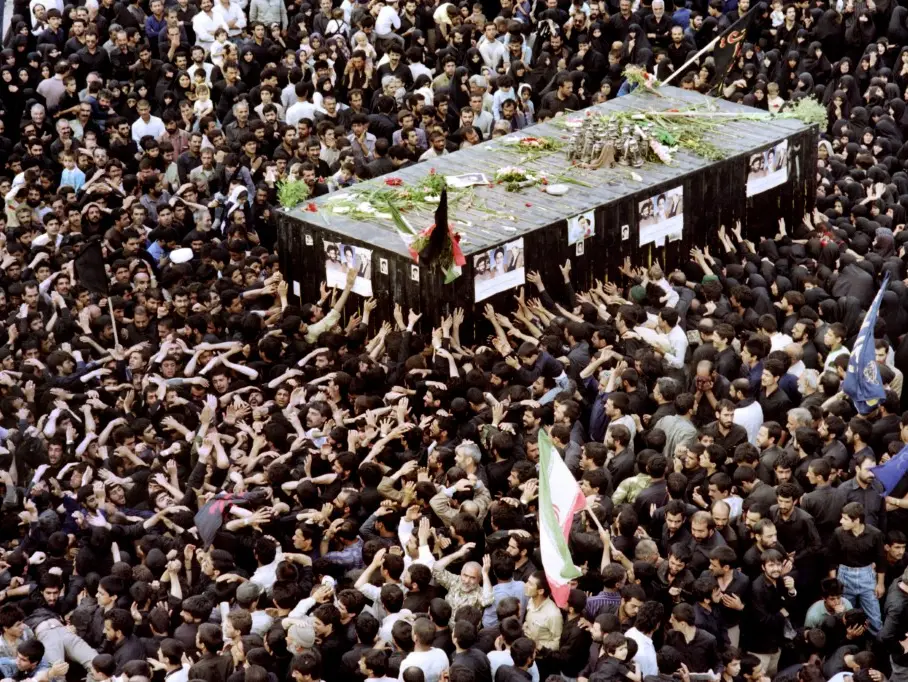
Only once in history had Iran buried their Supreme Leader. It was Ayatollah Ruhollah Khomeini, the revolutionary cleric of the Islamic Republic of Iran. It was chaotic on June 6, 1989; millions of people poured into the streets of Tehran amid the heat, desperate to touch Khomeini's funeral shroud. It was a massive crowd, unlike anything seen since the Islamic Revolution of 1979, almost entirely in black, the women wrapped in chadors. The Ayatollah was being buried with millions of “martyrs” of the Islamic Revolution and the following eight-year war with Iraq. It was a day of pandemonium; the Iranian government portrayed that frenzy as how much he was admired, as it was merely his audio tapes that stirred up a revolution against an unpopular monarchy and toppled it.
The emotion rapidly grew into hysteria; there were doubts about the possibility of burying the Shiite Muslim leader, pushing through the massive sea of the crowd. Before the day was over, Khomeini's casket was pulled over by mourners, and parts of the shroud were ripped off; the wooden coffin was broken. His body was exposed, and his legs were sticking out of the shroud. The soldiers had to fire warning shots to pull the coffin away from the intense emotional contagion of the crowd. A stampede ensued, killing at least eight people and injuring some 11,000 others. At one point, Iranian state television announced that the burial of Ayatollah, who died on Saturday, was postponed till Wednesday. Security forces were forced to evacuate the body using a helicopter and lift it back to his residence. Workers re-wrapped the body in a new shroud and placed it into a heavy, secure steel container. Millions of people stayed on the streets of Behesht-e Zahra cemetery in the intense heat. The whole process took roughly six to seven hours, during which it was flown away for at least five hours. The helicopter returned the following afternoon, and Revolutionary Guards formed a tight human shield as they quickly pushed the steel casket into the grave and covered it with concrete slabs.