Explained: International Court of Justice and its role in the Israel-Palestine conflict

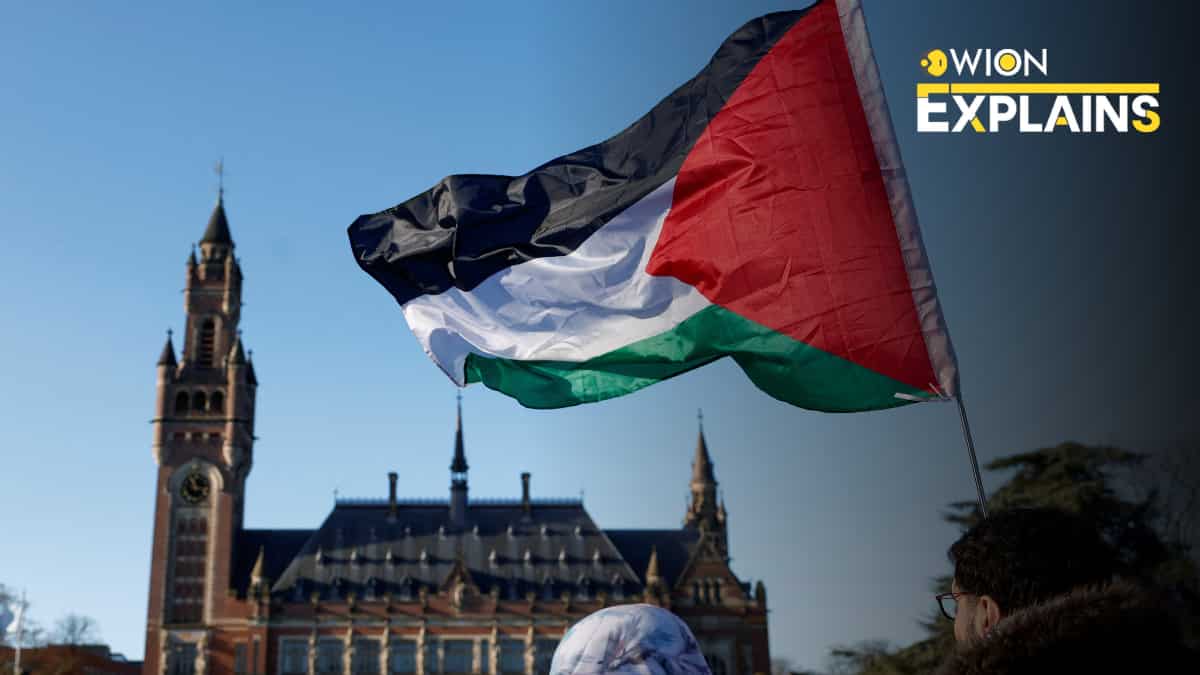
International Court of Justice
Palestinians are subjected to "colonialism and apartheid" under Israeli rule, their foreign minister Riyad Al-Maliki told the International Court of Justice (ICJ) on Monday (Feb 19). Maliki asked the World Court to impose an immediate and unconditional end to Israel's occupation.
"The Palestinians have endured colonialism and apartheid... There are those who are enraged by these words. They should be enraged by the reality we are suffering," Al-Maliki said.
What is ICJ?
It is the only international court that adjudicates general disputes between nations. ICJ consists of a panel of 15 judges who give advisory opinions on international legal issues. The judges are elected by the UN General Assembly (UNGA) and Security Council for nine-year terms. It is one of the six organs of the United Nations and was established in 1945 and is based in The Hague, Netherlands.
People often get confused between the ICJ and the International Criminal Court (ICC). Both are different as the ICC probes and punishes people for genocide, crimes against humanity, and war crimes.
The international court is holding hearings on the legal implications of Israel's occupation since 1967, with an unprecedented 52 countries, the United States and Russiaexpected to give evidence through February 26. The UNGA sought an advisory or non-binding, opinion on the occupation in 2022. Israel submitted a contribution dated July 24, 2023, and will not participate in the hearings.
The UNGA has asked the ICJ to consider two questions. Firstly, the court should examine the legal consequences of "the ongoing violation by Israel of the right of the Palestinian people to self-determination". Secondly, the ICJ should advise on how Israel's actions "affect the legal status of the occupation" and what are the consequences for the UN and other countries.
This is not the first time the UNGA asked the ICJ for an advisory opinion related to the region. In July 2004, ICJ found that Israel's separation wall in the West Bank violated international law and should be dismantled. However, it still stands to this day. While reacting to the probe, Israel once said the "prejudicial" and "tendentious" questions "represent a clear distortion of the history and present reality of the Israeli-Palestinian conflict."
Notably, these hearings are separate from a high-profile case brought by South Africa alleging that Israel is committing genocidal acts during its current Gaza offensive.
What did the Palestinians say?
Riad Mansour, who is the Palestinian representative to the UN, said in a speech: "We call on you to confirm that Israel's presence in the occupied Palestinian territory is illegal."
"A finding from this distinguished court...would contribute to bringing (occupation) to an immediate end, paving a way to a just and lasting peace. A future in which no Palestinians and no Israelis are killed. A future in which two states live side by side in peace and security," he added.
Israeli occupation and its history
David Ben-Gurion, the head of the Jewish Agency, proclaimed the establishment of the State of Israel on May 14, 1948, which was recognised by then-US President Harry S Truman on the same day.
The US on November 29, 1947, voted to partition British Mandatory Palestine into separate Jewish and Arab states, but the move was rejected by the Arab states. Their conflict led to a war with Israel after its creation.
During the eight-month-long war, Israel expanded its territory allotted to it by the UN as more than 760,000 Palestinians fled. Jordan occupied the West Bank including east Jerusalem, while Egypt took the coastal Gaza Strip.
Israel captured the West Bank, Gaza and East Jerusalem in a war in 1967 and has since built settlements in the West Bank and steadily expanded them. But the Palestinians want both regions for a state.
Watch:Israel government formally rejects recognition of Palestinian State
Meanwhile, Israeli leaders have argued that the territories are formally occupied on the basis that they were captured from Jordan and Egypt during a war rather than from a sovereign Palestine. In fact, recently also, the Israeli government formally rejected the recognition of a Palestinian state.
Since 1967, the UN has referred to the disputed territories as occupied by Israel. The world body also demanded that Israeli forces withdraw, saying it is the only way to secure peace. Notably, the occupation wasn't labelled specifically as illegal in the UN's resolution in 1967.
ICJ ruling's impact on the ongoing Israel-Hamas war
Analysts believe that the outcome in favour of Palestinians might put some political pressure on the war in Gaza, which has killed about 29,000 Palestinians, according to Gaza health officials. The war started after Hamas militants launched unprecedented attacks in Israel on October 7, which led to retaliatory action by the Israeli government.
So far in the past, Israel has ignored legal opinions and it claims that it faces an existential threat by Hamas militants and other groups and is acting in self-defence.
But one must also consider the fact that the ICJ's judgements are binding although it has little means to enforce them. However, in this case, the opinion it issues will be non-binding although most advisory opinions are acted upon.
(With inputs from agencies)