European Commission's president-elect faces final vote

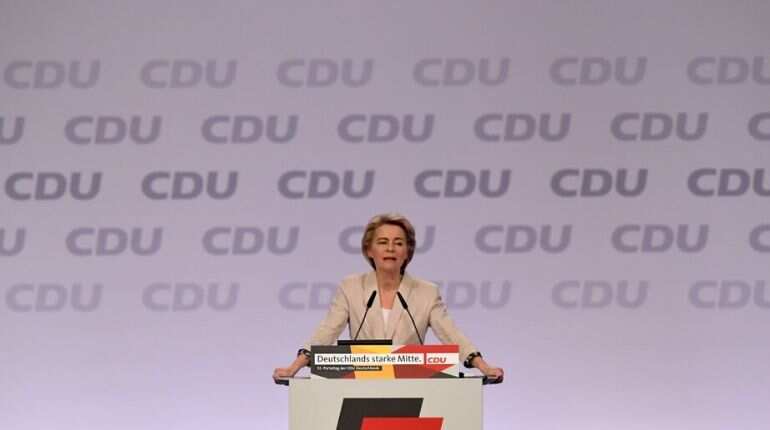
European Commission president-elect
Brussels' next top official Ursula von der Leyen presents her topteamto the European Parliament on Wednesday, hoping to finally put a difficult transition behind her.
Theincomingpresident of the European Commission had hoped to take office a month ago but was thwarted by wrangling over the membership of her executiveteam.
The former German defence ministerfacesa daunting brief when her mandate starts on December 1, with theEUat loggerheads with Washington over trade, climate and Iran, while it grapples with a sluggish economy and frets about Russia.
The 61-year-old, a veteran from Chancellor Angela Merkel's centre-right CDU party, also has to contend with growing divisions between her old boss and French President Emmanuel Macron as theEU's vaunted "Franco-German motor" misfires.
But first, she must convince MEPs in Strasbourg to give their backing to ateamdrawn from each of 27 member states, all of them bar Britain, which plans to leave the bloc.
Her own appointment to succeed Jean-Claude Juncker as head of the commission was approved in July with only nine votes more than she needed, a narrow margin inEUpolitics.
Three of her initial nominees to the commission were rejected during the parliamentary confirmation process, an unprecedented snub, weakening her authority from the outset.
Nevertheless,EUdiplomats and parliamentary leaders are cautiously optimistic she will clear Wednesday's hurdle, a publicvoteof MEPs at 12:30 pm.
"We will be united in our support for the commission," vowed Manfred Weber, head of the parliament's centre-right EPP bloc and himself a disappointed former presidential hopeful.
Weber was one of a small group of so-called "Spitzenkandidats" or lead candidates representing party blocs that MEPs had hoped would provide the eventual commission leader.
ButEUmember state leaders, spearheaded by Macron, overturned this experiment in a parliamentary democracy and imposed an outside choice.
Thevoteto confirm Von der Leyen was conducted by secret ballot, allowing many MEPs tovoteagainst her in protest at theEUleaders' political tactics.
But Wednesday's roll-call to approve the commission as a whole will be conducted openly, helping the main centre-right, social democratic and liberal factions to whip support.
The leader of the Socialists and Democrats group, Iratxe Garcia Perez, noted that pressure from the left had forced von der Leyen to commit to a broad-based political platform.
Brexit cloud
The commission has members from across the political spectrum, and von der Leyen altered plans to name one portfolio "Protecting our European Way of Life",a title seen by many as too close to the rhetoric of the far-right.
Twelve out of 27 of the members will be women, not quite the parity that was promised but the highest number ever in the European Commission.
"We'll have the most progressive commission of recent times, the most equal and its political priorities will include those our group finds essential," Garcia Perez said.
There will nevertheless be opposition. The parliament's eurosceptic, far-left and right-wing populist parties willvoteagainst, and the Greens have said they will abstain.
Five French socialists will also sit on their hands. "We won't sign a blank cheque," declared MEP Raphael Glucksmann.
And there is one more potential cloud hanging over the investiture: the absence of a British commissioner.
Prime Minister Boris Johnson is determined to pull Britain out of theEUon January 31, after Brexit was repeatedly delayed amid wrangling in Westminster over the divorce terms.
But in the meantime he has refused to fill Britain's seat on the commission, citing advice from officials that he cannot make such an appointment during anelectioncampaign.
Some Brussels lawyers are concerned thatEUdirectives may be subject to legal challenge if the commission is not properly constituted with a full 28-member complement.
But von der Leyen'steamhope that their threat to launch a legal challenge to London's decision will prove they made a good faith attempt to follow the treaty.