Dollar steadies after data knocks it off two-year highs

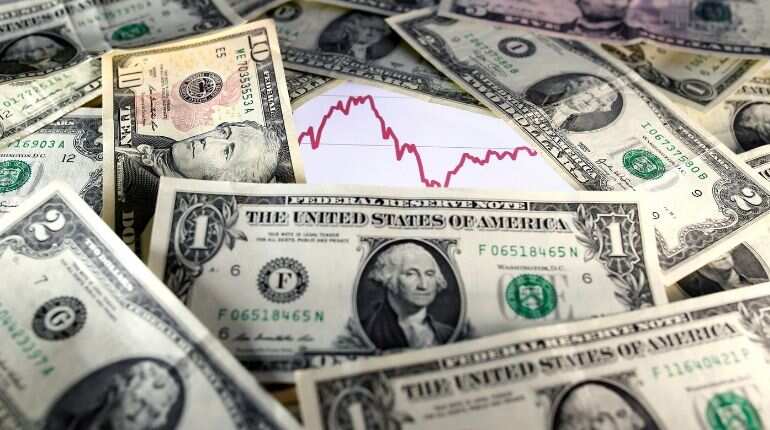
US Dollar notes
The USdollar edged higher on Wednesday after disappointing manufacturing data had whacked the greenback off two-yearhighs, while the euro clung to levels above $1.09.
The USmanufacturing contracted at the fastest pace in more than a decade in September, making the United States the latest country to suffer a manufacturing downturn amid a trade war between Washington and Beijing.
Many analysts, however, say the setback for the dollar will likely prove temporary given its higher yield versus peers and the relative strength of the USeconomy,non-farm payrolls data due on Friday should give some more insight into the health of the USeconomy.
"Yes USmanufacturing is disappointing but it's no more disappointing than the eurozone PMIs (Purchasing Managers' Index surveys) we saw," said Michael Hewson, an analyst at CMC Markets, referring to weak surveys in the euro area released this week.
Hewson said weakness in USmanufacturing would have to spill over into the services sector before it had a significant impact on monetary policy and the outlook for the dollar.
Others differed. The manufacturing reading was a bad omen for September USlabour figures due on Friday, BNY Mellon analysts said in a note since moves are often correlated.
"This reinforces our view that while the Fed is still stubbornly clinging to its view that rates are currently appropriate. It will ultimately have to accept that the pillars of support - the labour market and the consumer - are weakening," the bank said.
Even with more rate cuts, the dollar is still the highest-yielding currency among its developed market peers.
The dollar index inched 0.1 per centhigher to 99.242in early trade after hitting as high as 99.667 on Tuesday, a 29-month peak, before the manufacturing data was released.
The euro fell 0.1 per centto $1.0921but was above its two-year low of $1.0879 touched on Tuesday.
The Japanese yen strengthened 0.2 per centto 107.57, reflecting investor demand for safer assets after the USdata heightened concerns about the health of the global economy.
The Swiss franc, another safe-haven currency, fell, however, by 0.3 per centagainst the euroand 0.4 per centagainst the dollar.
Elsewhere, the Australian dollar struggled around the $0.67mark but remained above its decade-low of $0.6672 hit on Tuesday after the Reserve Bank of Australia cut rates to an all-time low.
The pound sank 0.3 per centagainst the dollar to $1.2271 and was headed back toward an almost one-month low plumbed overnight. Prime Minister Boris Johnson will unveil his final Brexit offer to the European Union on Wednesday and make clear that Britain intends to leave the EU on October31, no matter what.