Briton arrested in Germany for 'spying for Russia'

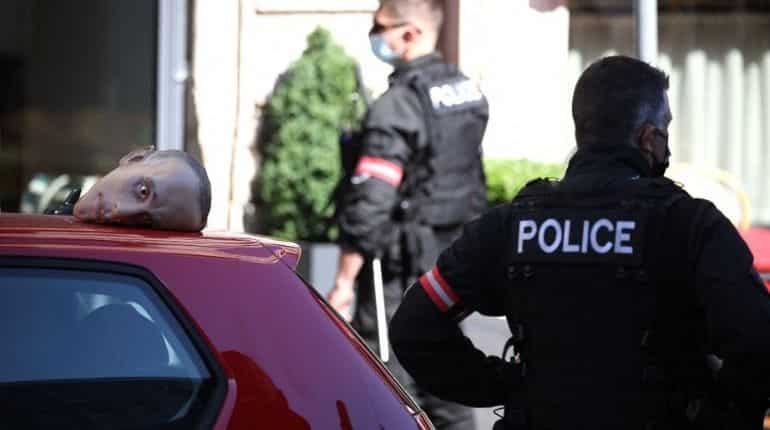
A Swiss police officer stands next to a mask of the Russian President after a protester has been arrested ahead of a Russia - US meeting in Geneva on June 16, 2021. (File Photo)
A British man suspected of spying forRussiain exchange for cash hasbeenarrestedin Germany, prosecutors said Wednesday, in a highly unusual case compared to a Cold War thriller.
Germany hasarresteda number of people in recent years accused of spying forRussia, but the capture of a citizen of a NATO ally is exceedingly rare.
German Foreign Minister Heiko Maas said Berlin was taking the case "extraordinarily seriously" as the "selection by an intelligence service of a close alliance partner is absolutely unacceptable".
The suspect identified only as David S., who worked as local staff at the British embassy, "on at least one occasion passed on documents he acquired as part of his professional activities to a representative of Russian intelligence".
"The accused received a cash payment in an unspecified amount in return," the federal prosecutor's office said in a statement.
It said David S. was detained Tuesday in the eastern city of Potsdam on an arrest warrant issued on August 4. His home and place of work were searched and he wasremanded in custody Wednesday by an investigating judge.
The suspect was believed to havebeenspying since November 2020 "at the latest".
His arrest was the result of a joint operation by German and British authorities. The British foreign office confirmed the arrest of someone "contracted to work for the government" but declined to comment further.
The Metropolitan Police in London said the suspect was a 57-year-old British national and that the investigation was conducted by the Met's Counter Terrorism Command and German counterparts.
It said his alleged offences were related to being engaged in "Intelligence Agent activity" under German law and that the German authorities would retain primacy over the probe.
Like Le Carre
Maas said Germany stood in "full solidarity" with Britain and would provide any assistance necessary to aid the prosecutors' probe.
Security specialist Edward Lucas likened the arrest to an early spy novel by the British writer John le Carre.
"The fact that the arrest hasbeenmade in Berlin suggests it's a non-diplomatic member of the embassy, that's why the German judicial system hasbeenbrought to bear on it," he told Times Radio.
Lucas, who formerly covered eastern and central European affairs for The Economist, said the arrest was "a reminder of how much effort the Russians put in to trying to find out what Western alliances are up to".
In June, German policearresteda Russian scientist at a German university accused of working for the Russian secret service since October 2020 at the latest.
And German prosecutors in February filed espionage charges against a German man suspected of having passed the floor plans of parliament to Russian secret services in 2017.
Moscow is at loggerheads with a number of Western capitals following a Russian troop build-up on Ukraine's borders and a series of espionage scandals.
In June, Italy said it had created a national cybersecurity agency following warnings by Prime Minister Mario Draghi that Europe needs to protect itself from Russian "interference".
The move came after an Italian navy captain was caught red-handed by police selling confidential military documents to a Russian embassy official.
Tit-for-tat expulsions
The leaders of nine eastern European nations in May condemned what they termed Russian "aggressive acts", citing operations in Ukraine and"sabotage" allegedly targeted at the Czech Republic.
Several central and eastern European countries expelled Russian diplomats in solidarity with Prague, butRussiahas branded accusations of its involvement as "absurd" and responded with tit-for-tat expulsions.
The latest espionage case also comes at a time of highly strained relations betweenRussiaand Germany on a number of fronts, including the ongoing detention of Kremlin critic Alexei Navalny, who received treatment in Berlin after near-fatal poisoning.
Relations between London and Moscow havebeenat a low point since the attempted poisoning of former spy Sergei Skripal in British Salisbury in 2018.
The Kremlin has denied any involvement in either case.