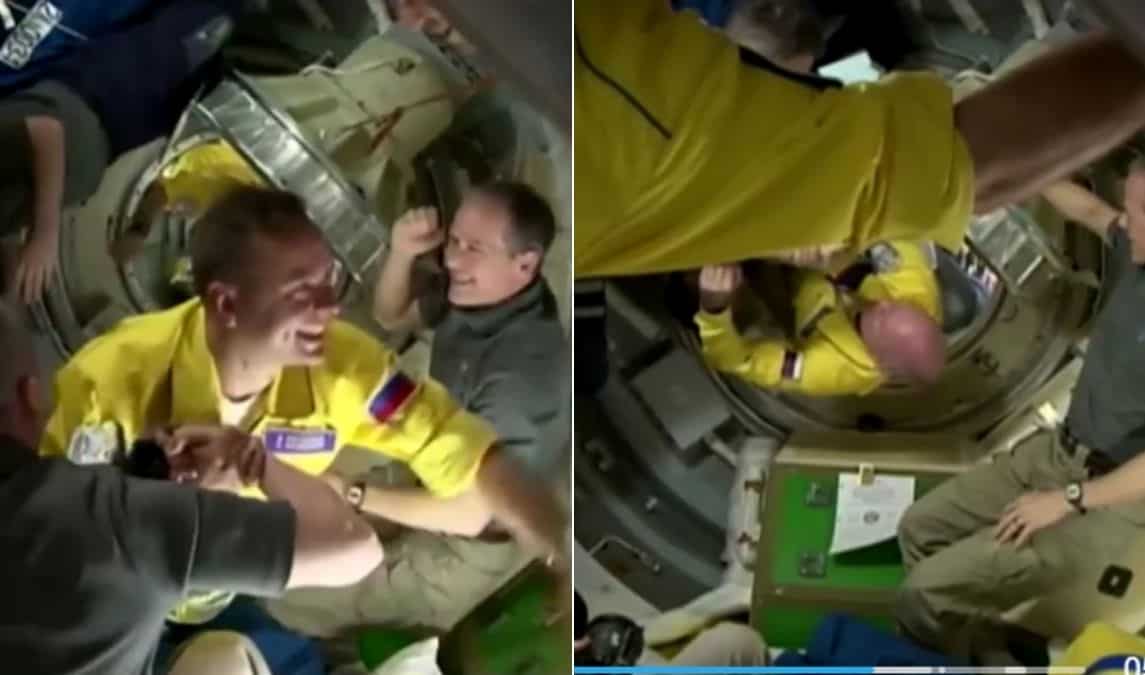
Amid Ukraine crisis, Russian cosmonauts welcomed aboard ISS in yellow and blue - Watch

Russia and US
Donning blue and yellow colours that appeared to match the Ukrainian flag, three Russian cosmonauts safely arrived at the International Space Station (ISS) on Friday (March 18).
The Roscosmāos cosmonaut Oleg Artemyev, Denis Matveev and Sergey Korsakov docked their Soyuz capsule with the outpost for a mission that continues a 20-year shared Russian-US presence in orbit.
However, the ties between the two countries deteriorated since Russian President Vladimir Putin ordered a "military operation" in Ukraine.
IN PICS |'Price of War': These empty strollers represent children killed during Russian invasion of Ukraine
NASA informed that the cosmonauts on the Soyuz MS-21 spacecraft docked to the ISS at 3:12 pm EDT while the station was travelling 260 miles over eastern Kazakhstan.
The trio has joined Expedition 66 Commander Anton Shkaplerov and cosmonaut Pyotr Dubrov of Roscosmos on the station. They also joined NASA astronauts Mark Vande Hei, Raja Chari, Tom Marshburn and Kayla Barron and ESA (European Space Agency) astronaut Matthias Maurer.
NASA further informed that on March 30, a Soyuz spacecraft will return as scheduled carrying NASA astronaut Mark Vande Hei and cosmonauts Pyotr Dubrov and Anton Shkaplerov back to Earth.
Upon their return, Vande Hei will hold the American record for the longest single human spaceflight mission of 355 days.
The US-Russian collaboration in space is being tested by heightened antagonism between the two former Cold War adversaries over Russia's three-week-old invasion of Ukraine.
When US President Joe Biden slapped sanctions on Moscow in the wake of Russia's invasion, it also included the aerospace industry, triggering dark warnings from Rogozin.
"If you block cooperation with us, who will save the ISS from uncontrolled deorbiting and falling on US or European territory?" the Roscosomos head wrote in a tweet last month -- noting that the station doesn't fly over much of Russia.
The ISS, a collaboration among the US, Canada, Japan, the European Space Agency and Russia, is split into two sections: the US Orbital Segment, and the Russian Orbital Segment.
WATCH |Russian cosmonauts arrive at the International space station for 6-month long mission