
&imwidth=800&imheight=600&format=webp&quality=medium "Indian-American astronaut Anil Menon sees auroras from space station, visuals captured from Earth as well")
Auroras lit up high-latitude regions on Earth on August 2 after a coronal mass ejection (CME) slammed into our planet’s magnetosphere around midday. Auroral displays were triggered across northern Scotland, Scandinavia and similar locations. The sun released a huge blast of solar material and magnetic fields a few days ago. Scientists say it was either a slow-moving CME released by the sun on July 27, or a slight blow from a July 30 eruption. It resulted in a geomagnetic storm of G2, or moderate levels.
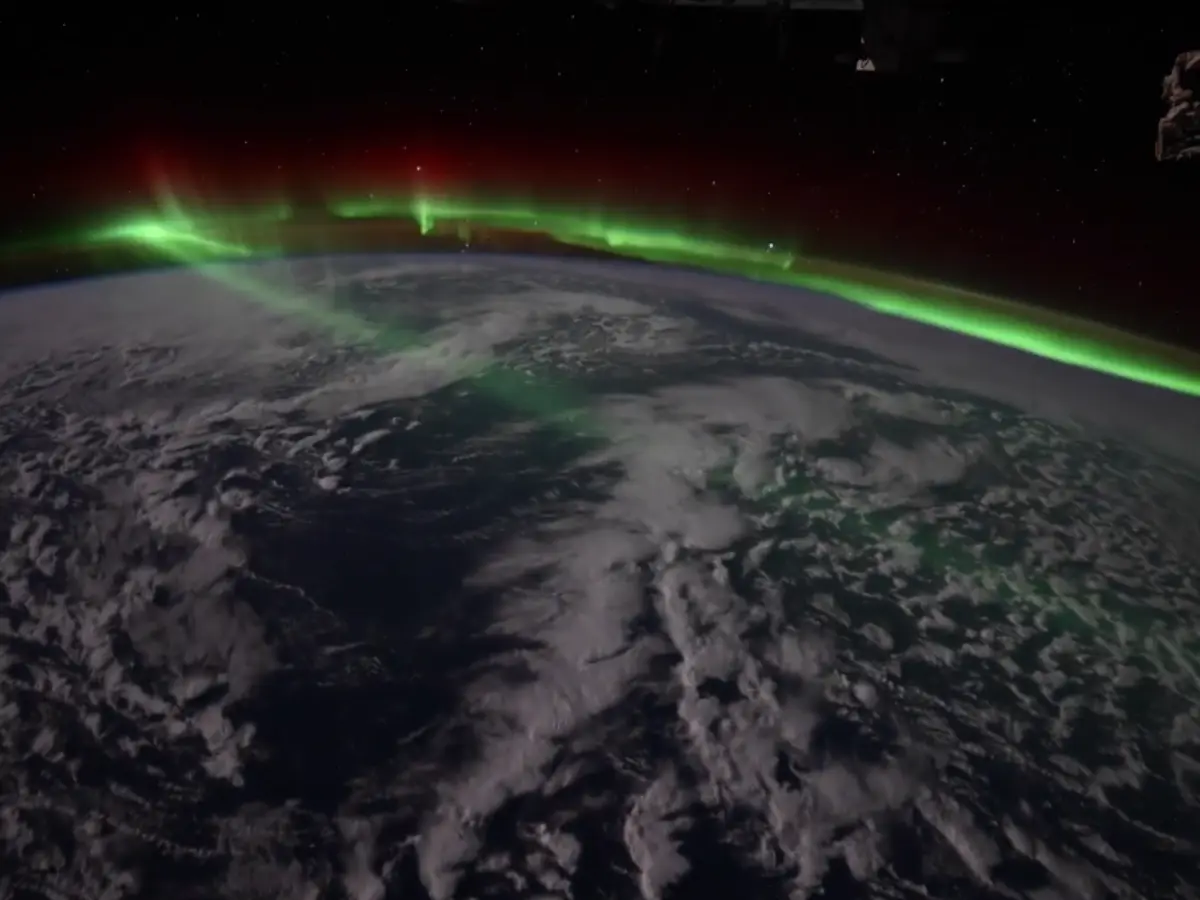
Meanwhile, astronauts on the space station also witnessed the mind-blowing activity from space. Jessica Meir shared a video of the green and red aurora over Earth. She also mentioned that it was "even more special as it was shared with Anil Menon", the Indian-American astronaut in space for the first time. "I‘ll stop posting timelapses of the aurora from the @Space_Station when I’m tired of looking at them . . . so basically never!" she wrote.
Also Read: Who is Anil Menon? Indian-origin NASA astronaut set for July 14 launch on eight month ISS mission

Jessica added, “Another unforgettable display of this ethereal phenomenon as it danced beneath us last night, this one even more special as it was shared with @astro_anil as he witnessed it for the first time with such intensity. The red wavelengths (above the green) were particularly bright in this pass.”
Video of aurora from space station
Yesterday, flare production was recorded at low levels, with 2 C-class and 2 B-class (weak) flares observed during the period, EarthSky reported. NOAA said that the largest flare was a C6.3 on August 2, followed by the strongest flare, which was a C1.3 from sunspot region AR4492 on the same day. On August 3, the sunspot region AR4498 fired a C1.0 flare.
Aurora predictions for August - Where to see auroras
Some predictions state that if the current solar conditions persist, auroras could also become visible much farther from the poles than usual. Meanwhile, satellites, radio communications, and power systems are also expected to take a hit from the solar material. Auroras are also predicted to occur in Edinburgh, Seattle, Toronto, Chicago, and even London and New York.
The solar activity is expected to continue over August 3 - 5. Most likely, there will be C flares, although there is a 20 per cent chance for M-class (moderate) flares as well, with R1–R2, minor–moderate radio blackouts. The chances for X-class (strong) flares remain very low. The sunspots that will be responsible for this activity are AR4498 and AR4499.

