

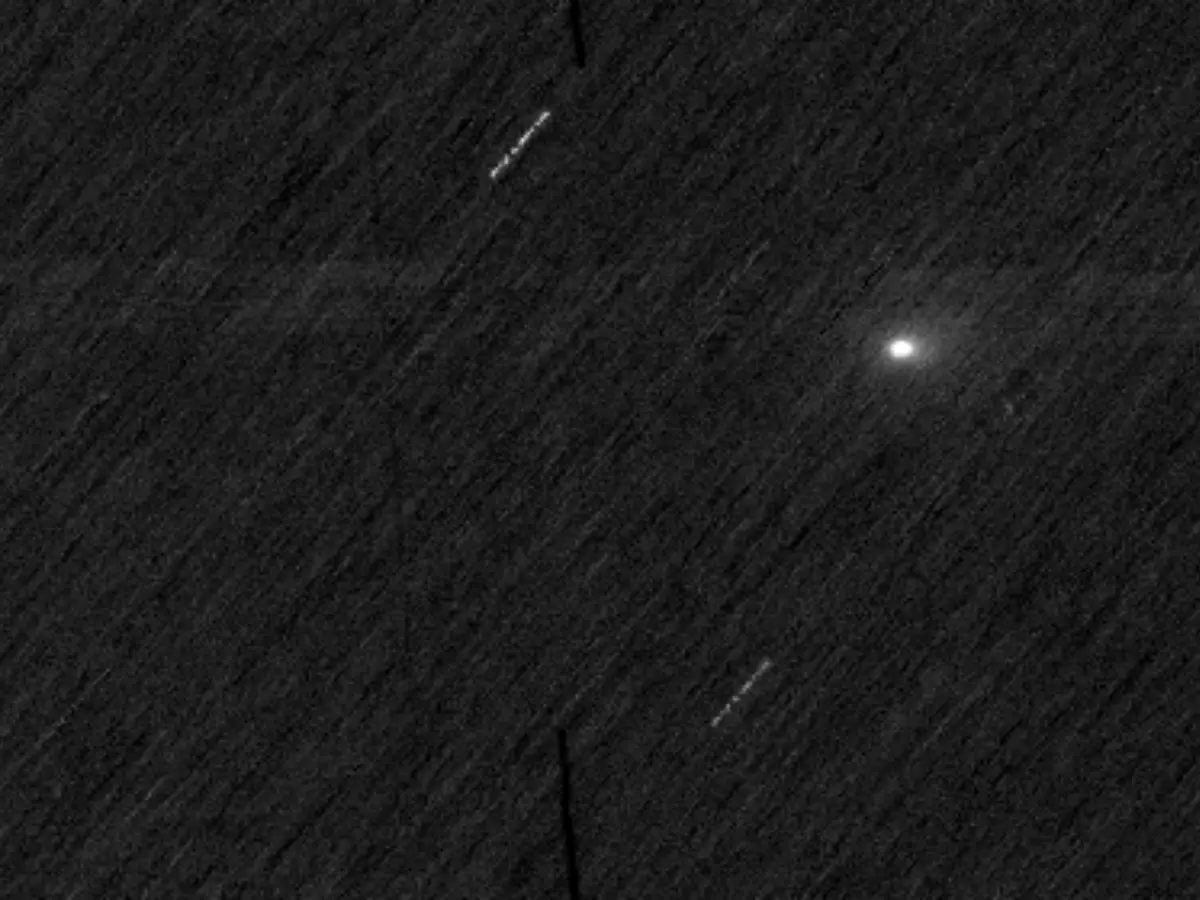
&imwidth=800&imheight=600&format=webp&quality=medium "3I/Atlas photo taken by Mars orbiter: ExoMars (TGO) captures bright coma but no tail")
First photos of interstellar comet 3I/Atlas taken by a Mars orbiter have been released by the European Space Agency (ESA). ExoMars Trace Gas Orbiter (TGO) captured a white ball of light tumbling through space at a distance of 30 million km. Meanwhile, images from the Mars Express spacecraft are still not available, as ESA says it took images "with an exposure time of just 0.5 seconds (the maximum limit for Mars Express) compared to five seconds for ExoMars TGO." The cameras on both the orbiters were turned towards 3I/Atlas between October 1 and 7 to allow them to capture the interstellar object that has been somewhat of a mystery since being discovered on July 1.ExoMars TGO captured the series of images using its Colour and Stereo Surface Imaging System (CaSSIS). ESA said that the "slightly fuzzy white dot moving downwards near the centre of the image" is 3I/Atlas.
Also Read: 3I/Atlas origin and trajectory: Interstellar object could have come from a 'conical disk'
3I/Atlas photo shows a bright coma, but no tail
However, it could not gather a lot of data about it because of it was too far away. ESA said it is just like watching the Moon from Earth using your phone. “This dot is the centre of the comet, comprising its icy-rocky nucleus and its surrounding coma,” the ESA wrote. The image of 3I/Atlas shows a bright coma, as CaSSIS could not distinguish the nucleus from the coma because of the distance. The space agency also said that the nucleus was only about a kilometre wide, as shown in previous observations, and so couldn't be captured by TGO. However, the coma, measuring a few thousand kilometres across, is clearly visible in the photos.
Meanwhile, the cometary tail is absent in the ExoMars Trace Gas Orbiter (TGO) photos, which might again trigger debate about the true nature of 3I/Atlas. ESA said that the photos do not show a tail, which is typically millions of kilometres long as comets move towards the Sun. But in the case of 3I/Atlas, it is much dimmer than the coma. "We can’t see the tail in the CaSSIS images, but it may become more visible in future observations as the comet continues to heat up and release more ice," the ESA said. Nick Thomas, Principal Investigator of the CaSSIS camera, explains, “This was a very challenging observation for the instrument. The comet is around 10,000 to 100,000 times fainter than our usual target.” ESA is still working to process the photos taken by Mars Express.

