

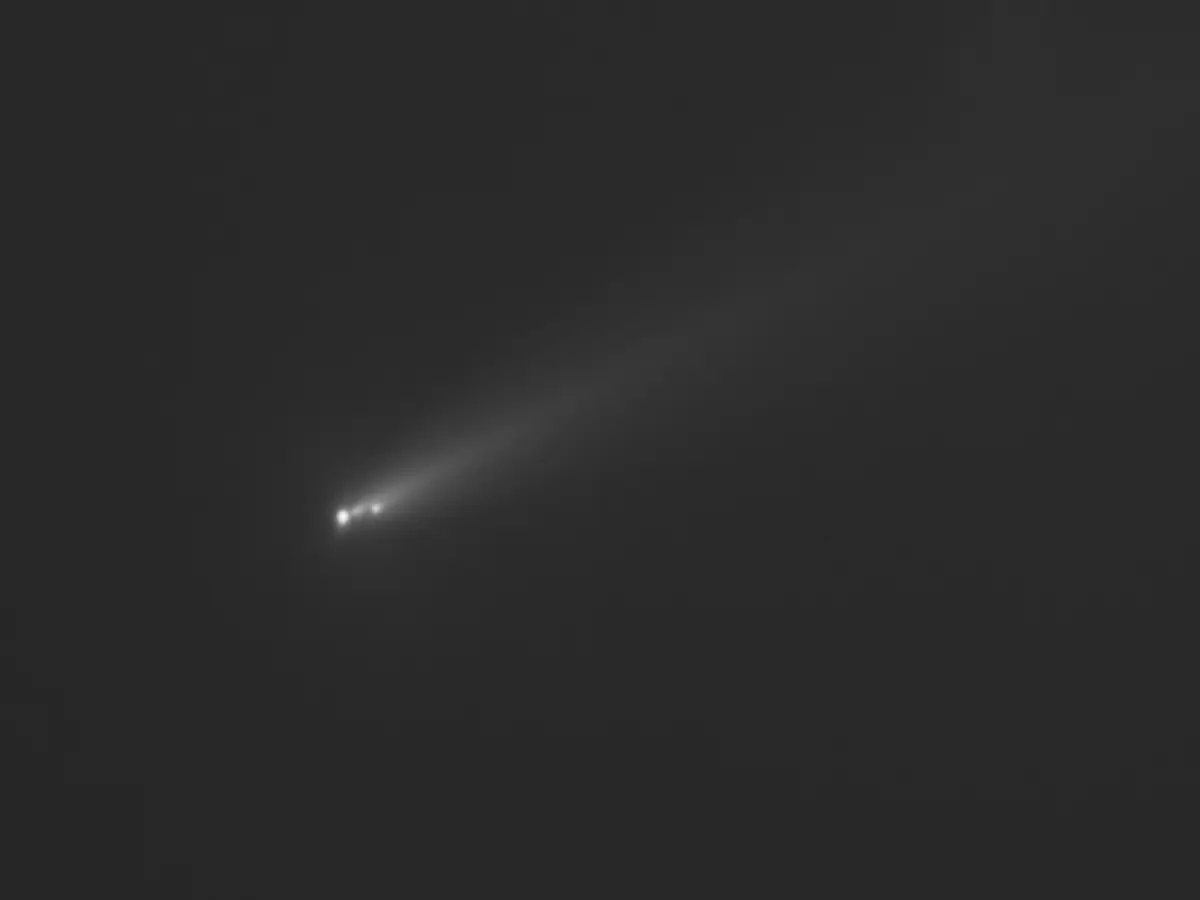
&imwidth=800&imheight=600&format=webp&quality=medium "'Other Atlas', the golden comet, breaks apart as it zooms towards Earth")
Comet C/2025 K1 (ATLAS), dubbed the “other Atlas”, has broken up into several pieces. It was discovered in May by astronomers at the Asteroid Terrestrial-impact Last Alert System (ATLAS) and reached perihelion on October 8. It was expected to be killed by our star, but observations showed that it survived. However, astronomer Gianluca Masi in Manciano, Italy, has now discovered that the comet has fragmented into several pieces. The gravitational force of the Sun stretched it to the limit, breaking it apart while letting it survive. "Several parts (sub-nuclei or clouds of debris) are visible, also a plume just below the leading (the first from the left) fragment," Masi, the founder of The Virtual Telescope Project, shared. It is called the “other Atlas” because right now, C/2025 N1 ATLAS, or 3I/ATLAS, is hogging all the limelight for being only the third interstellar visitor.
C/2025 K1 suddenly brightened around perihelion, changing it colour from green to golden, a rarity for comets. Astrophotographer Dan Bartlett took a photo of the comet from June Lake in California, with a distinct golden glow and a long ribbon-like tail visible. "This comet was not supposed to survive its October 8th perihelion, but it did," he said. It’s not clear why the comet turned golden, but some scientists believe it could be due to the relative lack of carbon-bearing molecules in the comet's coma. C/2025 K1 is now moving towards Earth, and will pass at its closest point on November 25, when it will be 60 million km away. It is expected to lose more matter till then. So we’ll have to wait and watch how it continues to change till then.
C/2025 K1 turns into a golden ribbon
Most comets turn green near the Sun because of either dicarbon or cyanide in their comas. "Devil comet" 12P/Pons-Brooks and C/2022 E3, also known as the "green comet", also had a greenish hue. But the “other Atlas” turned golden, and astronomer David Schleicher says that this could be because it lacks "carbon-bearing molecules, such as dicarbon, carbon monoxide and cyanide." Only two other comets are known to exhibit similar features, he says. However, he said, "we don't know exactly why" since it could have also been caused by the solar flyby or its relatively low ratio of gas to dust.

