Opinion: Modi praises blind cricketers but is India sensitive to the disabled

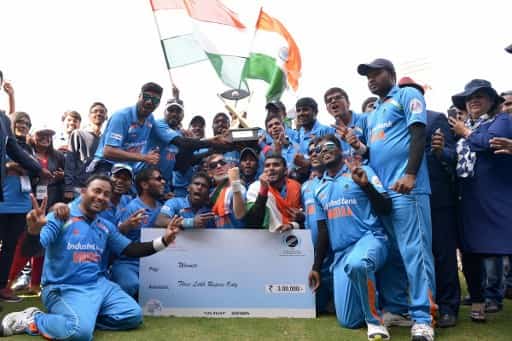
Blind World Cup
If India's public spaces are made more hospitable to people with special needs, it will definitely help to challenge the taboo against physically disabled.
Today, my morning started with a very mixed feeling. It happens to be the National Organ Donation Day, and coming from a family with a large number of Diabetic patients, this day is of crucial importance to me. Diabetes slowly gnaws away one's body, rendering the organs dysfunctional, the skin fragile and itchy, and the muscles languid. When you watch your nearest and dearest ones suffering from kidney failure or losing the eye-sight, you do wish the world was more sympathetic and supportive to the cause of organ donation.
People without a properly functioning organ are akin to physically disabled people. Someone with a dysfunctional kidney is as much helpless as one without eyesight or amputated legs and arms. Thus, closely coupled with this very personal concern for people with disability is a larger anxiety about how we respond to disability in India.
India does not behave well with physically disabled.
India does not behave well with physically disabled; we have little time, patience or empathy for them. Society considers them as a burden and little ones as much as old people suffering from disabilities are subjected to ridicule. Bollywood is no exception. In fact, the tinsel town has added to society's mockery of the disabled by making slapstick comedy scenes in movies, such as Humshakals, Golmaal 2 and Houseful 3.
In a country where diseases are often linked to sins committed in either this life or in the past life, if not by the person concerned then by his/her parents, disability is seen as a bane, a burden. But instead of empowering these people so that they could live a life of independence, our apathy is pushing them further into oblivion and into a dark dungeon of pessimism.
India's prime minister Narendra Modi in his Maan ki Baat speech to the nation has congratulated the Indian blind cricket team for winning the T20 World Cup for the Blind. This is a very fine gesture. For a very long time, we have celebrated the winning performance of our able-bodied male cricketers. The fact that even a team of blind players can make the nation proud, is definitely a game changer. This shows a shift in our attitude to excellence in sports and our ideas about victory.
But simply congratulating the winners who have made India proud at the international arena will not make India more habitable for the physically disabled.
I am hoping that the prime minister did not choose to congratulate the cricket team because it won a thrashing victory against Pakistan. I believe the prime minister chose to celebrate the indomitable spirit of these people rather than one win against India's arch nemesis as he also mentioned, in the same speech, the Indian sportspersons who won medals at the 2016 Rio Paralympics. As a nation of people who are obsessed with their national cricket team led by superman Virat Kohli, this is indeed a welcome break. Though it is too early to tell, this may also mean that with the prime minister making special mention, players from other sports may get a better chance of getting sponsorship, media coverage and improved training opportunities.
But simply congratulating the winners who have made India proud at the international arena will not make India more habitable for the physically disabled. For that, we need a conscious effort, an informed team of policymakers, and commitment on the part of the state as well as the civil society to translate those policies into action.
As a nation, we are not sensitive to the needs of the physically disabled in the public spaces. I know many heart patients who have gone through a heart transplant and are scared to visit the malls. They can't climb steps and would definitely prefer a ramp to walk into the mall. Very few of Indian malls or for that matter almost none of the shopping complexes, comprising of small shops have ramps. Under the circumstance, how will someone with any form of disability be able to perform the normal functions of life? Already challenged by diseases, our callousness is making their lives even more challenging.
Our cinema halls, bus stands, libraries, marts and offices need to cater to the physically disabled.
India desperately needs more disability-friendly public buildings. Our cinema halls, bus stands, libraries, marts and offices need to cater to the physically disabled. I have always wondered why there is not a single toilet in my office that is accessible to people with physical problems. Similarly, our public transports are equally apathetic. Buses in the uses all come equipped with automatic staircases which can come down to the level of the footpath, so that anyone with a disability can get into the bus in the wheelchair. I still remember in one of my cross-country bus journeys in the US, we waited for 3 hours because the stairs got jammed, preventing someone with an amputated leg to get into the bus. The bus did not leave without taking the passenger concerned.
India is getting all these fancy, air-conditioned buses with huge glass windows but none of these are equipped to serve better the physically disabled.
So, as a nation which is fast developing, it will be prudent to not only pay lip-service to the disabled. As we work towards encouraging more people to donate their working organs to those without, we should also strive to make the world more habitable for them. If India's public spaces are made more hospitable to people with special needs, it will definitely help to challenge the taboo against physically handicapped. Far from being a burden to the society, then they will become an asset. Even without being a trailblazer, such a person can be a valuable member of the civil society.