Explained | How Pakistan law which curbs Chief Justice’s powers also impacts former PM Nawaz Sharif’s return

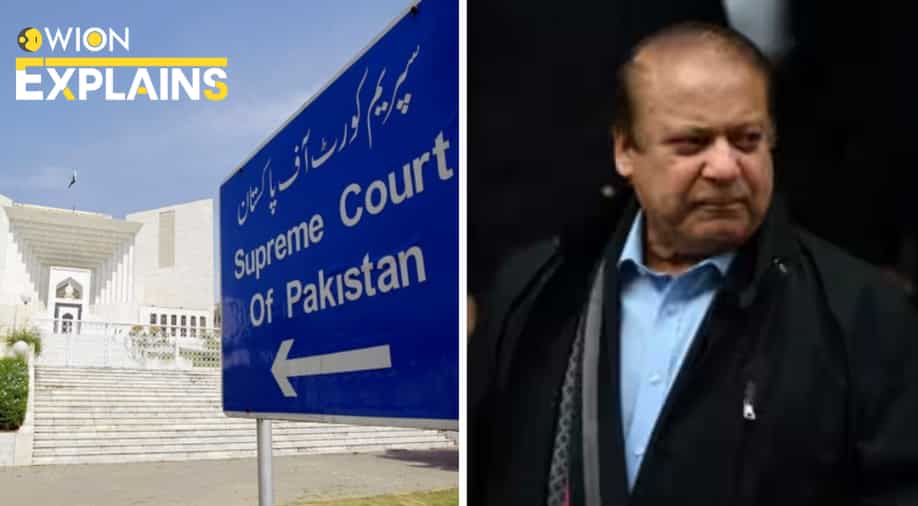
Nawaz Sharif-Pakistan Supreme Court explainer
Earlier this year, Islamabad passed a bill that effectively curtailed discretionary powers of the Chief Justice of Pakistan (CJP) which Prime Minister Shehbaz Sharif and his cabinet members claimed was creating political instability. The contentious bill reportedly became a law amid criticism from former PM Imran Khan and his party Pakistan Tehreek-e-Insaf (PTI).
However, the Pakistan Supreme Court, on Friday (August 11) moved to strike down the Supreme Court (Review of Judgments and Orders) Act, 2023 which expanded the scope of a review petition and termed it “unconstitutional”.
The verdict could throw a wrench into the Pakistan Muslim League-Nawaz (PML-N) and former PM Nawaz Sharif’s plan to return to Islamabad.
What is the law about?
The Supreme Court (Practice and Procedure) Bill, 2023 became a law back in April. According to a report by the Dawn, initially, the bill was approved by the federal cabinet on March 28 and then passed by both houses of parliament – the National Assembly and Senate.
However, despite a Supreme Court order halting the law’s implementation and Pakistan President Arif Alvi refusing to sign it for the second time, the controversial bill took legal effect on April 21 after it technically became an act of the parliament.
The law has effectively brought about three significant changes, one of which is what suo motu cases can be taken up is now decided by a committee consisting of the CJP and two other senior most judges as opposed to only the top justice.
Secondly, benches to hear these cases will also be decided by the committee instead of just the CJP, where any case that involves interpreting the Constitution will not have a bench with fewer than five judges. Lastly, the decisions made in such cases will be open to appeals.
Previously, the suo motu cases were taken up under Article 184(3), where the Supreme Court could take up a case “if it considers that a question of public importance with reference to the enforcement of any of the Fundamental Rights” is involved, and this was directly at the discretion of the CJP.
How is this related to Nawaz Sharif’s comeback?
Speaking in the National Assembly, Pakistan Law Minister Azam Nazeer Tarar, as quoted by the Dawn said, “In the past it has been observed that suo motu notice had been taken on petty matters like lack of parking space outside a hospital, submerging of a street in rainwater, or recovery of a bottle from an accused. Therefore, it is the need of the hour to form a mechanism to ensure transparency.”
He added, “Presently, there is no right of appeal in suo motu cases but in the proposed Bill we have given the right to the accused to file intra-court appeal within 30 days.”
Additionally, another provision says that any application that has pleaded “urgency or seeking interim relief, filed in a cause, appeal or matter,” should be heard within 14 days from the date of its filing.
Therefore, the recently passed bill would have allowed Nawaz Sharif and other parliamentarians disqualified by the Supreme Court under suo motu powers to appeal their disqualification within 30 days of the law’s enactment.
Why were the CJP’s powers curtailed?
One of the immediate triggers that led to the push of passing the bill was said to be the two supreme court judges’ dissenting verdict in a case related to the holding of elections in the Pakistani provinces of Punjab and Khyber Pakhtunkhwa, which slammed the concentrated powers with the CJP.
It also came amid tension between the government and Chief Justice Umar Ata Bandial, who is seen as supportive of PTI chief Imran Khan. The ousted PM has been demanding national elections and earlier this year forced the Election Commission of Pakistan’s (ECP) hand bydissolvingthe provincial assemblies in Punjab and Khyber Pakhtunkhwa.
However, since the commission did not announce an election schedule, President Alvi, a PTI member, unilaterally decided that elections in the two provinces would be held in April, which prompted Bandial to take suo motu notice of the matter and initiate a hearing.
The Supreme Court in a 3-2 verdict directed the ECP to go ahead with elections in Punjab and Khyber Pakhtunkhwa, which led the two dissenting justices to raise opposition to the unlimited authority of the CJP.
Pakistan SC strikes down the legislation
On Friday,a three-member SC bench which included the CJP, struck downthe bill that allowed the right of appeal under Article 184 of the constitution.
The law which was passed on May 5 according to the incumbent government was aimed at “facilitating and strengthening the Supreme Court in exercising its powers to review its judgements and orders,” as quoted by the Dawn.
However, the opposition viewed this move as an attempt to reverse the disqualification of PML-N leader Nawaz Sharif.
The bill essentially expanded the jurisdiction of the court by giving a right to appeal underArticle 184(3) and granted individuals the right to appeal within 30 days of a judgement in suo motu cases.
However, a detailed verdict, a copy of which is available with Dawn, said that the law was “repugnant to and ultra vires the Constitution” while being beyond the legislative competence of Parliament.
“In addition, the 2023 Act does not ‘enlarge’ review jurisdiction, it ‘creates’ a new appellate jurisdiction which has no constitutional basis, sanction or authorisation,” it added.
“It is accordingly struck down as null and void and of no legal effect,” the order said, as quoted by media reports.
Will it affect Nawaz’s return?
The top court’s decision comes a day after outgoing PM Shehbaz Sharif said his elder brother Nawaz would return next month to Pakistan and would lead the PML-N campaign in the upcoming polls.
After the verdict, former law minister Azam Nazeer Tarar told Geo News that the apex court’s verdict would have “no impact” on the cases related to the disqualification of the former PM Nawaz Sharif.
He called the verdict “unfortunate” and said it is not a positive precedent for the courts to repeatedly intervene in parliamentary affairs and issue rulings that compromise its autonomy. When asked if the verdict could cause a delay in Nawaz’s expected return, Tarar said, “Not at all.”
He also went on to refer to an amendment which he described as nearly unanimous legislation that limited the disqualification of lawmakers to a maximum of five years with retrospective effect.
Nawaz and “dozens of others disqualified only in the cases of 184(3) are now, after five years, eligible to take part in elections under Article 232 (disqualification on account of offences) of the Elections Act,” reportedDawn.
(With inputs from agencies)
WATCH WION LIVE HERE
You can now write for wionews.com and be a part of the community. Share your stories and opinions with us here.