Powerful jets from black hole have formed bubbles at centre of Milky Way Galaxy

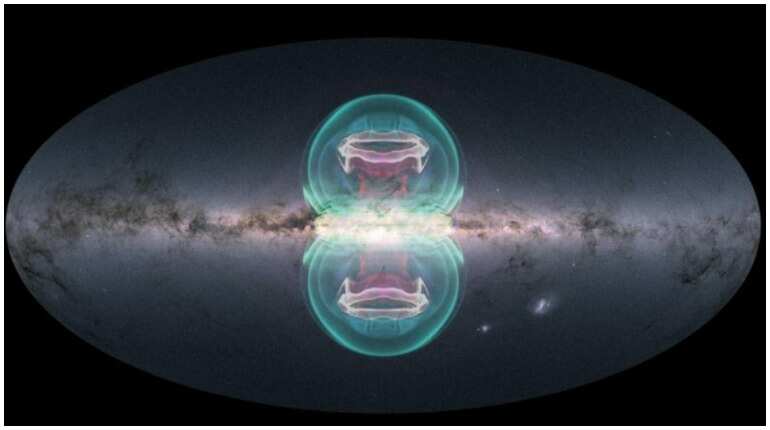
Milky way
We normally associate bubbles with water (or with soap, we know you do!). But bubbles in space? That's a bit of a bouncer for most of us. How can a bubble form in space when there is no air? It seems illogical.
But scientists are trying to explain bubbles originating from our Milky Way Galaxy. These bubbles are bigger than your bathroom. Bigger than Earth for that matter and are originating due to jets of energy emanating from the centre of the galaxy
These bubbles are being formed due to powerful jets originating from a supermassive black hole that is at the centre of our galaxy.
To put things in perspective, the supermassive black hole at the centre of our galaxy is 4 million times more massive than the Sun. It literally holds the entire galaxy together with its gravity.
There are two bubbles of very hot gas emanating form the centre of our galaxy. Black holes gobble up material to the extent that even light cannot escape from it. At the same time, black holes spew out powerful jets of material nearly at the speed of light.
The study about the bubbles says that jets that caused them to formed started spewing out material 2.6 million years ago.
The bubbles are really huge in size. They are 36,000 light-years tall. Study about these bubbles has been carried out by scientists including those from University of Michigan.
Astronomer Mateusz Ruszkowski, a co-author of the study, said, “There are two competing models that explain these bubbles, called Fermi and eRosita bubbles after the telescopes that named them. The first suggests that the outflow is driven by a nuclear starburst, in which a star explodes in a supernova and expels material. The second model, which the team’s findings support, suggests that these outflows are driven by energy thrown out from a supermassive black hole at the center of our galaxy.”
Hw was quoted by Tech Explorist. The study has been published in journal Nature Astronomy.