Mars' 'lumpy' moons suggests existence of ring around it

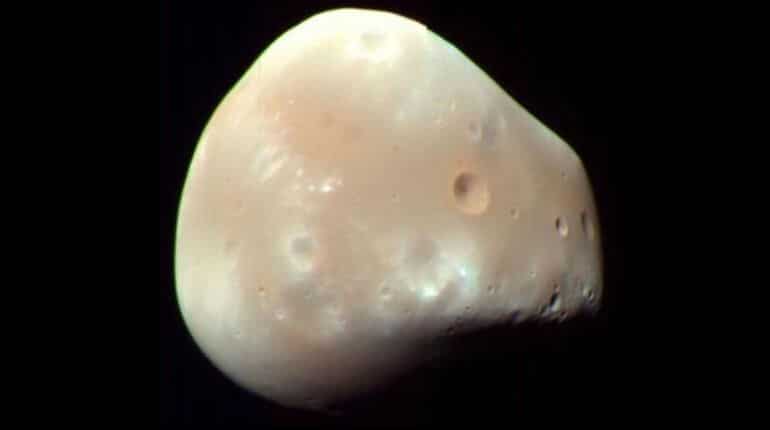
Deimos
Marshas two''lumpy'' moons and their existence suggests that the red planet had ringsaround,like some of the larger planets in our solar system.
The findings werepresentedduring the 236th Meeting of the American Astronomical Society, which is being held virtually this week during the pandemic.
The two lumpy moons, Phobos and Deimos, were both discovered in 1877 and named after the sons of Ares from Greek mythology.
Mars is named after the Roman god of war, which is Ares in Greek. Phobos means fear or panic and Deimos means dread.
Scientists believed that they were asteroids captured by the planet's gravity for a very long time.Both appear to besimilar in composition to blackish carbonaceous chondrite asteroids.
However,the recent research revealed that the moons are nearly in the same plane as the Martian equator. This suggests that they formed around the same time Mars did around 4.5 billion years ago.
Over time, Phoboswill loseheight as it interacts with Martian gravity and eventually, its orbit will be too low and Mars will essentially rip it into pieces that form a ring around the planet. It's estimated that this will happen within 50 million years.
Phobos, slightly larger than Deimos, is only about 3,700 miles above the Martian surface, no known moon in our solar system is closer to its planet.
Being so close, Phobos completes three orbits around Mars in one Earth day, while Deimos, which is more distant, takes about 30 Earth hours to complete an orbit.
The researchers believe that Phobos once had a grandparent 3 billion years ago that they called proto-Phobos — likely 20 times more massive as the small moon is now. Over the course of a few moon-ring cycles, it became Phobos — which would explain why some researchers believe it only formed about 200 million years ago.
A prominent ring around Mars would have pushed proto-Phobos outward, away from the planet. This would have also affected proto-Phobos' orbital resonance with Deimos and pushed it further from Mars as well.
The Japanese space agency, JAXA, plans to send a spacecraft to Phobos in 2024 to collect samples from the surface and return them to Earth. This may reveal more about the moon's past.