Largest twin jets erupt from a black hole, can stretch for 23 million light-years

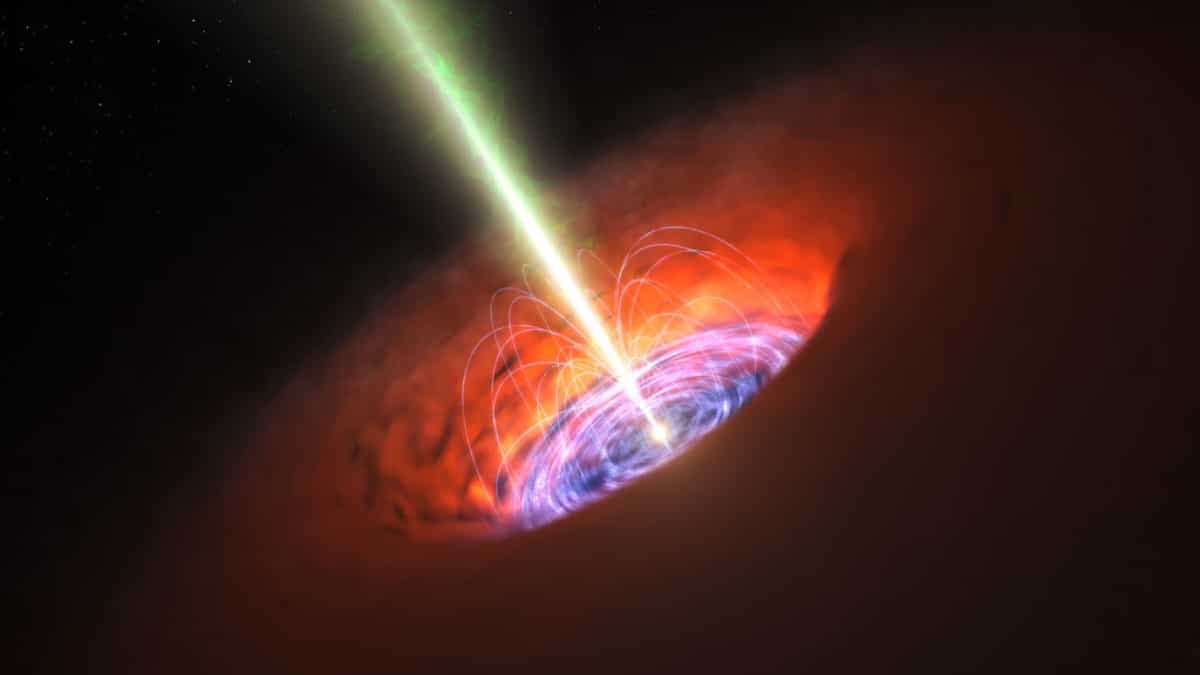
Representational image of Black Holes.
In a stunning discovery, astronomers spotted the eruption of the largest twin jets from a black holethatcan stretch for around 23 million light-years, which is equivalent to lined-up 140Milky Waygalaxies.
The scientists saw the jets erupting from the heart of a supermassive black hole, which is located nearly 7.5 billion light-years away.
The jets which blasted out from the black hole released trillions of times more energy every second compared to our Sun.
"We've known about these structures made by jets from galactic-centresupermassive black holesfor a long time, but this particular one stands out for three reasons," said team member Martin Hardcastle of the University of Hertfordshire, while speaking to Space.com.
Also Read:A 'primordial' black hole will pass through our solar system every 10 years. Will it harm?
"First, it's the largest yet, at over 20 million light years from end to end, which means it goes from the centre of its parent galaxy right out into the void between galaxies and galaxy groups," he added.
"Secondly, it's one of the most powerful we know about, with a fast rate of matter infall onto the black hole. And finally, it is found when the universe was only roughly half of its present age, and is thought to have been a much more violent place with much more going on that could have disrupted the jets," Hardcastle said.
Scientists name the powerful jets 'Porphyrion'
The scientists, along with the team which discovered the megastructure, gave the gigantic jets a suitable mythic name, "Porphyrion," which was borrowed fromGreek mythology.
According to the researchers, such an outflow of jets is likely to have played an important role in theevolution of galaxies in the early universe.
"Astronomers believe thatgalaxies and their central black holes co-evolve, and one key aspect of this is that jets can spread huge amounts of energy that affect the growth of their host galaxies and other galaxies near them," said team member George Djorgovski, professor of astronomy and data science at the California Institute of Technology (Caltech), in a statement.
Watch:Astronomers find a rare black hole that defies current theories
"This discovery shows that their effects can extend much farther out than we thought," he added.
Pophyrion was discovered by scientists using the LOw Frequency ARray (LOFAR) radio telescope.
"Giant jets were known before we started the campaign, but we had no idea that there would turn out to be so many," said Hardcastle.
"Usually, when we get a new observational capability, such as LOFAR's combination of wide field of view and very high sensitivity to extended structures, we find something new, but it was still very exciting to see so many of these objects emerging," he added.
(With inputs from agencies)