India's Chandrayaan-3 is now in space, historic journey to Moon begins

Chandrayaan-3
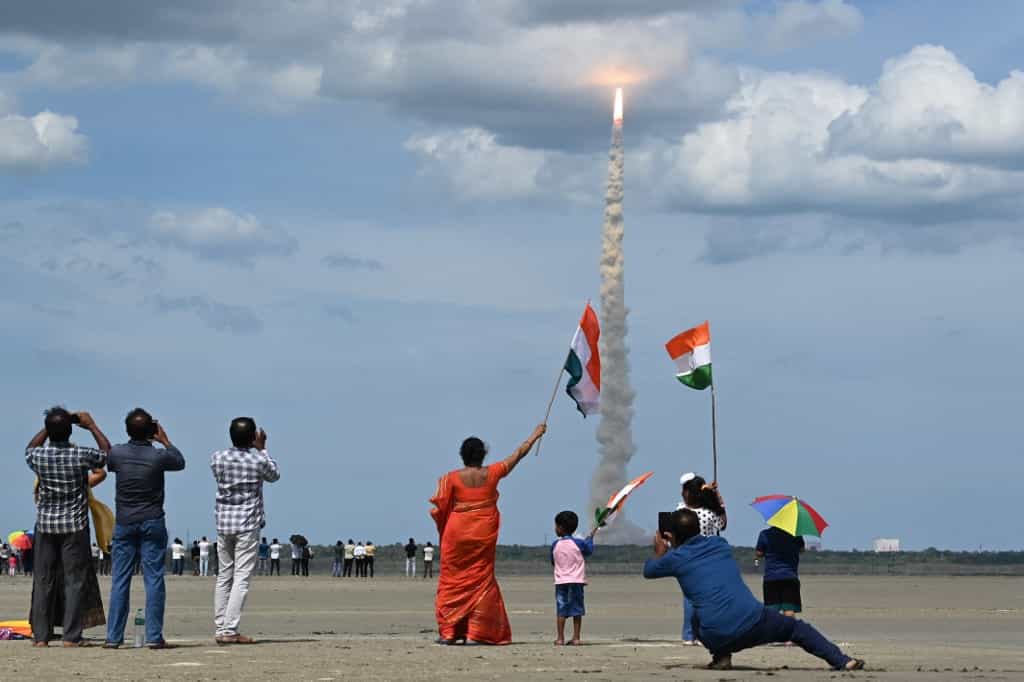
India's largest and heaviest rocket, the 642-tonne LVM3 lifted off majestically amid overcast skies at the Satish Dhawan Space Centre in Sriharikota, Andhra Pradesh. Propelled by 410 tonnes of solid fuel (stored in twin S200 solid boosters), the vehicle took to the skies from the second launchpad and emitted its characteristic engine roar, which was heard in at least a seven-kilometre radius around the launch pad. The LVM3 rocket, which has delivered success in all its missions to date, delivered yet another success by ejecting the Lunar spacecraft into the precise orbit.
The rocket is carrying a 3.9 tonne Lunar spacecraft Chandrayaan-3 to an orbit around the Earth, which measures 170x36,500. This means that the spacecraft is not in an even circular orbit around the Earth. This is a highly-elliptical orbit, where the spacecraft is 170kmabove the earth at its closest approach (perigee) and 36,500kmabove the earth at its farthest approach (apogee).
From this orbit, in a series of orbit-raising manoeuvres, the craft will gradually be flung away from Earth and from the Earth's influence. In a few weeks, it would be captured by the moon's gravity and then attempt to make a lunar soft landing around August 23. The Chandrayaan-3 spacecraft comprises a propulsion module (meant to take the spacecraft into lunar orbit), a Lunar lander named 'Vikram' and a Lunar rover named 'Pragyan'.
The goal is to make a lunar soft landing near the moon's 80 degree latitude (roughly 600 kmaway from the Lunar south pole) on August 23, which marks the start of the Lunar Day and then conduct in-situ experiments using the lander and rover. The in-situ experiments will include the detection of moon quakes, studies of the Lunar atmosphere, and studies of the mineral composition of Lunar rocks and soil, among others.
Chandrayaan 3 successfully launched to the moon | ISRO | Sriharikota
The landing is meant to happen at the start of the Lunar Day, as that will be the period when sunlight is available in the region. Sunlight is crucial to charge the solar panels and batteries on board the lander and rover and help them perform their respective roles.
One lunar day is equal to 14-15 days on Earth. Under ideal conditions, the Vikram lander and Pragyan rover are meant to function for 1 Lunar day. However, ISRO also believes that the rover and lander could survive the Lunar night and revive its activity, once the sun is up.
India's maiden lunar soft landing attempt and second Lunar mission Chandrayaan-2 crash-landed on the moon, in September 2019. Chandrayaan-3 is a mission that hopes to perform what its predecessor couldn't. It must be remembered that the Indian space agency ISRO was formally established in 1969, the same year when NASA's Apollo 11 crew performed the moon landing and moonwalk. ISRO's nascent days saw a humble beginning from a fishing hamlet in Thiruvananthapuram in Kerala, southern India.
Today, ISRO operates more than 50 spacecraft for its national and strategic purposes. ISRO also supports India's neighbouring nations with developing space capability and harnessing its benefits. India is among the few nations in the world with end-to-end space capability - the means to design, develop, build and launch its own rockets and satellites, the capability to guide and communicate with the spacecraft, receive and process their data for useful purposes. India carried out its maiden Lunar orbiting mission Chandrayaan-1 in 2008 and its maiden Mars orbiting mission in 2013.
WATCH WION LIVE HERE
You can now write for wionews.com and be a part of the community. Share your stories and opinions with us here.
