Distant star in death throes reveals itself in James Webb telescope’s stunning image

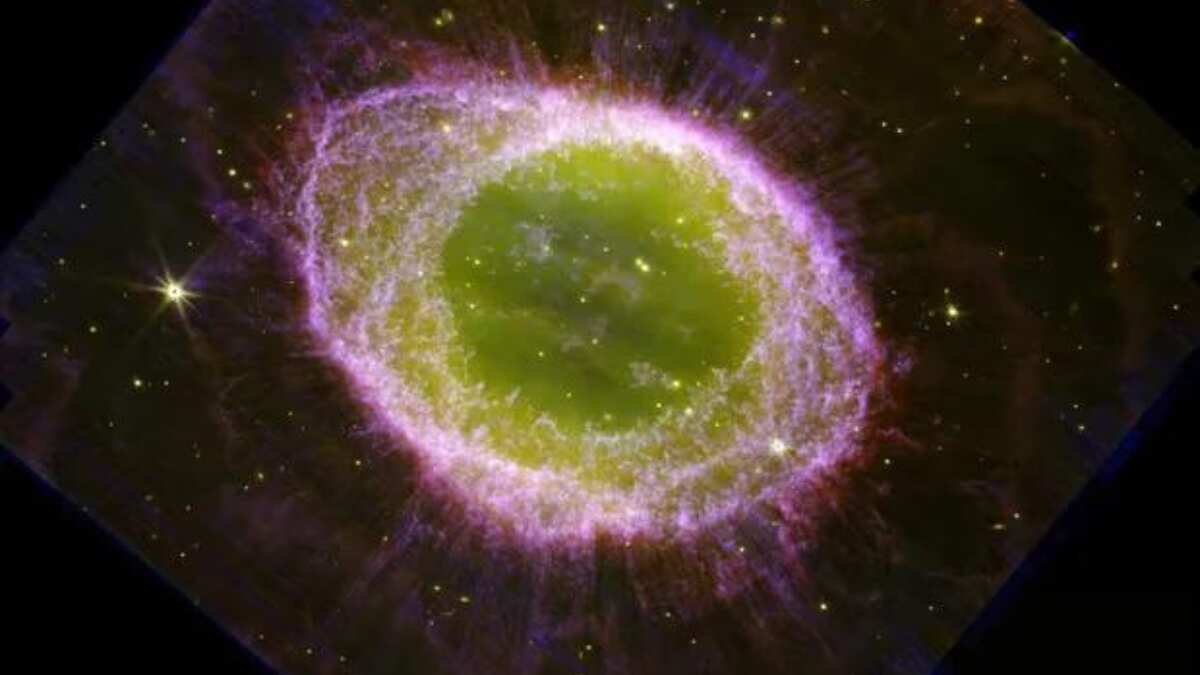
Image of distant star in its last stage as captured by James Webb telescope.
In an exquisitely detailed click, the James Webb space telescope (JWST) captured stunning images of a distant starin its final stages of life.
The snapshot, which was released by an international team of astronomers, reveals the glowing gas’ doughnut-shaped structure called the Ring Nebula, which is a well-known object in the sky and lies approximately 2,600 light years from Earth.
The nebula gets formed when a dying star blasts a large amount of its material into space and produces vivid coloured rings while expanding bubbles and wispy, intricate clouds. The sun awaits a similar fate when it will expire billions of years from now.
In the high-resolution images captured from the near-infrared camera (Nircam) of the telescope, not only the structure of the expanding shell of the nebula is visible, but also the inner region around its central white dwarf, which is a very dense star and as big as a planet, can be seen.
Mysteries of planetary nebulae
The white dwarf although has no relations with planets, such objects are known as ‘planetary nebulae’. The term has been carried forwards from astronomy’s early days when scientists used small telescopes to see these objects, which resembled planets.
As quoted by The Guardian,Prof Michael Barlow, emeritus professor of physics and astronomy at UCL, headed the team, said: "Stars like the sun are expected to end their lives as white dwarfs by ejecting their outer envelopes, which then form beautiful planetary nebulae that are illuminated by the radiation from their very hot pre-white dwarf central stars".
WATCH |NASA re-connects with space probe after losing communication
Chemical elements which emit light at various wavelengths create colourful bands in the nebula. Astronomers, by analysing the images, hope to know more about the complex processes that create nebula structures and discover the life cycles of stars and the elements they release into the cosmos.
“We don’t yet fully understand all the processes that take place during this caterpillar-to-butterfly-like phase,” said Barlow. “The Ring Nebula in Lyra is one of the closest and brightest of these planetary nebulae and is, therefore, an ideal target for JWST to study the small-scale and large-scale processes that work to form the dusty molecular structures that we see in these images,” he added.
You cannow write forwionews.comand be a part of the community. Share your stories and opinions with ushere.
WATCH WION LIVE HERE