Densely populated cities not necessarily prone to coronavirus infections, study finds

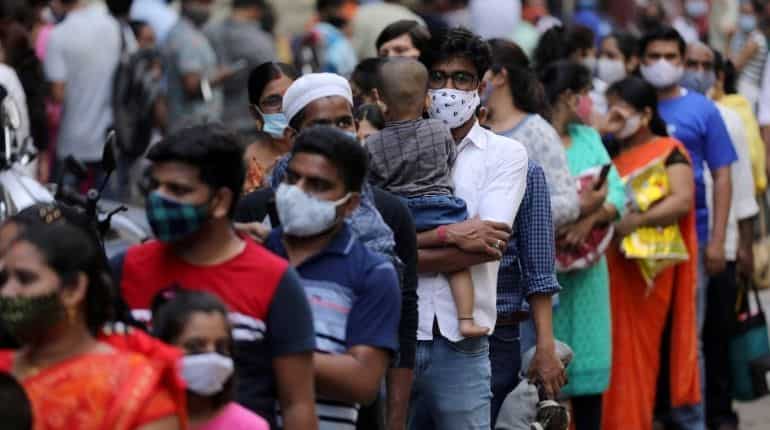
People wait in a line to enter a supermarket amidst the spread of the coronavirus disease (COVID-19) in Mumbai, India
Coronavirus pandemic continues to wreak havoc around the world. In just the last 24 hours, India witnessed its highest ever coronavirus infections at 2,34,692. A new research sheds light on how the virus affects urban areas. For long, it was believed that densely populated cities are hotbeds for infectious transmission.
A new study published in Sustainable Cities and Society suggests that crowded cities are not likely to cause more infections. Researchers took data from a health application in account. They also looked at the details from Tehran, Iran which was once an epicentre of the pandemic.
Researchers found that population density alone cannot be considered a risk factor. Even then, researchers accounted for the difference between “high density” and “overcrowding”. They found that overcrowding posed a bigger risk and continues to getin the way of social distancing.
The researchers added that overcrowding can occur even in districts that have a low density. Owing to this, they ascertained that cities that are densely populated may not be considered a risk factor.
To achieve this, researchers from the Universities of Tehran and Isfahan, along with Hiroshima University in Japan collected data which was recorded by Iran’s COVID-19 tracing application called “AC19”.
Tehran, the city around which the research as modelled has 8.6 million people living in 22 districts. Researchers found that population density played only a minimal role in COVID-19 transmission.
More important factors than population density included age, wealth, healthcare, along with how rigorously people follow protocols.