Christmas constellation? NASA's Hubble Telescope clicks galaxy that appears in festive mood

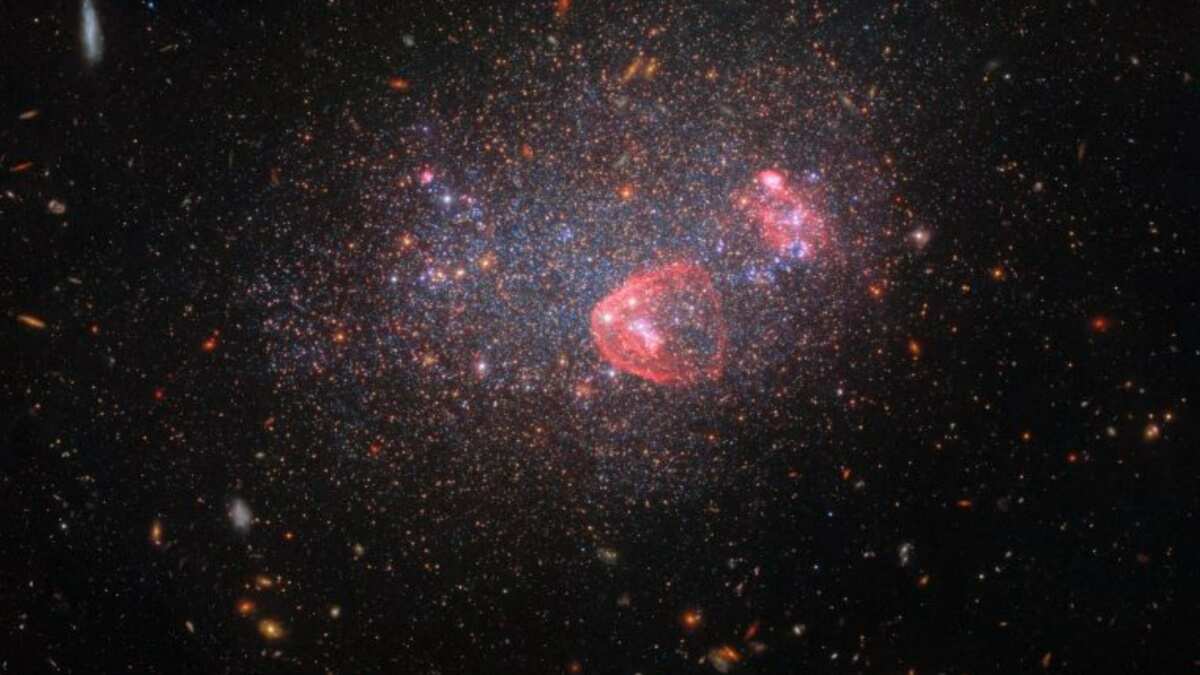
Christmas is just a fewdays away and the colour red has already started making its presence felt everywhere. The merry-making will soon start and NASA's Hubble Space Telescope couldn't have chosen a better time to click a galaxy that looks like apart of a Christmas tree adorned with red-coloured decorations.
If you are tempted to name thisgalaxy something along the lines of 'Christmas constellation', then wait a bit (though it can be a good name). The galaxy has been designated as UGC 8091. The image has been taken by NASA and the European Space Agency (ESA).
It is a dwarf galaxy that contains 1 billion stars. The image shows red and blue coloured stars with two predominantly visible red blobs.
One billion stars may sound a lot, but our Milky Way Galaxy has about 100 times more stars.
Watch | NASA streams an ultra-high-definition video of a cat back to Earth from deep space
UGC 8091 is 7 million light-years away from us in the constellation Virgo. We may imagine galaxies to always have the beautiful spiral form like our Milky Way Galaxy. However, only mature galaxies can normally look like this.
Dwarf galaxies, like UGC 8091, are yet mature. This means that they are still in process of merging with other galaxies and fully unveil their cosmic tapestry. When Milky Way Galaxy was maturing, it merged with other galaxies as well before taking the spectacular form that it has today.
And the tale does not end here. Milky Way Galaxy will merge will Andromeda Galaxy billions of years from now. This would make it lose its spiral form and two galaxies will merge to form a third mega galaxy which will not be a spiral one.
UGC 8091 is on a similar journey but a little behind the Milky Way Galaxy. We can only make predictive guesses as to what path UGC 8091 will take. It may take millions of years for it to change its form. But for now, its sitting pretty in the night sky, unravelling its splendid colours for telescopes as powerful as Hubble.
(With inputs from agencies)