
NASA's Sunita Williams Return Updates: First visuals of astronaut after successful landing of Crew Dragon

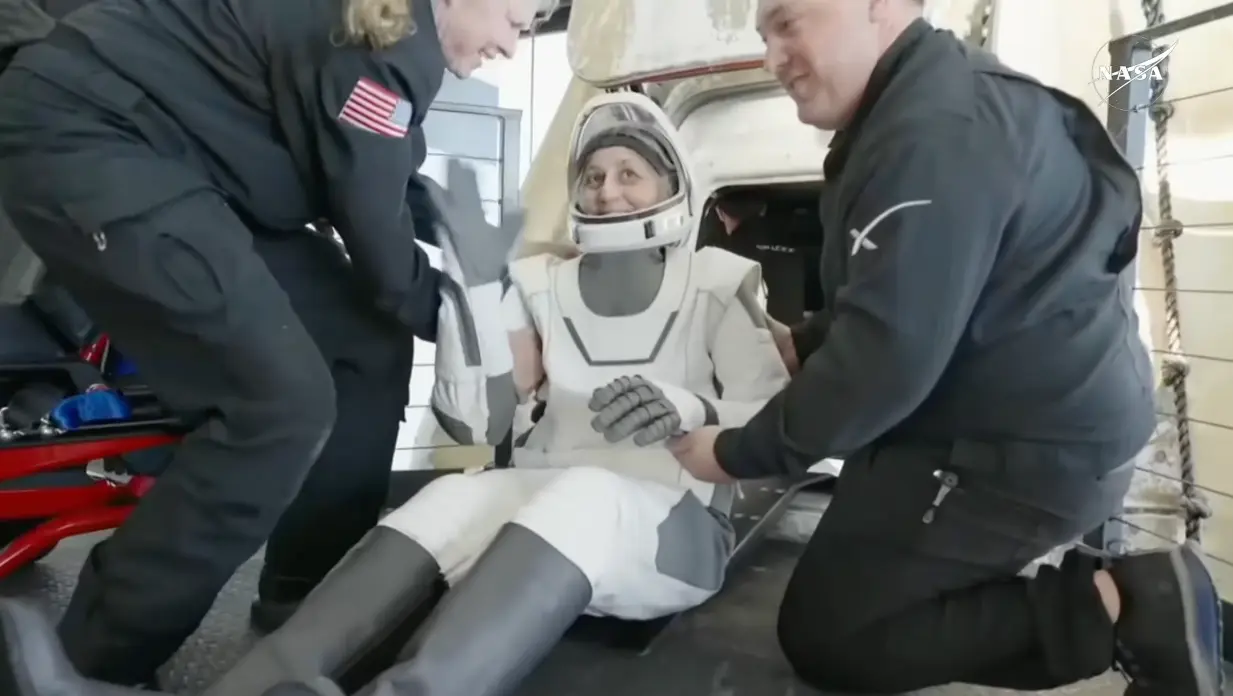
NASA Sunita Williams Return Live | The two 'stranded' NASA astronauts will return home on Tuesday (Mar 18) thanks to the successful launch of a replacement crew last week.
NASA Sunita Williams returns Live Updates:NASA astronauts Sunita Williams and Butch Wilmore are finally nearing their long-awaited return to Earth after more than nine months aboard the International Space Station (ISS). The two 'stranded' NASA astronauts will return home on Tuesday (Mar 18) thanks to the successful launch of a replacement crew last week.
Sunita Williams Returns Live Updates
The Crew-9's return journey will take roughly 42 hours, spanning March 17 to March 19, 2025.
Following the splashdown of astronauts Sunita Williams, Butch Wilmore, Nick Hague and cosmonaut Aleksandr Gorbunov, NASA will hold a Return-to-Earth media conference at 7:30 pm EDT (6:00 am IST, March 19).
NASA Sunita Williams Returns Live Updates on WION
During the press conference, NASA was asked whether or not there be any psychological studies of Wilmore and Williams to evaluate the effects not just of a prolonged stay in space.
Joel Montalbano, who is the deputy associate administrator, said, "It is awesome to have Crew-9 home. Just a beautiful landing."
"SpaceX has been an incredible partner,” Montalbano said, further adding that this mission is a great example of the power of NASA's public-private partnerships.
Steve Stich, manager of Nasa's commercial crew programme said, "You could see the dolphins swimming around the capsule, which was kind of incredible." He said that their presence echoed many other observers of the landing.
/wion/media/post_attachments/dd9292a3-996.png)
/wion/media/post_attachments/dcec0212-17c.png)
New Zealand struck twice with quick wickets of Shubman Gill and Virat Kohli.
Last Wkt: Virat Kohli lbw b Michael Bracewell 1(2) - 106/2 in 19.1 ov.
LIVE SCORE
IND 107/2 (19.3) CRR: 5.49 REQ: 4.75
India need 145 runs
NZ 251/7 (50)
/wion/media/post_attachments/d5528c55-2ab.png)
/wion/media/post_attachments/854acc3f-f75.png)
First /wion/media/post_attachments/d5900ba0-635.png)
/wion/media/post_attachments/f9b1225b-672.png)
/wion/media/post_attachments/ba3a687a-10b.png)
/wion/media/post_attachments/f34f54c6-38d.png)
/wion/media/post_attachments/c07e30f8-d61.png)
/wion/media/post_attachments/59b62d60-04f.png)
/wion/media/post_attachments/7f57f678-079.png)
/wion/media/post_attachments/1b937124-f3c.png)
/wion/media/post_attachments/4d1c79d3-3d7.png)
Dragon has successfully aligned with its trajectory for splashdown and has entered Earth’s atmosphere. As it encounters intense plasma buildup, a brief communication blackout will take place. The spacecraft, flying autonomously, will reconnect with SpaceX once it passes through atmospheric entry.
Dragon spacecraft is positioned for re-entry, with Freedom autonomously manoeuvring above Earth in preparation for splashdown off Florida’s coast.
Dragon will face temperatures exceeding 3,000 degrees Celsius during re-entry as it travels through Earth's atmosphere at hypersonic speeds. The spacecraft's heat shield is designed to withstand the intense heat and protect the crew inside, ensuring a safe descent.
The deorbit burn has been successfully completed, and SpaceX is now sealing the nose cone of the Dragon spacecraft. The nose cone, which has remained open since the spacecraft docked with the ISS in September, is being closed to prepare for reentry. Once secured, the spacecraft will commence its descent into Earth's atmosphere.
SpaceX’s Crew-9 Dragon spacecraft, Freedom, has separated from its trunk module and initiated its deorbit burn to begin its return to Earth. The burn, which started at approximately 5:11 PM ET, will last around 7.5 minutes, setting the spacecraft on its reentry path.
As the capsule enters Earth's atmosphere at hypersonic speed, its heatshield will protect the crew from extreme temperatures that can rise beyond 3,000°F during reentry. The descent is expected to take nearly an hour before splashdown.
This process involved detaching the umbilical connections between the spacecraft’s trunk and capsule, ensuring that power and data transfer systems are properly disengaged. With this step complete, Crew Dragon is now fully prepared for reentry, where it will endure intense atmospheric heating before deploying its parachutes for a safe splashdown.
The spacecraft is now gradually lowering its altitude, preparing for atmospheric reentry. During this phase, onboard systems are autonomously adjusting its trajectory and internal conditions, including temperature regulation, to ensure a safe descent.
The crew aboard will experience increasing gravitational forces as they re-enter Earth's atmosphere before parachutes deploy for a controlled splashdown off the coast of Florida.
With just 1 hour to go for landing, Crew Dragon is currently performing several tasks autonomously, according to NASA. It is adjusting its internal temperature for reentry, ensuring optimal conditions for the crew.
Additionally, the spacecraft is aligning itself for the deorbit burn, which will slow it down for atmospheric reentry. The heat shield is being prepared to withstand the intense heat and pressure during descent. Parachute deployment systems are also being checked to ensure a safe splashdown in the designated landing zone.
NASA will provide live coverage of the landing, starting at 2:15 a.m. IST. The timeline of key events is as follows:
- 2:15 a.m. IST (March 19): NASA livestream begins
- 2:41 a.m. IST (March 19): Dragon Crew-9 deorbit burn
- 3:27 a.m. IST (March 19): Splashdown
- 5:00 a.m. IST (March 19): NASA/SpaceX post-landing press conference
Live coverage will begin at 2:15 a.m. IST. Stay tuned for updates.
NASA will provide live coverage of the landing, starting at 4:45 p.m. EDT (2045 GMT). The timeline of key events is as follows:
- 4:45 p.m. EDT (2045 GMT): NASA livestream begins
- 5:11 p.m. EDT (2111 GMT): Dragon Crew-9 deorbit burn
- 5:57 p.m. EDT (2157 GMT): Splashdown
- 7:30 p.m. EDT (2330 GMT): NASA/SpaceX post-landing press conference
Live coverage will begin at 4:45 p.m. EDT.
NASA astronaut Sunita Williams has now recorded 608 days in space, making her the second astronaut with the longest cumulative time in orbit. She surpasses many seasoned space travelers but remains behind Peggy Whitson, who holds NASA’s record with 675 days.
Speaking to NewsNation Prime, former NASA astronaut Leroy Chiao highlighted the physical toll space travel takes on the human body, including a phenomenon known as “baby feet”.
“You basically lose the thick part of your skin,” Chiao said, explaining how prolonged weightlessness causes foot calluses to diminish. The soles of astronauts’ feet, he noted, undergo some of the most unexpected changes in a microgravity environment.
Upon landing, standard protocol dictates that the astronauts will be carried on stretchers. After prolonged exposure to microgravity, astronauts' bodies undergo physiological changes. Returning to Earth's gravity requires a period of readjustment, during which balance and coordination can be compromised. In microgravity, muscles are used less frequently, leading to atrophy.
Despite regular exercise routines on the ISS, some muscle weakening is inevitable, necessitating assistance upon return. Astronauts can experience bone density loss of approximately 1 per cent per month in space. This reduction increases the risk of fractures, making immediate support crucial upon landing.
Prayers are being held at the Dola Mata Temple in Jhulasan, the ancestral village of NASA astronaut Sunita Williams, for her safe return to Earth, according to ANI.
Williams and her fellow astronauts have embarked on their journey back after spending more than nine months on the International Space Station (ISS). Villagers have performed special rituals and lit an Akhand Jyot (eternal flame), seeking divine blessings for a smooth and safe landing.
Williams spent a total of 322 days in space throughout her two missions. With 50 hours and 40 minutes, she is second on the list of total cumulative spacewalk time by a female astronaut.
However, former NASA astronaut Cady Coleman explained that astronauts receive their standard salary without overtime benefits.
Read HERE to know more.
Let's take a look at how Sunita Williams landed back in Earth in 2007 after spending 195 days in space, her experience of running a marathon from space and a special call to her father.
Read the full story HERE.
Upon their return to Earth, both astronauts are expected to undergo significant physiological and psychological changes as they on their way to return to Earth after an extended stay of nine months aboard the International Space Station (ISS).
Read the full story HERE.
Indian-origin NASA astronaut Sunita Williams is gearing up for her much-awaited return to Earth, alongside fellow astronaut Butch Wilmore. Live coverage of their return will be available to watch online across multiple platforms, including NASA's official YouTube channel.
Read the full story HERE.
Union Minister Jitendra Singh has called NASA astronaut Sunita Williams a "daughter of India", as she is about to return to Earth along with Butch Wilmore.
Saying that India is "proud" of her and praying for her safe return, Singh said, "She (Sunita Williams), being a daughter of India, has made the entire world proud...She has successfully accomplished the task that she was assigned to. While all of us pray for a safe return, we also feel proud of her..."
The minister also referred to Sunita Williams' Indian roots in Gujarat and highlighted that Indian space scientists are making waves internationally.
Residents of Jhulasan village in Gujarat’s Mehsana district are preparing grand celebrations for astronaut Sunita Williams’ return to Earth. The village, which is the ancestral home of her father, Deepak Pandya, is buzzing with excitement as locals get ready to welcome her in a manner similar to Diwali.
Villagers have been offering special prayers for Williams’ safe return, with many lighting an Akhand Jyot (eternal flame) at the temple of Goddess Dola Mata.
Her cousin, Navin Pandya, shared that a grand procession will be organised in her honour, featuring prayers and fireworks to create a festive atmosphere akin to Diwali and Holi.
“The atmosphere here is festive, with everyone eagerly anticipating her return. We will definitely invite her to visit Jhulasan in the future. It would be an honour to have her among us in her ancestral village,” Pandya said.
NASA Sunita Williams Live: Indian Prime Minister Narendra Modi wrote a letter to NASA astronaut Sunita Williams praising her for her achievements.
"When I met President Trump or President Biden during my visits to the United States, I inquired about your well-being," PM Modi said in his letter to her.