Israel-Hamas war: Biden, Hamas, and different degrees of empathy

Israel-Hamas war
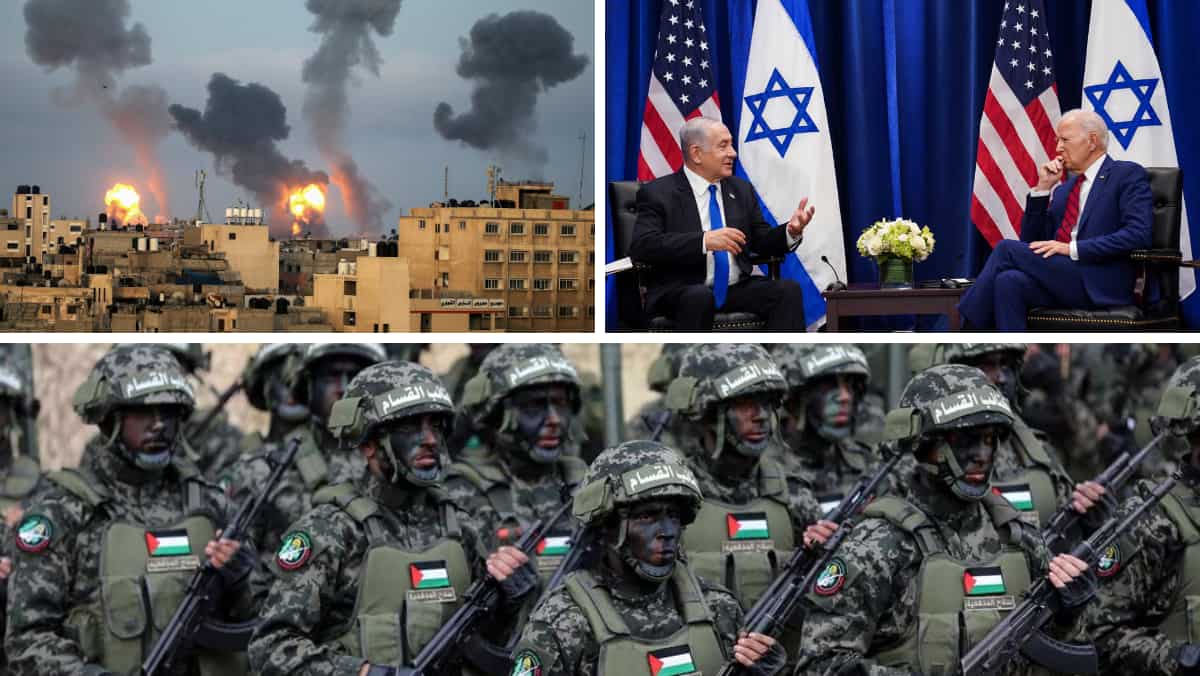
It took President Joe Biden 65 days, 18,000 dead Gazans, and large parts of the Gaza strip laid to waste to issue a public rebuke of Israel’s way of waging war on Hamas.
Biden has long had a reputation for being particularly empathetic, a quality not common in the world of politics, but critics say the long delay spotlights that he has felt more deeply for Israelis than for Palestinian victims of the war on Gaza.
The president, whose affinity for Israel goes back decades, travelled to Israel 11 days after militants of Hamas, the group that rules Gaza, stormed across the supposedly impenetrable border with Israel, massacred 1,200 Israelis, and abducted 240 to take them as hostages to Gaza.
In Tel Aviv, he made the first of what would be several touching speeches expressing sorrow for the suffering of Israelis and the fears of Jews worldwide. It won him deep appreciation among Israelis and supporters of Israel in the Gaza conflict.
Also Read |Red Sea sees sharp rise in missile attacks, says data from India's key maritime body, IFC-IOR
But many Arab and Muslim Americans, young voters, and liberals felt there was none of the heartfelt compassion in Biden’s rhetoric on the plight of Gazans as Israel responded to the Hamas attack with a ferocious bombing campaign, followed by a ground invasion that drove the death toll past 20,000 in three months.
“The president…has rarely talked about the Palestinian children torn to pieces or the hundreds of thousands of people without water or food, “ said Shibley Telhami, a Middle East scholar at the University of Maryland. “He talks about (the people of Gaza) as if they are victims of an earthquake or natural disaster – without tying them to the actions of the Israeli government with his support and backing.”
Biden’s first direct and public criticism of the way Israel is conducting the war came on December 12 in a meeting with donors to his 2024 re-election campaign. While the U.S. stood behind Israel, he told the meeting the country was losing international support because of “the indiscriminate bombing that takes place.”
By the time Biden made that statement, Israel had followed up its initial campaign of air strikes with a ground invasion and the loss of support for the way it conducted the war had been obvious by massive pro-Palestinian demonstrations in cities around the world.
Five countries had withdrawn their ambassadors in protest and three cut diplomatic tries entirely, including South Africa, whose top diplomat, Nalendi Pandor, likened Israel’s occupation of Palestinian territory to her country’s former system of Apartheid.
Nothing irritates Israeli officials more than comparisons with Apartheid South Africa but Pandor told the Al Jazeera television network there could be no denial of the similarities.
“We know people cannot own property and that property can be seized without any compensation, which is what we experienced in our country. People have to carry identity documents that reflect your ethnicity rather than citizenship. All this is part of the apartheid feature.”
Just two days before that Biden’s belated rebuke, his Department of State approved the sale of 14,000 rounds of tanks shells and other tank equipment worth $106.5 million. The deal invoked an emergency declaration to bypass the congressional review normally required for arms transfers.
Biden’s warning followed a string of expressions of concern from senior administration officials over the huge civilian casualty toll of the Israeli campaign. They included Secretary of State Anthony Blinken, Vice President Kamala Harris, National Security Advisor Jake Sullivan, and Secretary of Defence Lloyd Austin.
Watch | Israel-Hamas war: US backs on Security Council vote on Gaza aid
Austin, a retired four-star general, had a piece of advice for his Israeli hosts they would do well to take to heart. “In this kind of fight, the center of gravity is the civilian population. And if you drive them into the arms of the enemy, you replace a tactical victory with a strategic defeat.”
If history can be a judge, Israel will largely shrug off American advice, angering the U.S. but not suffering consequences.
For decades, the U.S.-Israeli relationship has been unique, resembling that of an indulgent parent with a willful child rather than normal nation-to-nation ties. There is nothing quite like it. The world’s pre-eminent superpower has serious leverage over a country with a population only slightly larger than New York City but by and large, what Israel wants, Israel gets.
One of Washington’s levers is aid. The United States has given Israel more aid, much of it military, than any other country since its establishment in 1948. Annual aid has been running at $3.8 billion for years and a commitment to give Israel military superiority over potential adversaries is enshrined in American law.
But no U.S. administration has ever threatened to withhold or reduce that aid even when the Israeli government acted in defiance of U.S. policy, as has happened frequently in the matter of Israeli settlements in the occupied West Bank, territory the Palestinians want as a state of their own.
The other feature that makes the U.S.-Israeli relationship unique is a long-standing Washington policy of shielding Israel from criticism at the United Nations. Time and again, the U.S. and Israel have stood alone on resolutions backed by the majority of the U.S. 193 members.
How much Washington is willing to bend to Israeli wishes was spotlighted on Friday, when the U.N. Security Council, whose decisions are binding, adopted a resolution to speed up humanitarian aid for Gaza, where hundreds of thousands of civilians face starvation and disease.
After days of wrangling, the 15-member council voted 13-0 for the resolution. The United States abstained after threatening to veto the measure if it included a key phrase in the original draft calling for an “urgent suspension of hostilities between Israel and Hamas.
Israel and its American ally have rejected a ceasefire, arguing that it would allow Hamas to regroup and prepare for fresh attacks.
The watered-down version stipulates “urgent steps to immediately allow safe, unhindered and expanded humanitarian access and also for creating the conditions for a sustainable cessation of hostilities.” No details on the steps were given.
Just hours before the vote, Israel said it was widening its ground offensive.
Disclaimer: WION takes utmost care to accurately and responsibly report ongoing developments on the Israel-Palestine conflict after the Hamas attacks. However, we cannot independently verify the authenticity of all statements, photos and videos.
