PM Modi in Japan HIGHLIGHTS: 'Golden chapter in special strategic, global partnership,' PM Modi says in Tokyo

&imwidth=600&imheight=450&format=webp&quality=medium "PM Modi in Japan HIGHLIGHTS: 'Golden chapter in special strategic, global partnership,' PM Modi says in Tokyo")
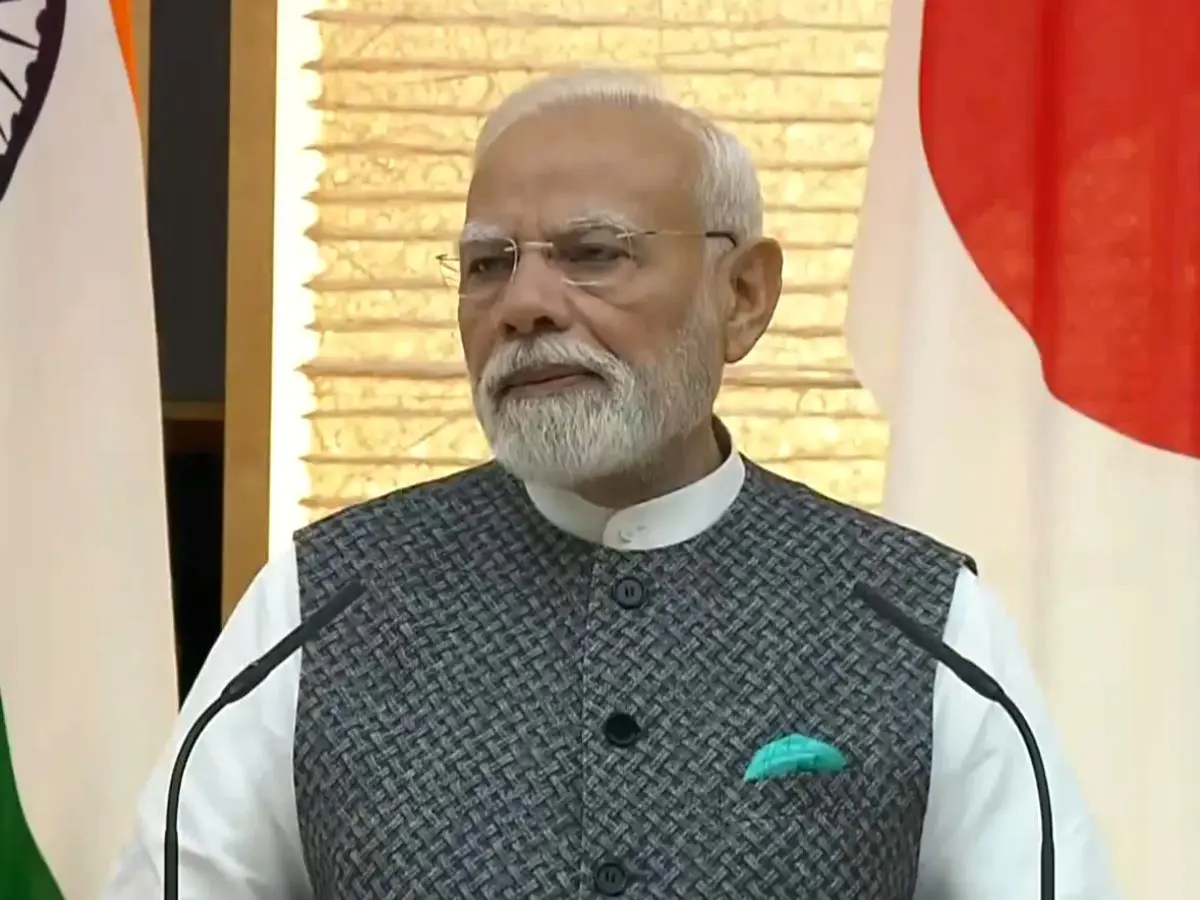
PM Modi address press joint press briefing in Tokyo Photograph: (ANI)
PM Modi is visting Japan to boost the India-Japan Special Strategic Partnership, focusing on defence, economic cooperation, and cultural ties. Talks with Japanese PM Shigeru Ishiba will underline the commitment to a free Indo-Pacific amid Trump's trade war
Indian Prime Minister Narendra Modi has embarked on a visit to Japan, marking yet another crucial chapter in India’s diplomatic outreach in the Indo-Pacific. The trip underlines New Delhi’s intent to deepen strategic, economic, and cultural ties with Tokyo at a time when global geopolitics is witnessing rapid shifts. During his two-day official visit from August 29 to 30, the PM will attend the 15th India-Japan Annual Summit. India and Japan share a “Special Strategic and Global Partnership,” rooted in democratic values and a mutual interest in ensuring a free, open, and rules-based Indo-Pacific. During his visit, Prime Minister Modi is expected to hold bilateral talks with Japanese Prime Minister Shigeru Ishiba, focusing on defence cooperation, regional security, and advancing collaboration in critical technologies. The visit comes at a crucial time when the world is reeling under the pressure of the United States' trade war.
Economic ties remain central to PM Modi’s agenda in Japan. The two nations are working to boost investments in infrastructure, digital innovation, and green technologies. Japan has been a major partner in India’s development journey, particularly through projects like the Mumbai-Ahmedabad High-Speed Rail corridor. The leaders are likely to discuss new avenues for trade, supply chain resilience, and investment opportunities that can further cement economic integration.
Beyond politics and economics, PM Modi’s visit also emphasises cultural diplomacy. India and Japan share a long history of cultural exchanges, influenced by Buddhism and strong academic collaboration. The Prime Minister is expected to meet members of the Indian community in Japan, highlighting the role of diaspora in strengthening bilateral ties. The outcomes of this trip are expected to reaffirm India and Japan’s shared commitment to peace, prosperity, and stability in the region.
This live blog has ended.
Indian Prime Minister Narendra Modi said that India and Japan have set a goal of investment of 10 trillion Yen ($67 billion) from Japan in the country in the next 10 years. He made the remarks during a joint press briefing with his Japanese counterpart Shigeru Ishiba in Tokyo on Friday (Aug 29). PM Modi is currently on a two-day official visit to the country to attend the 15th India-Japan Annual Summit.
As Indian Prime Minister Narendra Modi is on his two-day visit to Japan, where he met his Japanese counterpart Shigeru Ishiba, Foreign Secretary Vikram Misri said in a press conference, “Both leaders reaffirmed their commitment to a free, open, and inclusive Indo-Pacific that is peaceful, prosperous, and resilient. Prime Minister reaffirmed that Japan stands with India on the issue of cross-border terrorism.”
He added, “The two sides concluded an important action plan on human resource exchange today, which sets a headline number of two-way exchange of people of 5,00,000 over the next five years, including 50,000 skilled and semi-skilled personnel from India to Japan.”
Explaining the joint declaration on security cooperation, Misri said, “This is an enabling framework for Indian and Japan to better respond to contemporary security challenges... An important feature of this document is the broad concept of security it embodies, which includes cooperation on cybersecurity, counterterrorism, defence industry, research and development, and closer cooperation on security issues in multilateral groupings. One of the new features of the security engagement between the two countries would be an institutionalised dialogue between the national security advisors of the two countries.”
During his two-day visit to Japan, Indian Prime Minister Narendra Modi was presented with a Daruma doll by the Chief priest of Shorinzan Daruma-Ji Temple, Rev Seishi Hirose, in Tokyo on Friday (Aug 29). The traditional Japanese doll, which was gifted to PM Modi as a gesture of goodwill between the two nations, is a symbol of good luck and holds a significant place in the country’s culture.
Indian Prime Minister Narendra Modi on Friday said in an interview that India has maintained a principled and humanitarian stance on the ongoing conflict between Russia and Ukraine.
“India has maintained a principled and humanitarian stance on the conflict which is equally appreciated by both President Putin and President Zelenskyy. In line with this, both the leaders spoke to me to share their perspectives on the developments related to the conflict. I reiterated India's principled and consistent stand and encouraged dialogue and diplomacy to resolve the conflict,” PM Modi told Japanese news outlet The Yomiuri Shimbun.
“India is bringing transformation to the whole world...Japan can also boast of advanced technology, leading the world's growth. When we think about Japan and India's relations going forward, we need to take advantage of each other's strengths to gain solutions to our challenges and to help each other...Japan and India share the fundamental values and the Indo-Pacific region, we need to maintain free and open international order based rule of law...As we see increasing opaqueness in the international circumstances, Japan and India need to bring in their strengths together for peace and stability of the region,” Japanese PM Shigeru Ishiba said during the joint press conference in Tokyo.
Speaking during the joint press briefing in Tokyo, PM Modi said that India and Japan share similar concerns over terrorism and cybersecurity.
“India and Japan are fully committed to a free, open, peaceful, prosperous and rules-based Indo-Pacific. Our concerns over terrorism and cybersecurity are similar. Our mutual interests are linked to defence and maritime security. We have decided the cooperation in sector of defence industry and innovation will be further strengthened.”
He added, “India and Japan partnership is rooted in mutual trust, reflects our national priorities and is shaped by our shared values and beliefs. Together, we carry a common dream of peace, progress and prosperity of our people and for the world...For the next India-Japan Annual Summit, I invite you to India.”
PM Modi said, “We believe that Japanese technology and Indian talent are a winning combination. Where we are working on high-speed rail, under next-generation mobility partnership we will also make rapid progress in sectors like ports, aviation and ship-building. For cooperation in Chandrayaan 5 Mission, we welcome the agreement between ISRO and JAXA. Our active cooperation will cross the boundaries of the earth and become a symbol of humanity's progress in space.”
He also said, “Under the action plan of human resource exchange, in the next 5 years, exchange of 5 lakh people in different sectors will be conducted.”
During the joint press briefing in Tokyo, PM Modi said, “Our Joint Crediting Mechanism for energy is a major victory. It shows that our green partnership is as strong as our economic partnership. In this direction, we are also beginning the sustainable fuels initiatives and battery supply chain partnership. We are launching the economic security cooperation initiative. Under this, we will go ahead in critical and strategic sectors, with an extensive approach.”
He added, “Cooperation in the high technology sector is a priority for both of us. In this regard, Digital Partnership 2.0 and AI Cooperation Initiative are being taken up. Semiconductors and rare earth minerals will be at the top of our agenda.”
Prime Minister Narendra Modi also talked about Japanese investment in India, saying that the two nations will focus on connecting their small and medium enterprises and startups.
“We have set a goal of investment of 10 Trillion Yen from Japan in India in the next 10 years. Special emphasis will be laid on connecting India's and Japan's small and medium enterprises and startups,” he said.
“Even in the India-Japan Business Forum, I told the Japanese companies, ‘Make in India, Make for the World,’” he added
Addressing the joint press conference with Japanese PM Shigeru Ishiba, PM Modi said that the two leaders held “productive” and “purposeful” discussions today.
“Our discussions today were productive as well as purposeful. We agree that as the two largest economies of the world and living democracies, our partnership is essential not just for the two countries but also for global peace and security. Strong democracies are natural partners in shaping a better world. Today, we have laid the foundation of a new and golden chapter in our special strategic and global partnership. We have charted a roadmap for the next decade. In the centre of our vision lie investment, innovation, economic security, environment, technology, health, mobility, people-to-people exchanges,” PM Modi said.
PM Modi received the Guard of Honour during his two-day official visit to Japan. Modi also held several meetings with political leaders of the country including Speaker Fukushiro Nukaga and a group of Members of Parliament, former prime minister Yoshihide Suga, and former prime minister Fumio Kishida.
Taking to X PM Modi wrote, “Had a wonderful meeting with the former Prime Minister of Japan, Mr. Fumio Kishida. He has always been a great advocate of closer India–Japan relations. We discussed the progress in our bilateral partnership across trade, critical technologies and human resource mobility. We also discussed the vast potential in emerging areas such as technology and semiconductors.”
PM Modi highlighted the significant potential of collaboration in cutting edge technologies, manufacturing & investments and human resource exchanges.
"India is the springboard for Japanese businesses in the global south, and together we will shape the Asian century for stability, growth and prosperity," PM Modi concludes his address with ‘arigato’
A shared workforce will lead to shared prosperity. India and Japan's partnership is strategic and smart: PM Modi in Tokyo
Japan's excellence and India's scale can create a perfect partnership: PM Modi's address in Tokyo
During his address, the Prime Minister lauded Japan for its technology. He said, “Japan is a tech powerhouse and India is a talent powerhouse.”
Japan has always been an important partner in India's development journey. From metro rail to manufacturing, semiconductors to startups...Japanese companies have invested over $40 billion in India…: PM Modi's address in Tokyo
The world is not just watching India, it is counting on India: PM Modi's address in Tokyo
In 2017, we started the one nation, one tax, we are working on more reforms. A couple of weeks ago, our parliament gave a go-ahead for a simplified income tax code. We have stressed on ease of doing business: PM Modi
Reform, perform, transform has been India's approach to bring about change and growth: PM Modi
Today, India is the world's fastest-growing economy. In India, capital not only grows, it multiplies, PM Modi said in Tokyo
People-to-people exchanges will be the key to enriching the future of our nations, said Japanese PM Shigeru Ishiba
Prime Minister Narendra Modi is scheduled to speak at the India-Japan Joint Economic Forum shortly, where he is expected to highlight key areas of bilateral cooperation, including trade, technology, clean energy, and investment.
Indian PM Narendra Modi told Japanese newspaper The Yomiuri Shimbun that India and Japan will deepen defence ties by revising their 2008 Joint Declaration on Security Cooperation. The updated pact will include new areas like economic security and defence industry collaboration. PM Modi praised Japan’s defence technology and emphasised co-developing next-gen platforms for global markets. He also noted Japan's recent transfer of ship antennas to India and highlighted the need to diversify India's defence imports, previously reliant on Russia.
Indian Prime Minister Narendra Modi is scheduled to travel to China from August 31 to September 1, 2025. The purpose of the visit is to attend the annual Shanghai Cooperation Organisation (SCO) summit in the city of Tianjin, at the invitation of Chinese President Xi Jinping
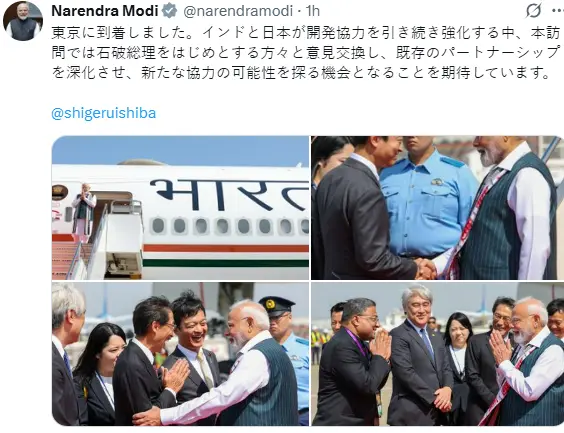
Indian PM Narendra Modi PM Modi shared a post on X upon his arrival in Tokyo and wrote in Japanese stating that he looks forward to discussions with PM Ishiba.
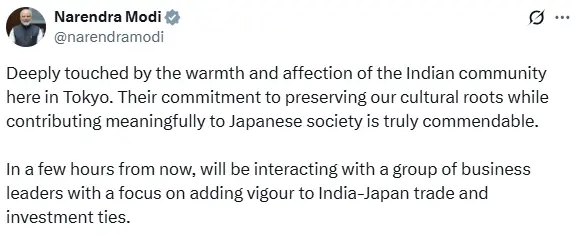
Prime Minister Narendra Modi expressed his heartfelt appreciation for the warmth and affection shown by the Indian community in Tokyo. He praised their dedication to maintaining cultural heritage while actively contributing to Japanese society. He also mentioned that later, he would meet with business leaders to discuss strengthening trade and investment ties between India and Japan.
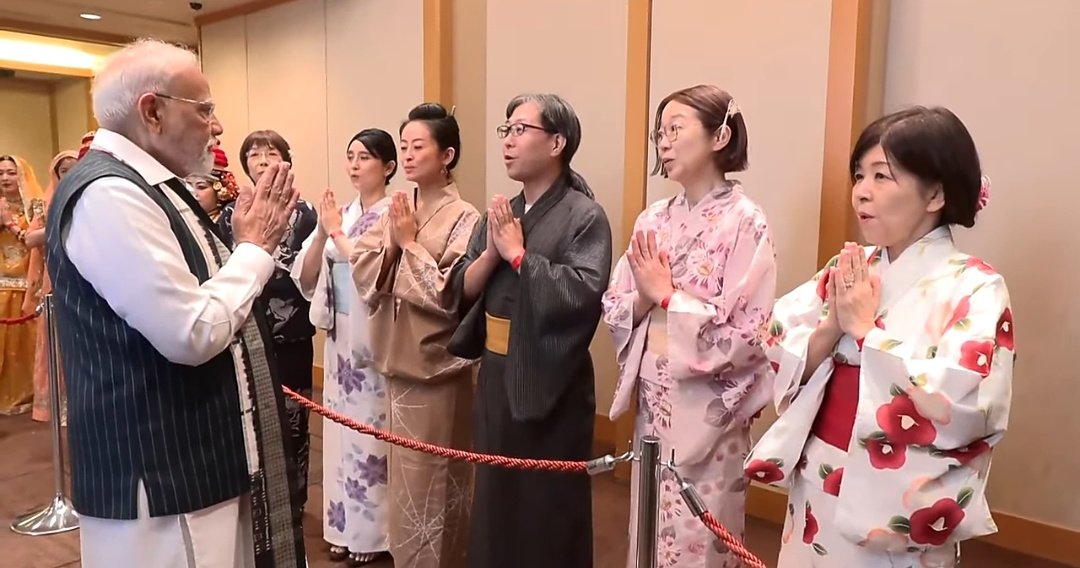
Prime Minister Narendra Modi warmly greeted members of the Indian diaspora and the Japanese community upon his arrival in Tokyo, reaffirming the deep cultural and people-to-people ties that form a vital pillar of the India-Japan relationship.


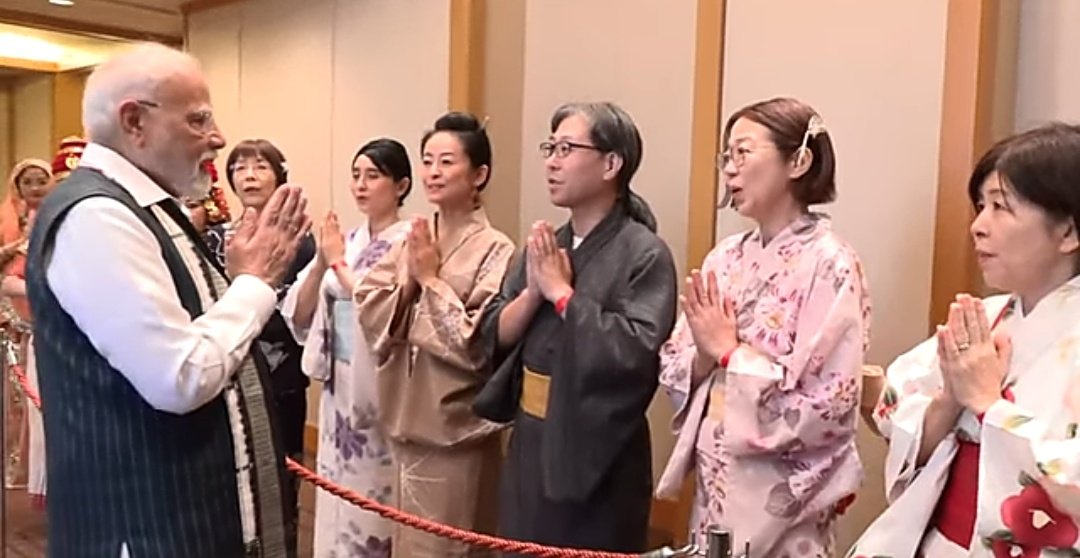
Prime Minister Narendra Modi has officially arrived in Tokyo, Japan, marking the beginning of a significant diplomatic visit aimed at deepening bilateral ties between India and Japan. Later this evening, PM Modi is scheduled to hold comprehensive discussions with Japanese Prime Minister Shigeru Ishiba. The leaders will engage in a wide-ranging dialogue covering key areas such as defence cooperation, strategic partnerships, trade and investment, emerging technologies, and people-to-people exchanges.


Just hours before Indian Prime Minister Narendra Modi's arrival in Tokyo, Japan's top trade negotiator Ryosei Akazawa unexpectedly cancelled a high-level visit to the United States, a move that has raised eyebrows in diplomatic and economic circles. The trip was expected to finalise a massive $550 billion investment package Japan has been preparing to offer the U.S., aimed at mitigating the impact of punitive tariffs recently imposed by Washington.
Prime Minister Narendra Modi has arrived in Tokyo, marking the beginning of his high-profile visit to Japan. India’s Ambassador to Japan, Sibi George , and Japan’s Ambassador to India, Hiroshi Suzuki, were present at the airport to personally welcome the Prime Minister. Their presence underlines the close diplomatic ties and the mutual commitment to deepening cooperation in key areas such as high-speed rail, clean energy, defence collaboration, and regional security in the Indo-Pacific.The visit is expected to further bolster the "Special Strategic and Global Partnership" between India and Japan, setting the stage for significant agreements and future-oriented initiatives.

During Prime Minister Modi's visit to Japan, India and Japan are expected to finalise a deal for the next-gen E10 Series Shinkansen for the Mumbai–Ahmedabad bullet train project, with initial testing using retired E5 and E3 models in 2026. Japan is also launching a $68 billion private investment plan across sectors like semiconductors, clean energy, AI, and pharmaceuticals. Defence ties are deepening with projects like the UNICORN radar system and naval cooperation. Amid rising US tariffs, Japan's infrastructure investments may help India diversify exports. The visit sets the stage for stronger strategic, economic, and technological ties ahead of the Quad and SCO summits. READ MORE
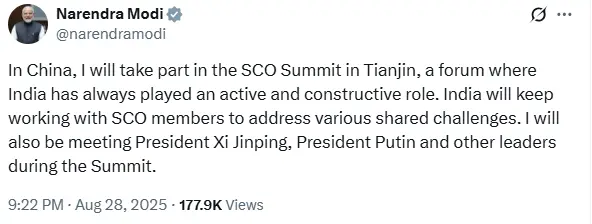
In a post on X, Prime Minister Narendra Modi said that in China, he is set to participate in the SCO Summit in Tianjin, a platform where India has consistently played an active and constructive role. He is expected to reaffirm India’s commitment to working with SCO member states to tackle shared challenges. During the summit, he will also hold meetings with President Xi Jinping, President Vladimir Putin, and other world leaders.
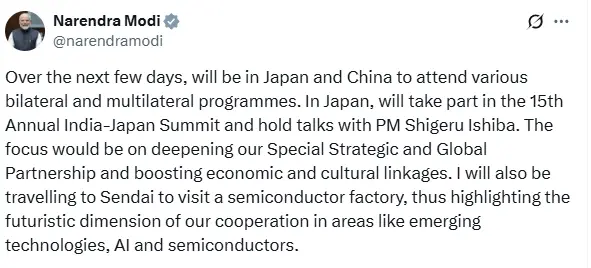
In a post on X, Prime Minister Narendra Modi said that he is scheduled to visit Japan and China to participate in a series of bilateral and multilateral programmes. In Japan, he will attend the 15th Annual India-Japan Summit and hold discussions with Prime Minister Shigeru Ishiba, with a focus on strengthening the Special Strategic and Global Partnership between the two nations and enhancing economic and cultural ties. He is also expected to travel to Sendai to visit a semiconductor factory, underscoring the forward-looking aspect of India-Japan cooperation in emerging technologies, artificial intelligence, and semiconductors.
Indian Prime Minister Narendra Modi has embarked on a visit to Japan, marking yet another crucial chapter in India’s diplomatic outreach in the Indo-Pacific. The trip underlines New Delhi’s intent to deepen strategic, economic, and cultural ties with Tokyo at a time when global geopolitics is witnessing rapid shifts. During his two-day official visit from August 29 to 30, the PM will attend the 15th India-Japan Annual Summit. India and Japan share a “Special Strategic and Global Partnership,” rooted in democratic values and a mutual interest in ensuring a free, open, and rules-based Indo-Pacific. During his visit, Prime Minister Modi is expected to hold bilateral talks with Japanese Prime Minister Shigeru Ishiba, focusing on defence cooperation, regional security, and advancing collaboration in critical technologies. The visit comes at a crucial time when the world is reeling under the pressure of the United States' trade war.
Economic ties remain central to PM Modi’s agenda in Japan. The two nations are working to boost investments in infrastructure, digital innovation, and green technologies. Japan has been a major partner in India’s development journey, particularly through projects like the Mumbai-Ahmedabad High-Speed Rail corridor. The leaders are likely to discuss new avenues for trade, supply chain resilience, and investment opportunities that can further cement economic integration.
Beyond politics and economics, PM Modi’s visit also emphasises cultural diplomacy. India and Japan share a long history of cultural exchanges, influenced by Buddhism and strong academic collaboration. The Prime Minister is expected to meet members of the Indian community in Japan, highlighting the role of diaspora in strengthening bilateral ties. The outcomes of this trip are expected to reaffirm India and Japan’s shared commitment to peace, prosperity, and stability in the region.
This live blog has ended.
Indian Prime Minister Narendra Modi said that India and Japan have set a goal of investment of 10 trillion Yen ($67 billion) from Japan in the country in the next 10 years. He made the remarks during a joint press briefing with his Japanese counterpart Shigeru Ishiba in Tokyo on Friday (Aug 29). PM Modi is currently on a two-day official visit to the country to attend the 15th India-Japan Annual Summit.
As Indian Prime Minister Narendra Modi is on his two-day visit to Japan, where he met his Japanese counterpart Shigeru Ishiba, Foreign Secretary Vikram Misri said in a press conference, “Both leaders reaffirmed their commitment to a free, open, and inclusive Indo-Pacific that is peaceful, prosperous, and resilient. Prime Minister reaffirmed that Japan stands with India on the issue of cross-border terrorism.”
He added, “The two sides concluded an important action plan on human resource exchange today, which sets a headline number of two-way exchange of people of 5,00,000 over the next five years, including 50,000 skilled and semi-skilled personnel from India to Japan.”
Explaining the joint declaration on security cooperation, Misri said, “This is an enabling framework for Indian and Japan to better respond to contemporary security challenges... An important feature of this document is the broad concept of security it embodies, which includes cooperation on cybersecurity, counterterrorism, defence industry, research and development, and closer cooperation on security issues in multilateral groupings. One of the new features of the security engagement between the two countries would be an institutionalised dialogue between the national security advisors of the two countries.”
During his two-day visit to Japan, Indian Prime Minister Narendra Modi was presented with a Daruma doll by the Chief priest of Shorinzan Daruma-Ji Temple, Rev Seishi Hirose, in Tokyo on Friday (Aug 29). The traditional Japanese doll, which was gifted to PM Modi as a gesture of goodwill between the two nations, is a symbol of good luck and holds a significant place in the country’s culture.
Indian Prime Minister Narendra Modi on Friday said in an interview that India has maintained a principled and humanitarian stance on the ongoing conflict between Russia and Ukraine.
“India has maintained a principled and humanitarian stance on the conflict which is equally appreciated by both President Putin and President Zelenskyy. In line with this, both the leaders spoke to me to share their perspectives on the developments related to the conflict. I reiterated India's principled and consistent stand and encouraged dialogue and diplomacy to resolve the conflict,” PM Modi told Japanese news outlet The Yomiuri Shimbun.
“India is bringing transformation to the whole world...Japan can also boast of advanced technology, leading the world's growth. When we think about Japan and India's relations going forward, we need to take advantage of each other's strengths to gain solutions to our challenges and to help each other...Japan and India share the fundamental values and the Indo-Pacific region, we need to maintain free and open international order based rule of law...As we see increasing opaqueness in the international circumstances, Japan and India need to bring in their strengths together for peace and stability of the region,” Japanese PM Shigeru Ishiba said during the joint press conference in Tokyo.
Speaking during the joint press briefing in Tokyo, PM Modi said that India and Japan share similar concerns over terrorism and cybersecurity.
“India and Japan are fully committed to a free, open, peaceful, prosperous and rules-based Indo-Pacific. Our concerns over terrorism and cybersecurity are similar. Our mutual interests are linked to defence and maritime security. We have decided the cooperation in sector of defence industry and innovation will be further strengthened.”
He added, “India and Japan partnership is rooted in mutual trust, reflects our national priorities and is shaped by our shared values and beliefs. Together, we carry a common dream of peace, progress and prosperity of our people and for the world...For the next India-Japan Annual Summit, I invite you to India.”
PM Modi said, “We believe that Japanese technology and Indian talent are a winning combination. Where we are working on high-speed rail, under next-generation mobility partnership we will also make rapid progress in sectors like ports, aviation and ship-building. For cooperation in Chandrayaan 5 Mission, we welcome the agreement between ISRO and JAXA. Our active cooperation will cross the boundaries of the earth and become a symbol of humanity's progress in space.”
He also said, “Under the action plan of human resource exchange, in the next 5 years, exchange of 5 lakh people in different sectors will be conducted.”
During the joint press briefing in Tokyo, PM Modi said, “Our Joint Crediting Mechanism for energy is a major victory. It shows that our green partnership is as strong as our economic partnership. In this direction, we are also beginning the sustainable fuels initiatives and battery supply chain partnership. We are launching the economic security cooperation initiative. Under this, we will go ahead in critical and strategic sectors, with an extensive approach.”
He added, “Cooperation in the high technology sector is a priority for both of us. In this regard, Digital Partnership 2.0 and AI Cooperation Initiative are being taken up. Semiconductors and rare earth minerals will be at the top of our agenda.”
Prime Minister Narendra Modi also talked about Japanese investment in India, saying that the two nations will focus on connecting their small and medium enterprises and startups.
“We have set a goal of investment of 10 Trillion Yen from Japan in India in the next 10 years. Special emphasis will be laid on connecting India's and Japan's small and medium enterprises and startups,” he said.
“Even in the India-Japan Business Forum, I told the Japanese companies, ‘Make in India, Make for the World,’” he added
Addressing the joint press conference with Japanese PM Shigeru Ishiba, PM Modi said that the two leaders held “productive” and “purposeful” discussions today.
“Our discussions today were productive as well as purposeful. We agree that as the two largest economies of the world and living democracies, our partnership is essential not just for the two countries but also for global peace and security. Strong democracies are natural partners in shaping a better world. Today, we have laid the foundation of a new and golden chapter in our special strategic and global partnership. We have charted a roadmap for the next decade. In the centre of our vision lie investment, innovation, economic security, environment, technology, health, mobility, people-to-people exchanges,” PM Modi said.
PM Modi received the Guard of Honour during his two-day official visit to Japan. Modi also held several meetings with political leaders of the country including Speaker Fukushiro Nukaga and a group of Members of Parliament, former prime minister Yoshihide Suga, and former prime minister Fumio Kishida.
Taking to X PM Modi wrote, “Had a wonderful meeting with the former Prime Minister of Japan, Mr. Fumio Kishida. He has always been a great advocate of closer India–Japan relations. We discussed the progress in our bilateral partnership across trade, critical technologies and human resource mobility. We also discussed the vast potential in emerging areas such as technology and semiconductors.”
PM Modi highlighted the significant potential of collaboration in cutting edge technologies, manufacturing & investments and human resource exchanges.
"India is the springboard for Japanese businesses in the global south, and together we will shape the Asian century for stability, growth and prosperity," PM Modi concludes his address with ‘arigato’
A shared workforce will lead to shared prosperity. India and Japan's partnership is strategic and smart: PM Modi in Tokyo
Japan's excellence and India's scale can create a perfect partnership: PM Modi's address in Tokyo
During his address, the Prime Minister lauded Japan for its technology. He said, “Japan is a tech powerhouse and India is a talent powerhouse.”
Japan has always been an important partner in India's development journey. From metro rail to manufacturing, semiconductors to startups...Japanese companies have invested over $40 billion in India…: PM Modi's address in Tokyo
The world is not just watching India, it is counting on India: PM Modi's address in Tokyo
In 2017, we started the one nation, one tax, we are working on more reforms. A couple of weeks ago, our parliament gave a go-ahead for a simplified income tax code. We have stressed on ease of doing business: PM Modi
Reform, perform, transform has been India's approach to bring about change and growth: PM Modi
Today, India is the world's fastest-growing economy. In India, capital not only grows, it multiplies, PM Modi said in Tokyo
People-to-people exchanges will be the key to enriching the future of our nations, said Japanese PM Shigeru Ishiba
Prime Minister Narendra Modi is scheduled to speak at the India-Japan Joint Economic Forum shortly, where he is expected to highlight key areas of bilateral cooperation, including trade, technology, clean energy, and investment.
Indian PM Narendra Modi told Japanese newspaper The Yomiuri Shimbun that India and Japan will deepen defence ties by revising their 2008 Joint Declaration on Security Cooperation. The updated pact will include new areas like economic security and defence industry collaboration. PM Modi praised Japan’s defence technology and emphasised co-developing next-gen platforms for global markets. He also noted Japan's recent transfer of ship antennas to India and highlighted the need to diversify India's defence imports, previously reliant on Russia.
Indian Prime Minister Narendra Modi is scheduled to travel to China from August 31 to September 1, 2025. The purpose of the visit is to attend the annual Shanghai Cooperation Organisation (SCO) summit in the city of Tianjin, at the invitation of Chinese President Xi Jinping
Indian PM Narendra Modi PM Modi shared a post on X upon his arrival in Tokyo and wrote in Japanese stating that he looks forward to discussions with PM Ishiba.
Prime Minister Narendra Modi expressed his heartfelt appreciation for the warmth and affection shown by the Indian community in Tokyo. He praised their dedication to maintaining cultural heritage while actively contributing to Japanese society. He also mentioned that later, he would meet with business leaders to discuss strengthening trade and investment ties between India and Japan.
Prime Minister Narendra Modi warmly greeted members of the Indian diaspora and the Japanese community upon his arrival in Tokyo, reaffirming the deep cultural and people-to-people ties that form a vital pillar of the India-Japan relationship.
Prime Minister Narendra Modi has officially arrived in Tokyo, Japan, marking the beginning of a significant diplomatic visit aimed at deepening bilateral ties between India and Japan. Later this evening, PM Modi is scheduled to hold comprehensive discussions with Japanese Prime Minister Shigeru Ishiba. The leaders will engage in a wide-ranging dialogue covering key areas such as defence cooperation, strategic partnerships, trade and investment, emerging technologies, and people-to-people exchanges.
Just hours before Indian Prime Minister Narendra Modi's arrival in Tokyo, Japan's top trade negotiator Ryosei Akazawa unexpectedly cancelled a high-level visit to the United States, a move that has raised eyebrows in diplomatic and economic circles. The trip was expected to finalise a massive $550 billion investment package Japan has been preparing to offer the U.S., aimed at mitigating the impact of punitive tariffs recently imposed by Washington.
Prime Minister Narendra Modi has arrived in Tokyo, marking the beginning of his high-profile visit to Japan. India’s Ambassador to Japan, Sibi George , and Japan’s Ambassador to India, Hiroshi Suzuki, were present at the airport to personally welcome the Prime Minister. Their presence underlines the close diplomatic ties and the mutual commitment to deepening cooperation in key areas such as high-speed rail, clean energy, defence collaboration, and regional security in the Indo-Pacific.The visit is expected to further bolster the "Special Strategic and Global Partnership" between India and Japan, setting the stage for significant agreements and future-oriented initiatives.
During Prime Minister Modi's visit to Japan, India and Japan are expected to finalise a deal for the next-gen E10 Series Shinkansen for the Mumbai–Ahmedabad bullet train project, with initial testing using retired E5 and E3 models in 2026. Japan is also launching a $68 billion private investment plan across sectors like semiconductors, clean energy, AI, and pharmaceuticals. Defence ties are deepening with projects like the UNICORN radar system and naval cooperation. Amid rising US tariffs, Japan's infrastructure investments may help India diversify exports. The visit sets the stage for stronger strategic, economic, and technological ties ahead of the Quad and SCO summits. READ MORE
In a post on X, Prime Minister Narendra Modi said that in China, he is set to participate in the SCO Summit in Tianjin, a platform where India has consistently played an active and constructive role. He is expected to reaffirm India’s commitment to working with SCO member states to tackle shared challenges. During the summit, he will also hold meetings with President Xi Jinping, President Vladimir Putin, and other world leaders.
In a post on X, Prime Minister Narendra Modi said that he is scheduled to visit Japan and China to participate in a series of bilateral and multilateral programmes. In Japan, he will attend the 15th Annual India-Japan Summit and hold discussions with Prime Minister Shigeru Ishiba, with a focus on strengthening the Special Strategic and Global Partnership between the two nations and enhancing economic and cultural ties. He is also expected to travel to Sendai to visit a semiconductor factory, underscoring the forward-looking aspect of India-Japan cooperation in emerging technologies, artificial intelligence, and semiconductors.
Indian Prime Minister Narendra Modi has embarked on a visit to Japan, marking yet another crucial chapter in India’s diplomatic outreach in the Indo-Pacific. The trip underlines New Delhi’s intent to deepen strategic, economic, and cultural ties with Tokyo at a time when global geopolitics is witnessing rapid shifts. During his two-day official visit from August 29 to 30, the PM will attend the 15th India-Japan Annual Summit. India and Japan share a “Special Strategic and Global Partnership,” rooted in democratic values and a mutual interest in ensuring a free, open, and rules-based Indo-Pacific. During his visit, Prime Minister Modi is expected to hold bilateral talks with Japanese Prime Minister Shigeru Ishiba, focusing on defence cooperation, regional security, and advancing collaboration in critical technologies. The visit comes at a crucial time when the world is reeling under the pressure of the United States' trade war.
Economic ties remain central to PM Modi’s agenda in Japan. The two nations are working to boost investments in infrastructure, digital innovation, and green technologies. Japan has been a major partner in India’s development journey, particularly through projects like the Mumbai-Ahmedabad High-Speed Rail corridor. The leaders are likely to discuss new avenues for trade, supply chain resilience, and investment opportunities that can further cement economic integration.
Beyond politics and economics, PM Modi’s visit also emphasises cultural diplomacy. India and Japan share a long history of cultural exchanges, influenced by Buddhism and strong academic collaboration. The Prime Minister is expected to meet members of the Indian community in Japan, highlighting the role of diaspora in strengthening bilateral ties. The outcomes of this trip are expected to reaffirm India and Japan’s shared commitment to peace, prosperity, and stability in the region.
This live blog has ended.
Indian Prime Minister Narendra Modi said that India and Japan have set a goal of investment of 10 trillion Yen ($67 billion) from Japan in the country in the next 10 years. He made the remarks during a joint press briefing with his Japanese counterpart Shigeru Ishiba in Tokyo on Friday (Aug 29). PM Modi is currently on a two-day official visit to the country to attend the 15th India-Japan Annual Summit.
As Indian Prime Minister Narendra Modi is on his two-day visit to Japan, where he met his Japanese counterpart Shigeru Ishiba, Foreign Secretary Vikram Misri said in a press conference, “Both leaders reaffirmed their commitment to a free, open, and inclusive Indo-Pacific that is peaceful, prosperous, and resilient. Prime Minister reaffirmed that Japan stands with India on the issue of cross-border terrorism.”
He added, “The two sides concluded an important action plan on human resource exchange today, which sets a headline number of two-way exchange of people of 5,00,000 over the next five years, including 50,000 skilled and semi-skilled personnel from India to Japan.”
Explaining the joint declaration on security cooperation, Misri said, “This is an enabling framework for Indian and Japan to better respond to contemporary security challenges... An important feature of this document is the broad concept of security it embodies, which includes cooperation on cybersecurity, counterterrorism, defence industry, research and development, and closer cooperation on security issues in multilateral groupings. One of the new features of the security engagement between the two countries would be an institutionalised dialogue between the national security advisors of the two countries.”
During his two-day visit to Japan, Indian Prime Minister Narendra Modi was presented with a Daruma doll by the Chief priest of Shorinzan Daruma-Ji Temple, Rev Seishi Hirose, in Tokyo on Friday (Aug 29). The traditional Japanese doll, which was gifted to PM Modi as a gesture of goodwill between the two nations, is a symbol of good luck and holds a significant place in the country’s culture.
Indian Prime Minister Narendra Modi on Friday said in an interview that India has maintained a principled and humanitarian stance on the ongoing conflict between Russia and Ukraine.
“India has maintained a principled and humanitarian stance on the conflict which is equally appreciated by both President Putin and President Zelenskyy. In line with this, both the leaders spoke to me to share their perspectives on the developments related to the conflict. I reiterated India's principled and consistent stand and encouraged dialogue and diplomacy to resolve the conflict,” PM Modi told Japanese news outlet The Yomiuri Shimbun.
“India is bringing transformation to the whole world...Japan can also boast of advanced technology, leading the world's growth. When we think about Japan and India's relations going forward, we need to take advantage of each other's strengths to gain solutions to our challenges and to help each other...Japan and India share the fundamental values and the Indo-Pacific region, we need to maintain free and open international order based rule of law...As we see increasing opaqueness in the international circumstances, Japan and India need to bring in their strengths together for peace and stability of the region,” Japanese PM Shigeru Ishiba said during the joint press conference in Tokyo.
Speaking during the joint press briefing in Tokyo, PM Modi said that India and Japan share similar concerns over terrorism and cybersecurity.
“India and Japan are fully committed to a free, open, peaceful, prosperous and rules-based Indo-Pacific. Our concerns over terrorism and cybersecurity are similar. Our mutual interests are linked to defence and maritime security. We have decided the cooperation in sector of defence industry and innovation will be further strengthened.”
He added, “India and Japan partnership is rooted in mutual trust, reflects our national priorities and is shaped by our shared values and beliefs. Together, we carry a common dream of peace, progress and prosperity of our people and for the world...For the next India-Japan Annual Summit, I invite you to India.”
PM Modi said, “We believe that Japanese technology and Indian talent are a winning combination. Where we are working on high-speed rail, under next-generation mobility partnership we will also make rapid progress in sectors like ports, aviation and ship-building. For cooperation in Chandrayaan 5 Mission, we welcome the agreement between ISRO and JAXA. Our active cooperation will cross the boundaries of the earth and become a symbol of humanity's progress in space.”
He also said, “Under the action plan of human resource exchange, in the next 5 years, exchange of 5 lakh people in different sectors will be conducted.”
During the joint press briefing in Tokyo, PM Modi said, “Our Joint Crediting Mechanism for energy is a major victory. It shows that our green partnership is as strong as our economic partnership. In this direction, we are also beginning the sustainable fuels initiatives and battery supply chain partnership. We are launching the economic security cooperation initiative. Under this, we will go ahead in critical and strategic sectors, with an extensive approach.”
He added, “Cooperation in the high technology sector is a priority for both of us. In this regard, Digital Partnership 2.0 and AI Cooperation Initiative are being taken up. Semiconductors and rare earth minerals will be at the top of our agenda.”
Prime Minister Narendra Modi also talked about Japanese investment in India, saying that the two nations will focus on connecting their small and medium enterprises and startups.
“We have set a goal of investment of 10 Trillion Yen from Japan in India in the next 10 years. Special emphasis will be laid on connecting India's and Japan's small and medium enterprises and startups,” he said.
“Even in the India-Japan Business Forum, I told the Japanese companies, ‘Make in India, Make for the World,’” he added
Addressing the joint press conference with Japanese PM Shigeru Ishiba, PM Modi said that the two leaders held “productive” and “purposeful” discussions today.
“Our discussions today were productive as well as purposeful. We agree that as the two largest economies of the world and living democracies, our partnership is essential not just for the two countries but also for global peace and security. Strong democracies are natural partners in shaping a better world. Today, we have laid the foundation of a new and golden chapter in our special strategic and global partnership. We have charted a roadmap for the next decade. In the centre of our vision lie investment, innovation, economic security, environment, technology, health, mobility, people-to-people exchanges,” PM Modi said.
PM Modi received the Guard of Honour during his two-day official visit to Japan. Modi also held several meetings with political leaders of the country including Speaker Fukushiro Nukaga and a group of Members of Parliament, former prime minister Yoshihide Suga, and former prime minister Fumio Kishida.
Taking to X PM Modi wrote, “Had a wonderful meeting with the former Prime Minister of Japan, Mr. Fumio Kishida. He has always been a great advocate of closer India–Japan relations. We discussed the progress in our bilateral partnership across trade, critical technologies and human resource mobility. We also discussed the vast potential in emerging areas such as technology and semiconductors.”
PM Modi highlighted the significant potential of collaboration in cutting edge technologies, manufacturing & investments and human resource exchanges.
"India is the springboard for Japanese businesses in the global south, and together we will shape the Asian century for stability, growth and prosperity," PM Modi concludes his address with ‘arigato’
A shared workforce will lead to shared prosperity. India and Japan's partnership is strategic and smart: PM Modi in Tokyo
Japan's excellence and India's scale can create a perfect partnership: PM Modi's address in Tokyo
During his address, the Prime Minister lauded Japan for its technology. He said, “Japan is a tech powerhouse and India is a talent powerhouse.”
Japan has always been an important partner in India's development journey. From metro rail to manufacturing, semiconductors to startups...Japanese companies have invested over $40 billion in India…: PM Modi's address in Tokyo
The world is not just watching India, it is counting on India: PM Modi's address in Tokyo
In 2017, we started the one nation, one tax, we are working on more reforms. A couple of weeks ago, our parliament gave a go-ahead for a simplified income tax code. We have stressed on ease of doing business: PM Modi
Reform, perform, transform has been India's approach to bring about change and growth: PM Modi
Today, India is the world's fastest-growing economy. In India, capital not only grows, it multiplies, PM Modi said in Tokyo
People-to-people exchanges will be the key to enriching the future of our nations, said Japanese PM Shigeru Ishiba
Prime Minister Narendra Modi is scheduled to speak at the India-Japan Joint Economic Forum shortly, where he is expected to highlight key areas of bilateral cooperation, including trade, technology, clean energy, and investment.
Indian PM Narendra Modi told Japanese newspaper The Yomiuri Shimbun that India and Japan will deepen defence ties by revising their 2008 Joint Declaration on Security Cooperation. The updated pact will include new areas like economic security and defence industry collaboration. PM Modi praised Japan’s defence technology and emphasised co-developing next-gen platforms for global markets. He also noted Japan's recent transfer of ship antennas to India and highlighted the need to diversify India's defence imports, previously reliant on Russia.
Indian Prime Minister Narendra Modi is scheduled to travel to China from August 31 to September 1, 2025. The purpose of the visit is to attend the annual Shanghai Cooperation Organisation (SCO) summit in the city of Tianjin, at the invitation of Chinese President Xi Jinping
Indian PM Narendra Modi PM Modi shared a post on X upon his arrival in Tokyo and wrote in Japanese stating that he looks forward to discussions with PM Ishiba.
Prime Minister Narendra Modi expressed his heartfelt appreciation for the warmth and affection shown by the Indian community in Tokyo. He praised their dedication to maintaining cultural heritage while actively contributing to Japanese society. He also mentioned that later, he would meet with business leaders to discuss strengthening trade and investment ties between India and Japan.
Prime Minister Narendra Modi warmly greeted members of the Indian diaspora and the Japanese community upon his arrival in Tokyo, reaffirming the deep cultural and people-to-people ties that form a vital pillar of the India-Japan relationship.
Prime Minister Narendra Modi has officially arrived in Tokyo, Japan, marking the beginning of a significant diplomatic visit aimed at deepening bilateral ties between India and Japan. Later this evening, PM Modi is scheduled to hold comprehensive discussions with Japanese Prime Minister Shigeru Ishiba. The leaders will engage in a wide-ranging dialogue covering key areas such as defence cooperation, strategic partnerships, trade and investment, emerging technologies, and people-to-people exchanges.
Just hours before Indian Prime Minister Narendra Modi's arrival in Tokyo, Japan's top trade negotiator Ryosei Akazawa unexpectedly cancelled a high-level visit to the United States, a move that has raised eyebrows in diplomatic and economic circles. The trip was expected to finalise a massive $550 billion investment package Japan has been preparing to offer the U.S., aimed at mitigating the impact of punitive tariffs recently imposed by Washington.
Prime Minister Narendra Modi has arrived in Tokyo, marking the beginning of his high-profile visit to Japan. India’s Ambassador to Japan, Sibi George , and Japan’s Ambassador to India, Hiroshi Suzuki, were present at the airport to personally welcome the Prime Minister. Their presence underlines the close diplomatic ties and the mutual commitment to deepening cooperation in key areas such as high-speed rail, clean energy, defence collaboration, and regional security in the Indo-Pacific.The visit is expected to further bolster the "Special Strategic and Global Partnership" between India and Japan, setting the stage for significant agreements and future-oriented initiatives.
During Prime Minister Modi's visit to Japan, India and Japan are expected to finalise a deal for the next-gen E10 Series Shinkansen for the Mumbai–Ahmedabad bullet train project, with initial testing using retired E5 and E3 models in 2026. Japan is also launching a $68 billion private investment plan across sectors like semiconductors, clean energy, AI, and pharmaceuticals. Defence ties are deepening with projects like the UNICORN radar system and naval cooperation. Amid rising US tariffs, Japan's infrastructure investments may help India diversify exports. The visit sets the stage for stronger strategic, economic, and technological ties ahead of the Quad and SCO summits. READ MORE
In a post on X, Prime Minister Narendra Modi said that in China, he is set to participate in the SCO Summit in Tianjin, a platform where India has consistently played an active and constructive role. He is expected to reaffirm India’s commitment to working with SCO member states to tackle shared challenges. During the summit, he will also hold meetings with President Xi Jinping, President Vladimir Putin, and other world leaders.
In a post on X, Prime Minister Narendra Modi said that he is scheduled to visit Japan and China to participate in a series of bilateral and multilateral programmes. In Japan, he will attend the 15th Annual India-Japan Summit and hold discussions with Prime Minister Shigeru Ishiba, with a focus on strengthening the Special Strategic and Global Partnership between the two nations and enhancing economic and cultural ties. He is also expected to travel to Sendai to visit a semiconductor factory, underscoring the forward-looking aspect of India-Japan cooperation in emerging technologies, artificial intelligence, and semiconductors.