

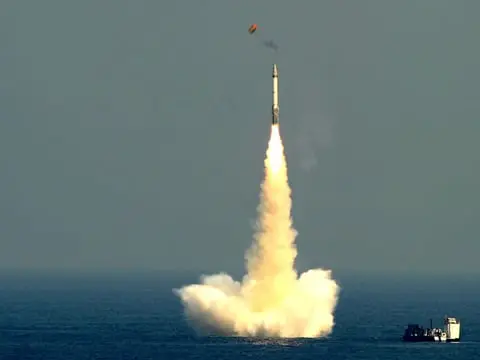
&imwidth=800&imheight=600&format=webp&quality=medium "Undersea powerplay: India successfully test-fires K-4 missile from nuclear submarine INS Arighaat")
India has carried out a major demonstration of its undersea nuclear strike capability with the successful test of the K-4 submarine-launched ballistic missile from INS Arighaat. The launch took place in the Bay of Bengal, off the Visakhapatnam coast, on Tuesday (December 23). Capable of striking targets up to 3,500 km away, the K-4 significantly enhances India’s sea-based nuclear deterrence. Defence sources confirmed that the missile was tested for its full operational range.
INS Arighaat, India’s second nuclear-powered ballistic missile submarine, was inducted into service last year. With this test, India further consolidates its position among a select group of nations that possess a fully operational nuclear triad, land, air, and sea-based nuclear delivery systems. The K-4 SLBM, inducted into the Indian Navy on August 29, 2024, is derived from the Agni-III ballistic missile. The system has been extensively adapted for underwater launch, enabling it to eject from a submarine silo, rise through the water column, and ignite its rocket motor once it breaches the surface.
Designed to carry a nuclear payload weighing up to 2.5 tonnes, the missile can be deployed from Arihant-class submarines. These platforms are engineered for prolonged stealth patrols, remaining undetected in vast oceanic stretches, thereby ensuring a credible second-strike capability.
As the most concealed component of India’s nuclear arsenal, submarine-launched missiles like the K-4 play a critical role in deterrence, especially in scenarios where land-based assets may be compromised in a first strike. The K-4 also fills the capability gap between the shorter-range K-15 missile and the longer-range SLBMs currently under development for future deployments. The ‘K’ series of missiles is named in honour of former India President APJ Abdul Kalam, who was instrumental in shaping India’s missile development programme.

