
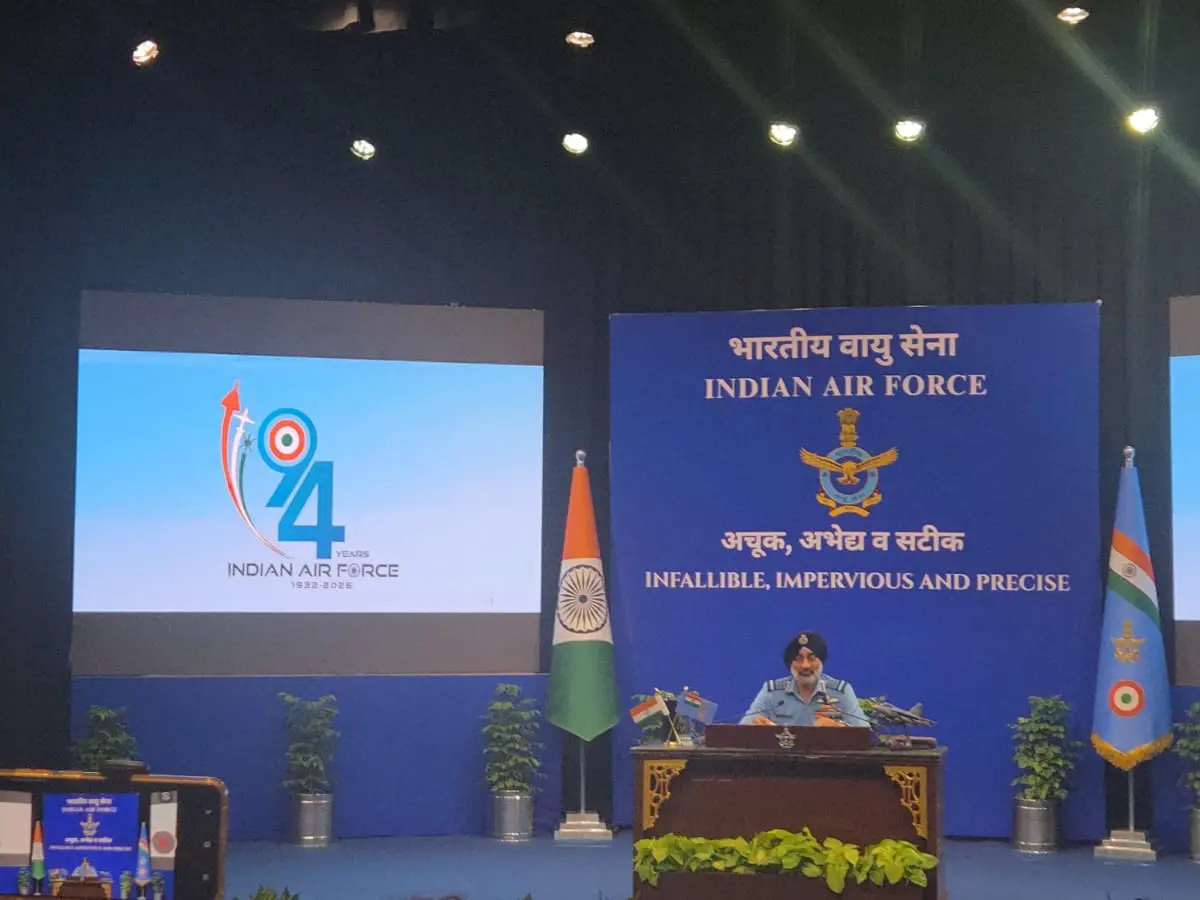
India's air force chief has warned that falling fighter squadron numbers and delays in new aircraft programmes will leave the service exposed, and said the force needs the equivalent of almost two squadrons a year simply to stop the decline. Air Chief Marshal AP Singh, speaking at his annual press conference in Delhi, said squadron numbers were already falling after the retirement of the MiG-21 fleet last year. “Everyone understands at this point that our numbers are coming down,” he said. “This time, this delay has become somewhat more, because it is going to hurt us, no doubt.”
He named the Tejas Mark 1A, the proposed multi-role fighter aircraft (MRFA) buy, and the Tejas Mark 2 as the programmes expected to close the gap, alongside the longer-term AMCA. “If things go well, we should be able to sign MRFA in this financial year,” he said. On the stealth fighter, he added: “If there are delays in the AMCA fifth-generation fighter programme, we may have to look at other options. Russia has offered the Su-57, but no decision has been taken yet.”
Alternative options were being examined because adversaries were acquiring fifth-generation aircraft, he said, while stressing that all programmes needed a “whole-of-nation” push and that Hindustan Aeronautics and the Aeronautical Development Agency remained focused on delivery. Singh acknowledged that delays on the Tejas Mark 1A had been greater than planned. “It happens that you plan something, but things get delayed. But this time, the delay has been much,” he said, adding that the Mark 2 and other orders were intended to fill the shortfall.
On unmanned systems, he rejected the idea of a standalone drone force. Loitering munitions used in Operation Sindoor had helped “in creating chaos and also taking down some of the adversaries,” he said, but described drones as evolutionary rather than revolutionary for the air force. “These capabilities have been with us for decades… Whether we need a separate drone force, I don’t think so. They should be part of the same setup… We cannot operate one type of weapon separately somewhere and another type of weapon separately.” Specialised units already existed and could be expanded if required.
The chief also used the briefing to underline the service’s non-combat role, citing flood and forest-fire relief inside India and missions in Uganda, Venezuela, the Philippines, Madagascar, Thailand, Cuba and Jamaica as expressions of “Vasudhaiva Kutumbakam.”
On the multilateral Tarang Shakti exercise, he said the presence of F-35s for the first time in such an event in India, along with new participants and observers, was intended to build interoperability and shared procedures. Broader geopolitical shifts, he argued, had shown that “it is the air power which has come to fore, which has come out as the cutting edge of military power.”
He also praised Flydubai captain Smit Machchhar, whose actions he called “exceptionally brave” and a lesson in physical and mental resolve. “Every Indian is proud of him,” Singh said.
Squadron numbers falling and delays ‘will hurt us’, IAF chief warns

Authored By Siddhant Sibbal
Published: Oct 03, 2026, 17:39 IST | Updated: Oct 03, 2026, 17:39 IST
&imwidth=800&imheight=600&format=webp&quality=medium "Squadron numbers falling and delays ‘will hurt us’, IAF chief warns")
IAF Chief AP Singh's annual presser in Delhi Photograph: (WION)
Story highlights
Singh acknowledged that delays on the Tejas Mark 1A had been greater than planned. “It happens that you plan something, but things get delayed. But this time, the delay has been much,” he said, adding that the Mark 2 and other orders were intended to fill the shortfall.
