

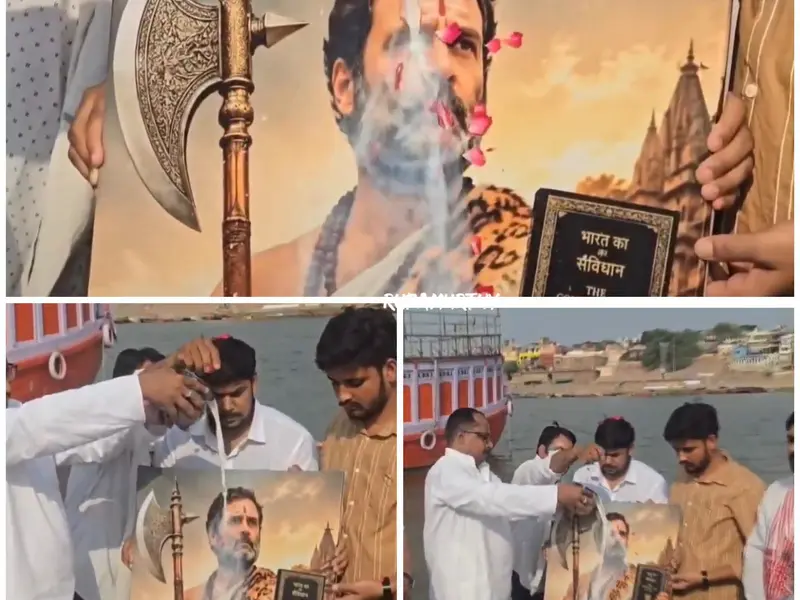
Youth Congress workers in Varanasi, on the 56th Birthday of the Leader of Opposition Rahul Gandhi, put up a poster depicting Rahul Gandhi in attire resembling that of Hindu deities with the Constitution of India in one hand and a battleaxe in the other hand. They carried out some rituals and chants along with pouring milk and flower petals on the portrait of Rahul Gandhi standing in knee-deep water of the Ganga River.
BJP supporters on social media targeted the Congress leader over the depiction, calling it a lookalike of Parshuram and accused of “mockery and blasphemy”. "How can these Congress workers portray Rahul Gandhi as Parashurama? It's nothing short of blasphemy. They should be booked for hurting religious sentiments," said one BJP supporter. “Dieties are sacred and should never be used for political glorification or personality cults. After Hindu terror, mocking Sanatan, questioning Prabhu Ram's existence, now this! What a shame. This has become a pattern !! Will Rahul Gandhi apologise? Is he Bhagwan? Is he above crores of Hindus ?” said another user.
Deification of Indian political leaders
The deification of political leaders in India is not a recent phenomenon. BJP, which is traditionally the Hindu nationalist party have been accused of depicting its leaders as reincarnations of gods. During the 2014 elections, a chant became popular, which was “Har Har Modi”. In a similar occurrence during the inauguration of Ram Mandir, a larger-than-life figure of Narendra Modi was shown walking with a child-like depiction of Lord Ram guiding him towards Ram Mandir. Madhya Pradesh Agriculture Minister Kamal Patel has publicly declared Modi as Avatari Purush sent to end the cultural despair of Hindu. Congress, which calls itself a secular socialist party, follows the BJP closely. There is a temple dedicated to the deceased Indira Gandhi in central India, and worship there continued at least till 2017. There had been references to goddess Durga by party workers with both Indira Gandhi and Priyanka Gandhi. Indian society, even though excelling at science and technology, has elements of dogmatism, which many social scientists call localised religion. The Prime Minister of India, during the 2024 election campaign, in a highly publicised interview, said that he did not consider himself born through the standard biological process following his mother's death. It reflects the social fabric of India, where the boundary between sacred and secular is fluid and is usually blurred by political leaders for electoral ambitions and their sycophant followers to gain favour from those leaders.

