India: PM Modi to meet ISRO’s Chandrayaan-3 team after historic lunar landing

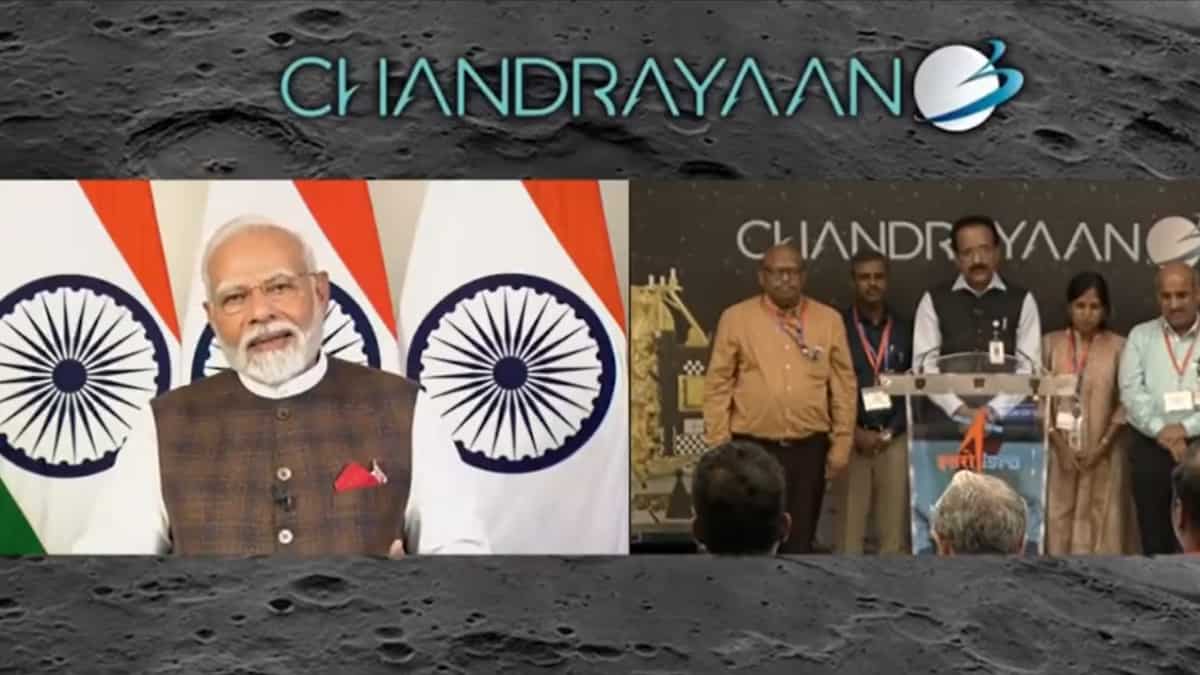
PM Modi-Chandrayaan-3
As the minister who is directly in charge of crucial portfolios including Space and Atomic energy, among others, Indian Prime Minister Narendra Modi would be visiting ISRO’s Telemetry, Tracking and Command Network (ISTRAC) facility in Bengaluru.
He is expected to depart for the Indian city, directly after completing his official visit to Greece. His first stop would be the ISTRAC facility, from where the entire mission operations (post-launch until landing and beyond) of Chandrayaan-3 are being carried out. His visit to ISTRAC is in line with what he had assured the team of scientists, during his video address to them, shortly after the soft landing on lunar south pole.
Notably, PM Modi had been present at ISTRAC, during the Lunar landing attempt of Chandrayaan-2, in September 2019. After the mission could not make a soft landing, the PM addressed the Indian Space Research Organisation (ISRO) team. Back in September 2014, when India’s Mars Orbiter Mission entered Martian orbit, PM Modi witnessed the event at ISTRAC and congratulated the scientists.
ALSO READ |‘Chandrayaan-3 scripts new chapter’: PM Modi about successful launch of India’s third lunar mission
While the Chandrayaan-3 orbiter and rover are functioning normally and the science experiments are being carried out, not many post-landing pictures of the lander and rover have been officially shared by ISRO.
So far, ISRO has shared videos of the Vikram Lander’s downward view, as the craft flew over the Lunar surface, making a landing approach. The Indian space agency had also shared images of the lander’s legs firmly on the lunar surface and also a video of the Pragyan rover rolling down its ramp and travelling a few inches.
Expectations are high that the Indian government-run space agency will share exciting new pictures and videos of the Chandrayaan-3 lander and rover, once the Prime Minister arrives at ISTRAC. Most awaited are the pictures and videos of the lander standing tall and upright, as captured by the 26-kgrover from afar and vice versa.
ALSO READ |Chandrayaan-3: PM Modi to join virtually from South Africa as India attempts moon landing
It is also expected that there would be videos and pictures of the rover literally making India’s mark on the moon. The rover wheels are said to have been embossed with the Indian National Emblem, which is an adaptation of the Lion Capital of Emperor Ashoka at Sarnath and the iconic ISRO logo.
Following the meet and greet at ISTRAC, starting around 6:00 am (local time) on Saturday (August 26), and his address to team ISRO, the Prime Minister is expected to address a public meeting in Bengaluru city, following which he will departfor New Delhi.
In his address to ISRO after the successful soft-landing of the Chandrayaan-3 craft, the PM made a mention of ISRO’s upcoming and planned missions – Gaganyaan (sending Indian astronauts to Low Earth orbit and returning them safely), Robotic Spacecraft mission to Venus (Shukrayaan) and even the second Mars Mission (perhaps, a landing mission). Meanwhile, fresh from the Chandrayaan-3 moon mission success, India’s maiden mission to study the sun, Aditya-L1, is being prepared for launch on a PSLV rocket, in the first week of September 2023.
ALSO READ |‘India's Modi out of this world’: PM, Brazil’s Lula read South African paper on Chandrayaan-3
“The preparation for Aditya-L1 is going on really well. At the Satish Dhawan Space Centre, final checks are being carried out on the spacecraft and the PSLV rocket (mission number C57) for this mission is being assembled,” A. Rajarajan, the director of the spaceport, told WION.
Speaking to WION after the successful landing of Chandrayaan-3, he said that the Aditya-L1 mission is to be launched in the first week of September. So far, the Indian space agency has launched six missions in the year 2023. While four of these missions were for India’s own national and scientific purposes, two of them have been missions for foreign customers. ISRO has had a great year with successes in all launch missions.
ALSO READ |‘India is on the moon’: ISRO chief S Somanath celebrates Chandrayaan-3's triumph on lunar landing
Aditya-L1 is the first observatory-class space-based solar mission from India. The spacecraft is to be placed in a halo orbit around the first Lagrange point, L1, of the Sun-Earth system. A satellite around the L1 point has the major advantage of continuously viewing the Sun without occultation/eclipses. This position provides a greater advantage of observing solar activities continuously.
Aditya-L1 carries seven payloads to observe the photosphere, chromosphere, and the outermost layers of the Sun (the corona) using electromagnetic and particle detectors. According to ISRO, Four payloads on Aditya-L1 directly view the Sun from the unique vantage point of L1, and the remaining three payloads carry out in-situ studies of particles and fields at the Lagrange point L1.
WATCH WION LIVE HERE
You can now write for wionews.com and be a part of the community. Share your stories and opinions with us here.
