India: Delhi-NCR remains top in worst polluted city rankings, Mizoram has cleanest air

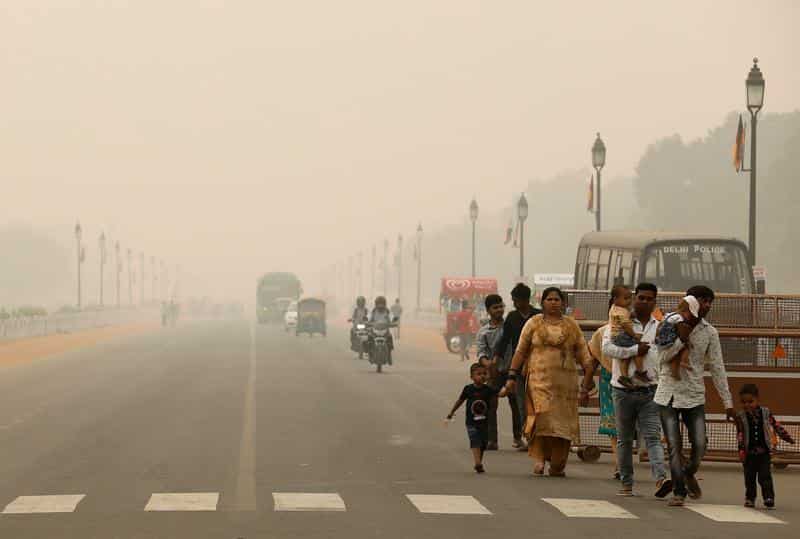
Delhi pollution
Delhi was adjudged the most polluted city in India in the past year despite its air quality seeing marginal improvement.
According to a study by independent think tank Climate Trends and tech firm Respirer Living Sciences, the concentration of PM2.5 was the highest in Delhi with 100.1 micrograms per cubic metre, which is three times more than the government's safe limit.
On the other hand, Manipur registered India's cleanest air with a PM2.5 level of only 11.1 micrograms per cubic metre.
PM2.5 is an umbrella term used to describe fine inhalable chemical particles, with diameters that are generally 2.5 micrometres and smaller.
While PM2.5 is more likely to travel into and deposit on the surface of the deeper parts of the lung, PM10 is more likely to deposit on the surfaces of the larger airways of the upper region of the lung.
Particles deposited on the lung surface can induce tissue damage and lung inflammation.
Report covers cities under NCAP
The report is based on the analysis of the government's PM2.5 data from October 1, 2022, to September 30, 2023, and focuses on the cities covered under the National Clean Air Programme, which aims to achieve a 40 per cent reduction in particulate matter concentration by 2026.
The study further noted that the cities surrounding Delhi, which are part of the National Capital Region, too recorded their worst air quality.
Faridabad (89 micrograms per cubic metre), Noida (79.1 micrograms per cubic metre), Ghaziabad (78.3 micrograms per cubic metre) and Meerut (76.9 micrograms per cubic metre) featured among the top 10 most polluted cities.
After Delhi, the second most polluted city was Patna in Bihar, with an average PM2.5 concentration of 99.7 micrograms per cubic metre. Notably, the city’s air quality deteriorated by 24 per cent compared to the previous year.
Cities with worst pollutionpart of the Indo-Gangetic Plains
The top seven polluted cities are Delhi, Patna, Muzaffarpur, Faridabad, Noida, Ghaziabad, and Meerut—all part of the Indo-Gangetic Plains—the report noted.
"The analysis reflects that there has been improvement in the Indo-Gangetic Plain cities over the last few years. However, considering the enormous pollution load, these cities continue to experience the highest PM levels in the country," Aarti Khosla, the director of Climate Trends, said.
"While measures like the Pradhan Mantri Ujjwala Yojana or hyperlocal developments like the peripheral highways around Delhi are positive actions, there is a need for a scientific approach to address air quality issues in a sustained manner through an airshed approach, she said.
WATCH WION LIVE HERE